Sierra Leone has officially launched the 50-day countdown to its 2026 Population and Housing Census, with Statistics Sierra Leone, the United Nations Population Fund (UNFPA) and the Ministry of Information and Civic Education calling for nationwide cooperation to ensure the successful conduct of the country’s first fully digital census.
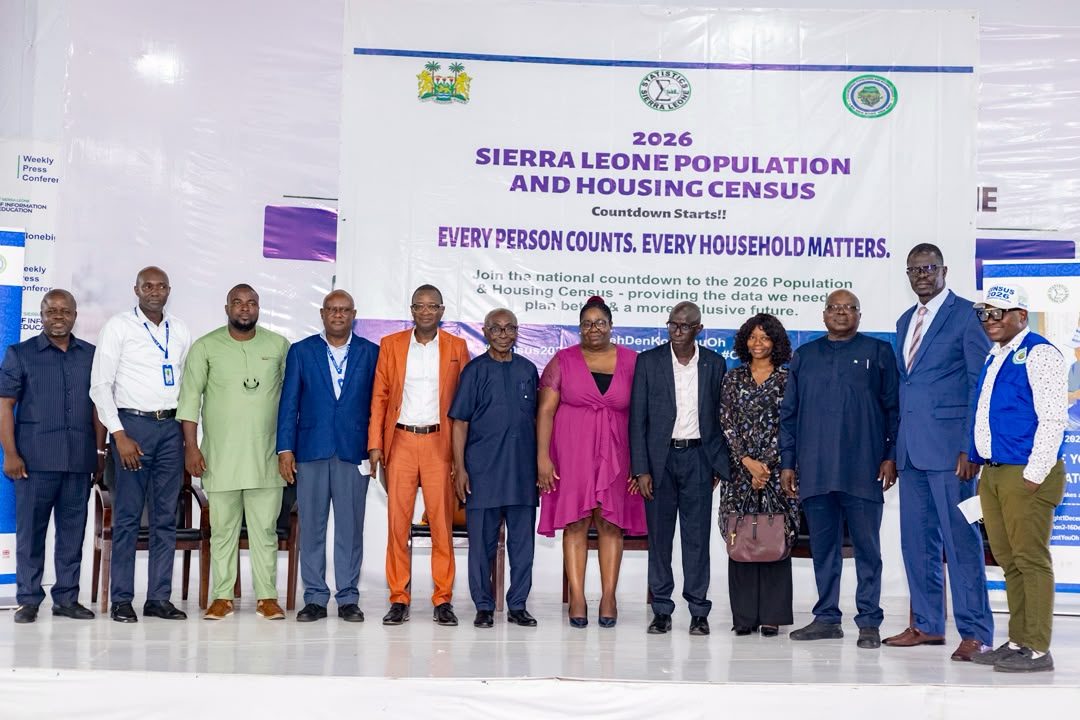
The ceremony, held on Monday, 12 October 2026, at the Miatta Civic Centre, Youyi Building, in Freetown, brought together Government officials, development partners, representatives of political parties, civil society organisations, traditional authorities and the media to assess preparations ahead of Census Night on 1 December 2026. Nationwide enumeration will begin on 2 December 2026.
Organized under the theme, “No One Gets Left Behind,” the event highlighted the importance of collecting reliable population and housing data to guide national development planning, resource allocation and investments in education, healthcare, water supply, infrastructure and social protection.
Speaking at the ceremony, the Statistician General of Statistics Sierra Leone, Andrew Bob Johnny, described the countdown as a major milestone, noting that the remaining period would focus on completing logistical arrangements, training personnel, strengthening operational systems and intensifying public education.
He disclosed that Statistics Sierra Leone had completed the national cartographic mapping exercise, conducted pilot and mock census exercises and developed standardized training materials to improve operational readiness. The July 2026 Mock Census, he explained, helped identify challenges and strengthen preparations for the nationwide exercise.
Andrew Bob Johnny further confirmed the receipt of 25,000 electronic tablets to facilitate digital data collection, improve accuracy and reduce delays associated with traditional paper-based enumeration.
“The success of the census depends not only on our technical preparedness but also on the cooperation and participation of the people of Sierra Leone,” he stated.
He assured citizens that information collected would remain confidential and be used strictly for statistical purposes. He also encouraged households to provide accurate information and appealed to Paramount Chiefs, religious leaders, local councils, community organisations and the media to support nationwide sensitization.
The Deputy Representative of UNFPA, Sibeso Mululuma, reaffirmed the organization’s commitment to supporting a credible, inclusive and fully digital census, commending the Government and Statistics Sierra Leone for the progress recorded.
She highlighted UNFPA’s technical and financial assistance, including the deployment of the census Chief Technical Adviser and international specialists, as well as support for training master trainers, data quality managers and facilitators.
Sibeso Mululuma also acknowledged contributions from development partners, including the Governments of Iceland, Ireland and the United Kingdom, with Iceland and Ireland providing financial support towards UNFPA’s technical assistance.
“High-quality population data is paramount. It provides the empirical foundation necessary to design targeted policies and programmes, ensuring assistance reaches the most vulnerable demographics and that no individual is left behind,” she stated.
She stressed that reliable data would help Government identify vulnerable populations, understand community needs and develop programmes to improve living conditions. However, she cautioned that technology alone would not guarantee success without trained personnel, public confidence and inclusive participation.
“Data alone cannot transform a nation without public trust, civic awareness and widespread cooperation,” she emphasized.
The UNFPA Deputy Representative urged traditional authorities, civil society organisations and media institutions to address misinformation, strengthen public confidence and encourage participation, particularly among persons with disabilities and residents of remote communities.
Addressing participants, the Chairman of the Statistics Council, Moses William, called for stronger collaboration among political parties, traditional leaders and community stakeholders to ensure the exercise receives nationwide support.
He emphasized the importance of involving Paramount Chiefs in public education and suggested recruiting census personnel at district level to build trust between enumerators and residents.
Moses William also urged political parties to put aside their differences and support the census as a national exercise. Representatives of the ruling Sierra Leone People’s Party (SLPP) and the main opposition All People’s Congress (APC) attended the ceremony, reflecting the importance of broad political cooperation.
Delivering the keynote address, the Minister of Planning and Economic Development, Kenyeh Barlay, described the census as a national responsibility that would provide essential information for effective development planning and improved service delivery.
She explained that the exercise would establish the country’s population, where people live and their housing conditions, enabling Government to identify communities requiring additional schools, healthcare facilities, water infrastructure and other essential services.
Kenyeh Barlay stressed that census figures represented real people whose needs and aspirations must be reflected in national development decisions.
She said the theme, “No One Gets Left Behind,” underscored the importance of including every individual, particularly vulnerable populations, persons with disabilities and residents of hard-to-reach communities.
The Minister commended Statistics Sierra Leone and development partners for their contributions, urging them to sustain their support throughout the enumeration process.
She further emphasized that the success of the census should not be measured solely by counting the population but also by how effectively the resulting information is used to guide policies, allocate resources and address development inequalities.
Kenyeh Barlay encouraged Sierra Leoneans to welcome enumerators, provide truthful information and take ownership of the exercise as an important contribution to national development.
The 2026 Population and Housing Census is expected to provide updated demographic information to strengthen evidence-based policymaking, improve public service delivery and support Sierra Leone’s progress towards achieving the United Nations Sustainable Development Goals.
With Census Night approaching, Statistics Sierra Leone and its partners are expected to intensify public education, complete logistical preparations and strengthen coordination to ensure that every household and community is counted in accordance with the national commitment that no one should be left behind.