- Taiwan’s Shenkeng region was once a major tea-producing center, but industrialization and urbanization hollowed out the industry by the 1970s, allowing abandoned tea terraces to return to forest.
- A government-backed effort is now restoring tea production and its cultural heritage, using the region’s historic stone terraces alongside drip irrigation, soil sensors, and more resilient tea varieties.
- Climate change is making the revival harder, with earlier-dissipating mist, erratic rainfall, and increasingly intense typhoons threatening tea plants and increasing landslide risks.
- Researchers and local growers are combining traditional farming techniques with new technology to make Shenkeng’s tea industry more resilient and preserve its cultural heritage for future generations.
See All Key Ideas
SHENKENG, Taiwan — Ten kilometers east of Taipei’s high-rises and dense traffic, the city gives way to a succession of steep, forested ridgelines sheltering villages in the valleys below. The subtropical mist that cloaks these slopes at dawn has already thinned, and by 9 a.m. the heat is climbing. Li Chao-shiang, an assistant professor in the Department of Interior Design at China University of Technology in Taipei, winds upward on a narrow stone path, pausing to wipe his brow.
Rounding a bend, he stops at an opening in the brush. Half the hillside before him is covered in dark-green ribbons, the regular corduroy of cultivated land. The other half looks like something took a bite out of it.
“This jungle has a secret,” Li says. “If you look closely at the hills all around us, you can still make out faint lines that run through the forest. It may not be much to look at now, but what you are seeing are stone terraces — the remnants of one of the world’s great empires of tea.”
For much of the late 19th and early 20th centuries, tea made these hills valuable. By 1897, tea accounted for 22% of Taiwan’s export earnings, four times the value of sugar, with 96% of the island’s Formosa oolong sailing for New York and Chicago. Shenkeng’s own signature style, the lightly oxidized Wenshan pouchong, came on the scene around 1912 and was refined through the 1920s, becoming Taiwan’s leading export to Southeast Asia.
“The soil, the slope, even the fog make this place almost perfect for tea,” Li continues. “But by the 1970s, industrialization and urbanization hollowed out the trade, and the local industry shifted to tofu production, allowing the jungle to reclaim the tea farms. Now we are building it back.”
Freshly brewed honey-scented black tea from Shenkeng district, Taiwan. The tea is famous for its unique honey and fruit aroma because the tea leaves are bitten by the tea green leafhopper, a tiny, sap-sucking insect common in Asian tea plantations. Image by Michael O. Snyder for Mongabay.
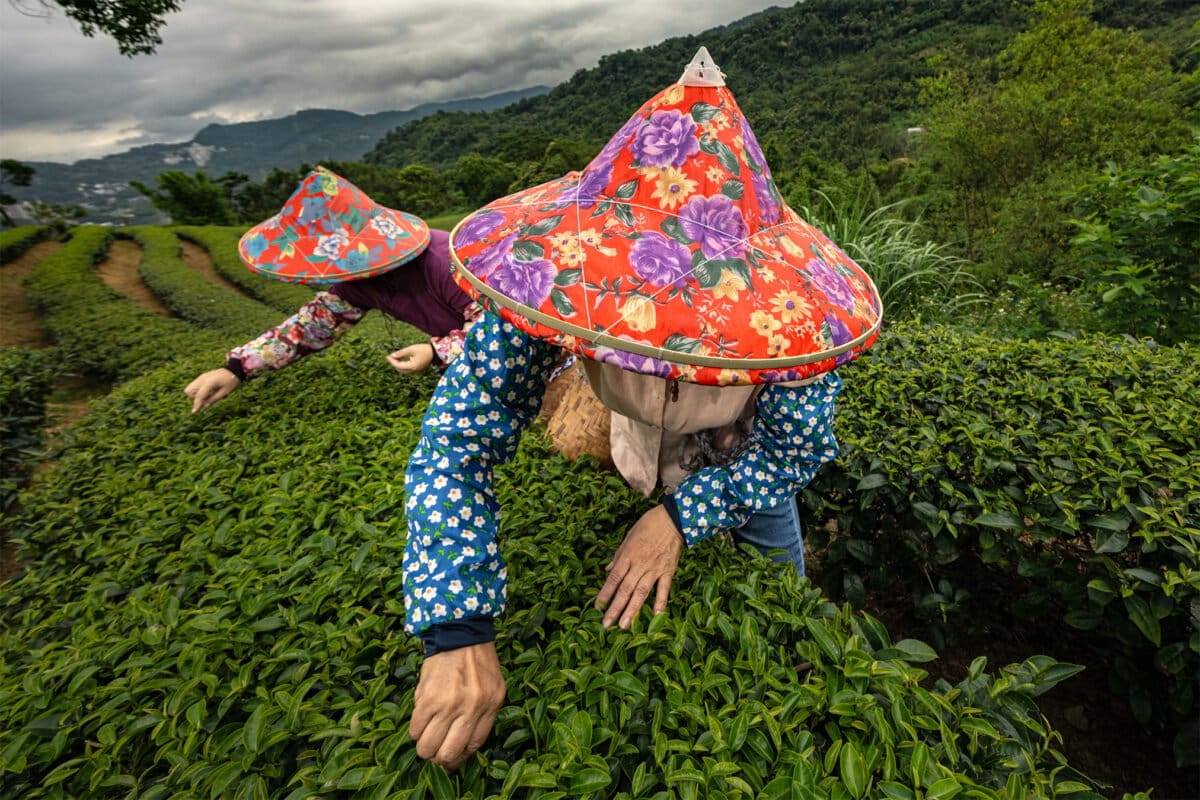
A volunteer harvests tea leaves in Shenkeng district, Taiwan. While machine harvesting is faster, the best teas are harvested by hand by highly skilled pickers who carefully determine the time for picking to coincide with peak ripeness and avoid insect-damaged leaves that affect taste. Image by Michael O. Snyder for Mongabay.
Li is part of a new government-backed revitalization effort to bring tea production, and its associated cultural heritage, back to the region — even as the weather patterns that once made Shenkeng ideal for growing it become less reliable due to climate change.
Morning mists that once kept slopes damp now burn off earlier in the day, drying soils and stressing plant roots. Rainfall, while still adequate overall, increasingly arrives in short, intense bursts rather than the steady drizzle tea plants prefer.
The bigger threat comes from typhoons. Researchers have found that storm intensity in the region has increased by 12-15%, with category 4 and 5 storms doubling or even tripling in frequency this century. In 2025 alone, typhoons caused more than NT$1 billion (roughly $31.3 million) in losses.
“The challenge with tea,” says Chien Chen-lung, a local grower who has joined Li on his hike, “is that the plants have shallow root systems and grow well in loose, well-drained soils. But this makes them very vulnerable to high winds and intense rains from typhoons.
“A single storm can wipe out a whole plantation, like what happened here,” he says, pointing to the bare hillside before him and Li. “If we want to bring tea back to Shenkeng, we are going to have to do it differently.”
Chien Chen-lung examines a tea plantation that was washed out by a recent typhoon. Typhoons have become increasingly powerful due to climate change, causing losses of more than NT$1 billion ($31.3 million) in 2025 alone. Image by Michael O. Snyder for Mongabay.
Li Chao-shiang and Chien Chen-lung demonstrate the use of a new app that shows the tea plantation slopes of Shenkeng and illustrates zones that are at high risk of landslides, which have become increasingly common with more powerful typhoons. Image by Michael O. Snyder for Mongabay.
In response to these challenges, Li has joined Preserving Legacies, an initiative funded by the National Geographic Society focused on helping culturally significant sites create locally led climate impact and adaptation assessments. That process, culminating in an executive summary of the assessment published in September 2026, has yielded a few novel solutions.
Researchers in Li’s design department have studied the stone terrace walls built by earlier generations of farmers and found them remarkably effective at channeling water away from slopes while holding soil in place. Rather than replace that design, restoration crews are rebuilding it, reinforced with drip irrigation systems tied to soil-moisture sensors that keep hillsides consistently damp and heavy, reducing the risk that roots will be torn loose by high winds.
Li Chao-shiang and Chien Chen-lung repair a stone slope, part of a traditional tea terrace, in the Tzeng family’s tea plantation. As part of the rebuild, the farm will now include pipes and modern drip irrigation systems that will bring water directly to the roots of the plants, protecting them from heat and over-drying and keeping the soils damp and heavy to protect the plants from uprooting during high winds. Image by Michael O. Snyder for Mongabay.
Chien Chen-lung measures rainfall at the newly cultivated experimental tea plantation, which will be named Ri Ri Shin Tea Plantation, in Shenkeng district, Taiwan. While overall rainfall in the region remains optimal, it now falls in more intense storms, followed by periods of heat and drying. In response, the region has introduced more drought-resistant tea varieties to Shenkeng to enhance the adaptability of tea plantations to climate change. Image by Michael O. Snyder for Mongabay.
Workers are also mulching bare soil with fallen leaves for added moisture retention and weight, planting drought-resistant and slope-stabilizing species such as the Taiwan crepe myrtle (Lagerstroemia subcostata) and acacia, and testing more resilient tea cultivars, including TTES #12 “Jin Xuan” and TTES #23 “Qi Yun.”
Monitoring has gone digital as well. Researchers are experimenting with satellite imagery to flag slope movement before it becomes a landslide, and Taiwan’s National Science and Technology Center for Disaster Reduction has built a “3D Disaster Potential Map” app that lets farmers see which sections of their own hillsides are at highest risk.
“It’s not just the tea, it’s the way of life,” says Chien, who is helping develop an experimental plantation on reclaimed terrace land and run various programs that support the preservation of tea culture, art, and food. “We are hoping to rebuild these traditions, but to do it with modern sustainable practices and technology that will help protect the plants and the heritage that they support from the challenges of climate change. The future will balance production with ecology, culture, and resilience.”
Chien Chen-lung displays a book by Yen Song-tao, illustrating the former prosperity of Old Street in Shenkeng district, Taiwan. Shenkeng was originally one of the most important tea production areas in Asia, known for its Wenshan pouchong tea, but the industry began to decline in the 1970s due to industrial transfer, urbanization, and an aging population. Image by Michael O. Snyder for Mongabay.
Tzeng Jih-san, left, and his son, Tzeng Hung-yi, spread tea leaves that have been dried by hot air on traditional bamboo sieves to dissipate heat and moisture. Image by Michael O. Snyder for Mongabay.
That future will take time. Tea bushes reach their best-quality leaf production between 5 and 30 years of age, meaning the terraces now being replanted won’t show their full worth for a generation. For Li, the urgency is worth the wait.
“We know that these storms are going to get stronger, so we have to adapt now,” he says. “Tea is still the most popular drink in the world after water. If we want to pass this down to future generations, we are going to have to innovate.”
Tzeng Jih-san, the third-generation owner, serves midday tea in a serving room at his family’s plantation in Shenkeng district, Taiwan. Image by Michael O. Snyder for Mongabay.
Banner image: Volunteers harvest tea leaves in Shenkeng district, Taiwan. During the harvest season, groups of women from the Shenkeng community will move from plantation to plantation, working in a centuries-old spirit of mutual assistance across farms. Experts contend that teas picked by hand are much less likely to be damaged and produce a finer product. Image by Michael O. Snyder for Mongabay.