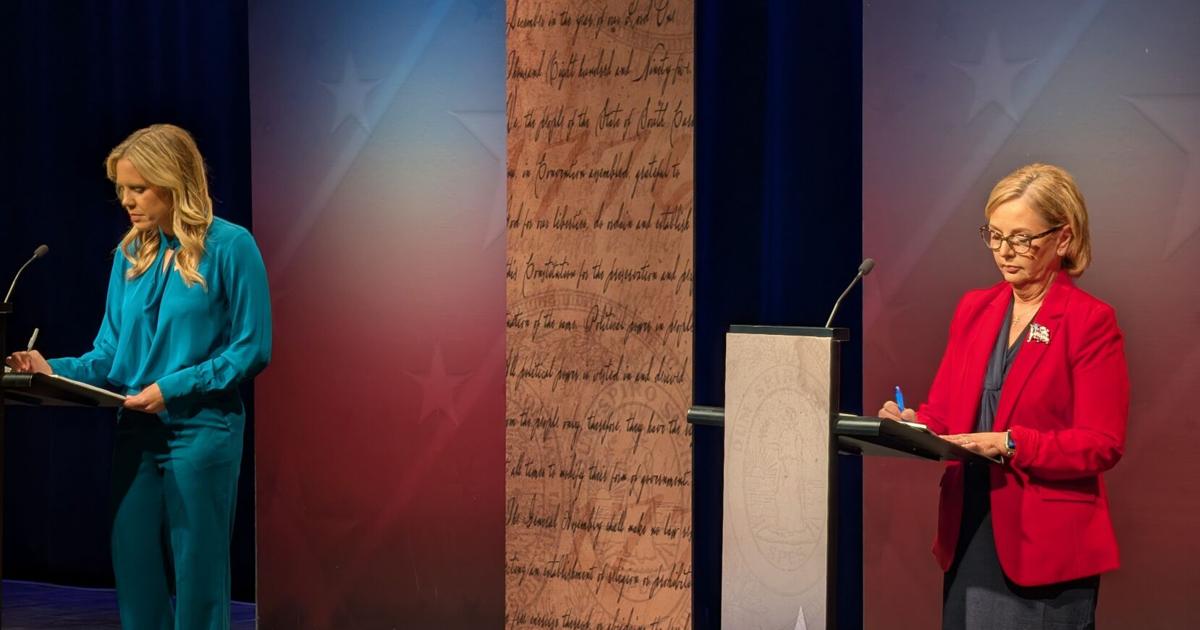
Annie Andrews (left) and Darline Graham (right) prepare notes ahead of their debate for U.S. Senate at the South Carolina Educational Television studios in downtown Columbia on Sunday, Oct. 11, 2026.
Nick Reynolds / Staff Photo
COLUMBIA — Three U.S. Senate candidates took the stage Oct. 11 for what would be the first and likely only debate of the 2026 election cycle: Republican incumbent Darline Graham, Democratic nominee Annie Andrews, and Kasie Whitener, a longshot Libertarian.
It was a historic lineup of all women. But the nation’s eyes were focused mainly on just two of them.
For an hour in the downtown Columbia studios of SCETV, Graham and Andrews traded verbal barbs and attacks in their first face-to-face meeting in this unusually tight U.S. Senate race. They picked apart one another’s platforms and positions in otherwise straightforward policy questions on issues like the economy and the war in Iran.
One hour before the debate, the scene outside the studio had the air of a campaign rally, as Andrews addressed a crowd of dozens of supporters as a competing but smaller pro-Graham crowd waved signs across the highway.
The debate itself was occasionally just as raucous. Andrews called Graham “unserious, and unqualified,” characterizing her throughout the evening as a D.C. plant in the pockets of industry, relying on a supplied script without having her own positions.
Graham, who declined to meet with reporters after the debate, described her opponent as one of the most radical candidates in state history and “pretending to be someone she’s not,” as Andrews has shied away from some of her more progressive positions in the past.
Both candidates also used the opportunity to brand themselves to voters: Graham, as “tougher on immigration” than her brother. Andrews, as a more moderate candidate nowhere resembling the politician millions of rival spending has painted her as.
Whitener used her time onstage to pitch voters on a third option beyond the mainstream parties.
The economy, and the war
A constant questioning string was the state of the U.S. economy under President Donald Trump as the country remains mired in war and under cost pressures imposed by his tariffs on foreign imports.
Andrews consistently attacked incumbent Sen. Graham over her support of a war she supports that’s the primary driver of high fuel prices, arguing she had numerous chances to do something about the conflict and failed.
“My opponent is the only one on this stage who had the opportunity to vote to end the war, but three times in a row she voted to continue it, and several days after one of those votes she had the audacity to walk out onto this stage and admit that national security isn’t really her thing,” Andrews said in reference to an earlier debate gaffe Graham made during the Republican primary.
Graham argued the war was actually started “under Democrats, with Iran almost having a nuclear weapon,” and accused Andrews of alignment with activist climate organizations, repeatedly mentioning Jane Fonda’s “Climate PAC,” in particular, that opposed inexpensive fossil fuel.
Little was broached on Graham’s stance on recent plans by the Trump administration to ease sanctions on Russian diesel — which could undermine the sanctions bill she staked her opening argument to voters on.
“I’m not going to speak for the senator,” Graham’s spokesman, T.W. Arrighi, told reporters after the debate.
Data centers become a dividing line
One of the sharpest contrasts between the two candidates was their respective positions on data centers and the tech industry.
Andrews, who has called for a two-year moratorium on data centers, characterized Graham as out of step with the rest of the country, calling her “Data Center Darline” for the sizeable support she received from the tech sector during a rough-and-tumble win in the August Republican primary.
Graham argued she supported local involvement in data center development, touting her co-sponsorship of the Ratepayer Protection Act, a non-binding bill debated in the U.S. Senate earlier this year to encourage utilities to require data centers to pay for the power they use.
That bill failed to pass the chamber over criticism that it did too little. Graham has also continued to argue the tech sector’s growth is critical in U.S. competition against China, cautioning against legislation to overly restrict the industry.
“We’re in electronic warfare basically right now,” she said. “So we cannot let them get ahead.”
Personal and professional attacks
The tone of the debate was often caustic, with both of the major party candidates regularly lobbing attacks at one another.
Andrews attacked Graham over her name, falsely saying she changed her name from her married name of “Nordone” while criticizing Graham over her work ethic on the campaign trail.
She also accused Graham of being the chosen candidate of the Washington establishment after being tagged to run for the seat after the death of her brother, late Sen. Lindsey Graham, from a torn aorta earlier this year.
“My opponent is going to stand up here and call me a socialist because that’s what her script says, and also because she doesn’t want to talk to you about your high gas prices, grocery prices or your closing rural hospitals,” Andrews said.
Graham continuously characterized Andrews as aligned with the “socialist” Democratic Party who was “unable to define a woman.” The transgender issue only came up in the closing moments of the debate.
But she also slammed Andrews over regularly evoking her family tragedy in advocating for a stronger social safety net, which Andrews has argued could have helped prevent the death of Graham’s parents while her and her brother were children.
“She’s taking my personal tragedy when I lost my parents at a young age and using it as a weapon,” Graham said at one point of the evening. “So shame on you for that, that’s despicable.”
Libertarian U.S. Senate candidate Kasie Whitener ahead of the first debate for U.S. Senate in Columbia on Oct. 11, 2026.
Nick Reynolds / Staff Photo
Spending, healthcare and other entitlements
The pair also traded blows on the protection of entitlements in the Big Beautiful Bill, a massive spending bill passed by Republicans earlier in Trump’s term.
Graham said Andrews once criticized the Big Beautiful Bill as the “Big Ugly Bill,” arguing Andrews was lying to South Carolinians about her support of middle-class tax cuts and funding for rural hospitals, which Graham said were both included in the package.
That bill also notably slashed Medicaid, which Andrews stated as her reason for opposing it, arguing Graham was “happy to gut healthcare so she can deliver tax cuts to her billionaire donors.”
“My opponent’s plan seems to be we should all work really hard, even when we’re sick, until we die,” Andrews said.
“If she’s talking about the One Big Beautiful Bill that requires able-bodied people to work or train for 20 hours a week to receive Medicaid, then yes, count me in,” Graham responded.
Kasie Whitener introduces herself
Whitener, a University of South Carolina business professor who introduced herself as “Kasie” in her opening statement, sought to separate herself from the other two women onstage, advocating for steep reforms to government entitlement programs neither candidate supported slashing in questions about government cuts.
“The reason we can’t address Social Security, it’s not because one party or the other is too greedy or cares one way or the other,” she said in one response. “It’s because powerful lobbying groups like the AARP insist on funding candidates that are willing to say nothing about Social Security. That kind of money in politics is the reason we can’t get things done.”
She also set herself apart on issues like the U.S. Israeli alliance, saying she believed the country could afford to pay for its own defense, and on immigration reform, accusing both parties of being unwilling to address the issue as a political strategy.