Editor’s Note: This essay appeared in Cognoscenti’s newsletter of ideas and opinions, delivered weekly on Sundays. To become a subscriber, sign up here.
My maternal grandparents owned a split-level house with a carport on a cul-de-sac in northern New Jersey. We went there at least a couple of weekends a month when I was kid, to hang with my mom’s big Italian family. I have a scar the shape of a tiny diamond on my left knee from when I went over the handlebars of my bike on that street. And my first crush, a boy named Joe, lived across the circle. Google tells me he’s a successful surgeon now, and he still has a full head of slicked-back hair.
I’ve been thinking about this house for a couple of reasons. First, a family member recently died, and I sometimes saw him there at big family gatherings. And two, because those memories remind me of poker.
My grandfather had a poker set, with a wood carousel and multi-color chips. After my cousins and I got tired of playing make believe or spying on the adults, we’d grab mini-bottles of ginger ale and play poker on a round table under one of those stained-glass pendants you see in taverns. We didn’t play for money, just chips. Eventually, my uncles would wander down to start a real game of poker, which was just fine with me. We were allowed to watch.
We didn’t play Texas Hold ‘em back then, just five-card draw. But I learned the basics: flush, straight, full house and three of a kind; how to shuffle, deal and bluff. I also learned that playing a game can make socializing easier. You can talk about the hand, instead of your life.
As an adult, I did not grow up to be someone who invites people over (or is invited) to play Catan or Wingspan. It’s not that I’m opposed to board games, I just don’t possess a mind for all those rules. I’m more of a cook than a baker — I like to improvise and don’t like to measure. But a new-to-me game has entered the chat, and so far, I’m intrigued. Bam! Krack! Pung! Kong! Yes, readers, I am a caricature of a middle-aged woman: I am learning to play mahjong.
The tile-based game originated in 19th-century China, and was introduced to the U.S. in the 1920s. In 1937, women in New York City took it upon themselves to standardize the rules, and the National Mah Jongg League was born. Every year, the League publishes an “official” card of winning hands (there are 72 this year), which they prefer you to purchase directly from their headquarters on 7th Avenue.
Four women playing mahjong in water at Bathing Beach in Washington D.C. in June 1924. (Universal History Archive/Universal Images Group via Getty Images)
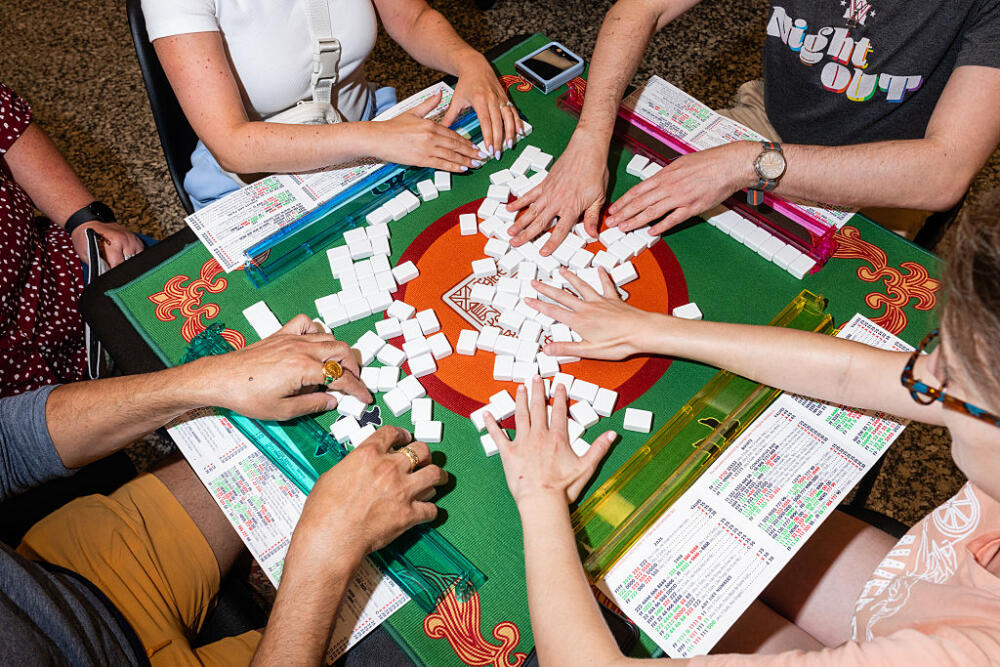
American mahjong is played with 152 tiles. The goal is to assemble a winning hand of 14 tiles that match one of the many combinations included on the official card of winning hands. Along the way, there is a Charleston (or two), winds, dragons, flowers and the curious phrase, “Pause, want!,” which I now say all the time, even when I’m not playing. This makes me feel like Liz Lemon (IYKYK).
If you think mahjong is everywhere these days, you’re not incorrect. It’s seen a resurgence in recent years, driven in part by people’s desire to socialize more without their digital devices. NPR reports Gen Z and Millennial players are leading the charge. There also appears to be a cottage industry of mahjong teachers, who charge a fee for lessons — typically $50 to $100 per hour. Public libraries and community centers also host lessons and open games; even WBUR got in on the fun with a mahjong night last year.
I wouldn’t normally hire someone to help me learn a game. But in this case, I had to. My good friend, a talented organizer of people and things, found a teacher and set a date. Another friend hosted us at her kitchen table. It was so much fun, we booked the teacher for another lesson the following week.
I don’t have a mahjong set of my own yet, though I have procured an official 2026 card from the League. I mostly understand the game, but often screw up or forget the rules. And at this point, I have zero strategy. That said, it’s a lovely way to spend time with friends, without the focus being food, alcohol or trying to catch up on the sidelines of a middle school cross country meet. It takes my mind off of current events and work. And it’s good for my brain, too, which my hormones are threatening to turn into a sieve.
Kara Baskin, a Boston-based journalist, nailed it in her Boston Magazine piece last year: “There’s something hypnotic about the ASMR-like clacking of tiles, the aesthetically pleasing setup. It’s like meditation, but prettier.” Indeed. Go play.
Load YouTube video