An education advocacy group behind a provocative new ad campaign skewering Boston Public Schools for “failing” some elementary students is trying again after its original ads were pulled last week by the Massachusetts Bay Transportation Authority after barely a day.
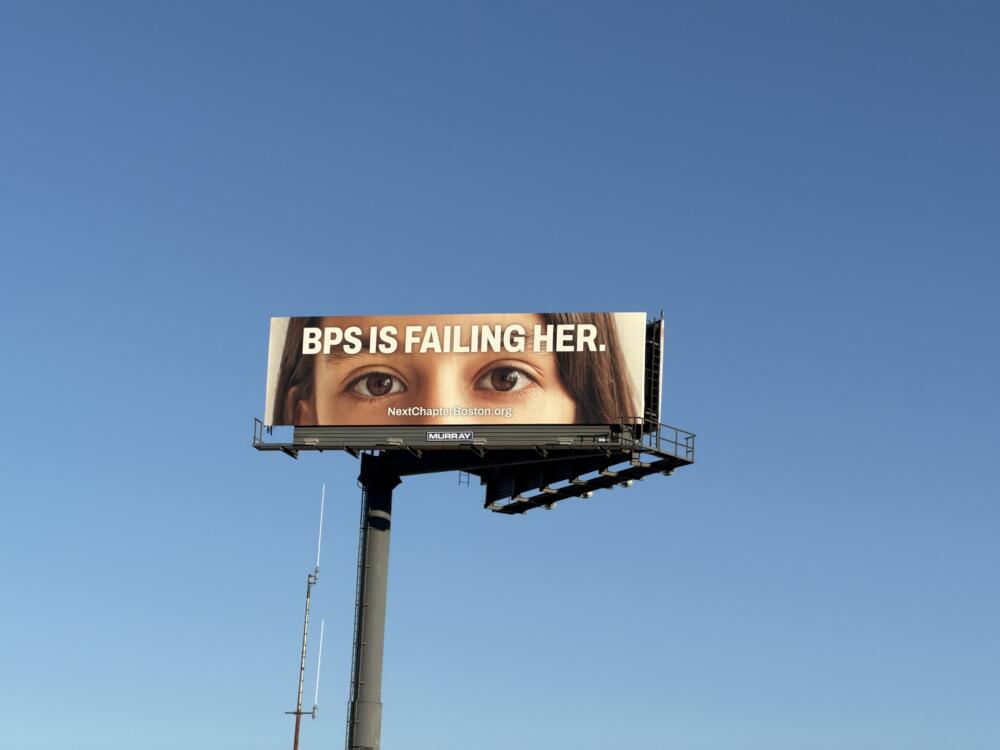
The initial ads displayed a close-up photo of a child’s eyes, stamped with a slogan blaring, “BPS is Failing Her.” (Other versions use images of a different child and the pronouns “him” and “them.”)
Underneath ran a tagline stating, “70% of third graders can’t read or do math at grade level,” along with the phrase, “We can fix it, together.”
A version of the original ad about BPS reading and math levels that appeared on the T before it was pulled. (Courtesy of Next Chapter Boston)
About 150 ads were installed on subway cars on the Red, Orange, and Green Lines, two commuter rail lines and bus stops in preparation for the campaign’s launch Monday, said Mary Tamer, a local education advocate spearheading the project. But the ads were yanked within 24 hours after some ads were put up ahead of schedule on the Red Line and spotted by the Boston Globe, which reached out to city officials.
“ I understand that this is a really hard truth and that they clearly don’t want it out there, which is why they squashed these MBTA ads,” Tamer said.
The city of Boston says it had nothing to do with the ads’ removal. But officials do take umbrage with the message.
A Boston city spokesperson said in a statement, “neither the city nor BPS has had any communications with the MBTA regarding its decision to either place or remove these ads.”
The statement added that “Spending millions of dollars on a political ad campaign that uses images of children and misleading rhetoric” is “both cynical and deeply unproductive.”
A statement from Boston Public Schools acknowledged that the district was aware of the advertisements without going into further detail.
“Our focus remains on improving the education for all of our students and ensuring each student is prepared for success beyond the classroom,” the BPS statement said.
The signs are part of an extensive $1.5 million ad campaign through an initiative called Next Chapter Boston, led by Tamer and Vernée Wilkinson.
Tamer is a former BPS parent, former Boston school committee member and founder of the education advocacy group MassPotential. She previously had been vocal about preserving the MCAS high school graduation requirement before it was repealed by voters in a 2024 ballot initiative.
She said the goal of the campaign is to draw attention to data around math and reading rates in BPS and spur the public to get involved.
“The frustration for so many of us has reached a peak and we knew that we had to do something bold in a desperate attempt to get BPS to do the right thing,” Tamer said in an interview. She said she wants the district to use “evidence-based practices and high quality instructional materials” and to more closely analyze data to create accountability metrics.
Wilkinson is a parent who describes herself as a “longtime Boston community advocate.”
“We find that the majority of Boston residents and folks in the surrounding area aren’t attentive or aware of the fact of the state of Boston Public Schools and that students are challenged,” she said.
In the spring 2026 MCAS standardized test results, state data shows 31% of third graders in Boston met or exceeded proficiency in reading, compared with 43% of students statewide. In math, 30% of Boston students met proficiency, compared to 42% statewide. A district statement said students in grades 3 to 8 “demonstrated typical growth, or academic progress, as compared to their peers across the state.”
The ad campaign was also deployed on streaming platforms, including Hulu and YouTube, and on large billboards along I-93 in the both north and south directions.
In a statement, the MBTA said the ads “did not comply with the viewpoint neutral restrictions contained in the MBTA guidelines relating to standards and permissible categories for advertising on MBTA property” and didn’t undergo required review.
An email obtained by WBUR between a T contractor and a Next Chapter Boston vendor reveals the ads were pulled for allegedly violating MBTA advertising guidelines, specifically ads it considers “demeaning or disparaging,”“false, misleading or deceptive” and those dealing with libel or intellectual property infringement.
Wilkinson contends the fact the ads were initially posted then immediately taken down by the MBTA is a form of censorship.
“There hasn’t been a great deal of clarity around why the ads were removed, so it’s our best understanding that there’s somebody that has enough power and leverage to remove this messaging,” she said.
Nonetheless, she said Next Chapter Boston is working to amend the ad campaign.
“We’ve submitted some alternative language and we’re waiting to hear back if that has been approved or not,” Tamer said, adding that at least one new proposed slogan, “She Deserves Better” was also rejected by the transit authority. Meantime, the group is considering other ways it can promote its message.
Asked about the funding behind Next Chapter Boston, Tamer said the “absolute bulk of the money is coming from Boston donors” plus contributions from an out of state foundation she declined to name but said “funds mission-driven organizations.”
She said the most significant contributions come from Rick Burnes, co-founder of the venture capital firm Charles River Ventures, and Michael Champa, a Boston resident and former Stoughton public high school teacher. She declined to name other donors.
In an interview, Champa described the initiative’s supporters as “a group of people who have been involved in watching Boston Public Schools for decades who believe we can do better. We have no other motivation other than that, plain and simple.” He declined to share the amount of his contribution.
A billboard paid for by Next Chapter Boston that’s drawn scrutiny by the city of Boston and its teacher’s union. (Courtesy of Next Chapter Boston)
The lack of transparency around the financial support behind the campaign doesn’t sit well with the Boston Teachers Union.
“The solution is not ultra wealthy individuals creating more shadowy special interest groups like this one who won’t disclose their donor list,” the union said in a statement.
The union pinned the main challenges to student progress on “federal policy and funding shortfalls.”