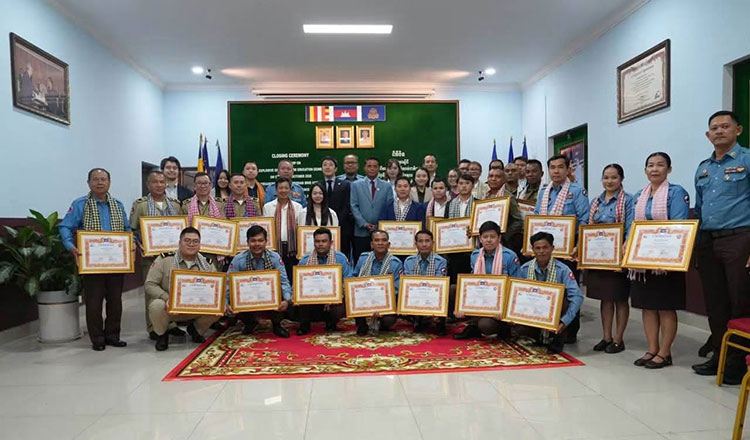
The Cambodian Mines Action Center (CMAC) and the Japan International Cooperation Agency (JICA) concluded a regional workshop on Explosive Ordnance Risk Education (EORE) on October 8 at CMAC Headquarters in Phnom Penh, bringing together 27 participants from Cambodia, Laos, Vietnam, and Timor-Leste to strengthen regional cooperation on mine action and community protection.
CMAC Director-General Heng Ratana and Yoshito Yako, Senior Representative of JICA Cambodia, presided over the closing ceremony of the workshop, held under the project “Technical Cooperation on Strengthening the Functions of CMAC Phase 2.”
Over the course of the workshop, participants shared knowledge, experiences, challenges, and technical methodologies in implementing EORE, behavioral change, community protection, and victim rehabilitation. Through presentations, discussions, and field study visits to schools, communities, and a rehabilitation center, attendees strengthened both their theoretical knowledge and practical experience while building a regional technical cooperation network.
Ratana thanked JICA and all relevant partners for contributing to capacity building and knowledge sharing among countries in the region.
“This cooperation is not only a transfer of technical knowledge but also a vital contribution to protecting lives, restoring livelihoods, and building sustainable peace,” he said. “I hope that you enjoy your trip, especially your stay in Cambodia’s Technical Institute of Mine Action.”
Reflecting on nearly three decades in the sector, Ratana noted that when he joined in late 1998, Cambodia was “very poor,” with no power and poor road access to communities affected by landmines. Mobile mine clearance teams operated in isolated areas, and what is now called EORE was then known as “mine resuscitation,” encompassing unexploded ordnance education as well.
He emphasized that affected communities must ultimately own the problem, with CMAC and other agencies serving as supporters rather than sole responders.
“That affected community should manage the problem and we as service providers support them. National police, armed forces, other demanding NGOs are just the supporters, but the real owners of the problem are the communities,” he said.
Ratana explained that it took more than five years to ensure communities understood and participated in the process, as many initially believed CMAC, police, or armed forces should handle all the work. In reality, he said, communities must be empowered to prioritize and discuss their own needs, promoting human rights, democracy, and gender inclusion in the process.
“We will provide based on their request,” he said. “That is part of the system, and we believe we need to build strong community-based assistance. We provide assistance to them as well — the knowledge base, not the money, not the equipment, but the knowledge base. We build the knowledge within the community.”
The workshop is expected to contribute to strengthened regional cooperation and more effective, community-centered risk education across Southeast Asia and Timor-Leste.