Overview:
Can artificial intelligence help Palau’s small newsrooms do more with fewer staff — without compromising accuracy, privacy or journalistic standards? Journalists from Palau explored that question at a two-day Google News AI Lab workshop in Sydney, testing ways to streamline news production, manage publishing across multiple platforms and make better use of limited resources. But as AI becomes part of newsroom work, concerns remain about protecting photographs, safeguarding information and ensuring every story is accurate.
By: Summer Kennard
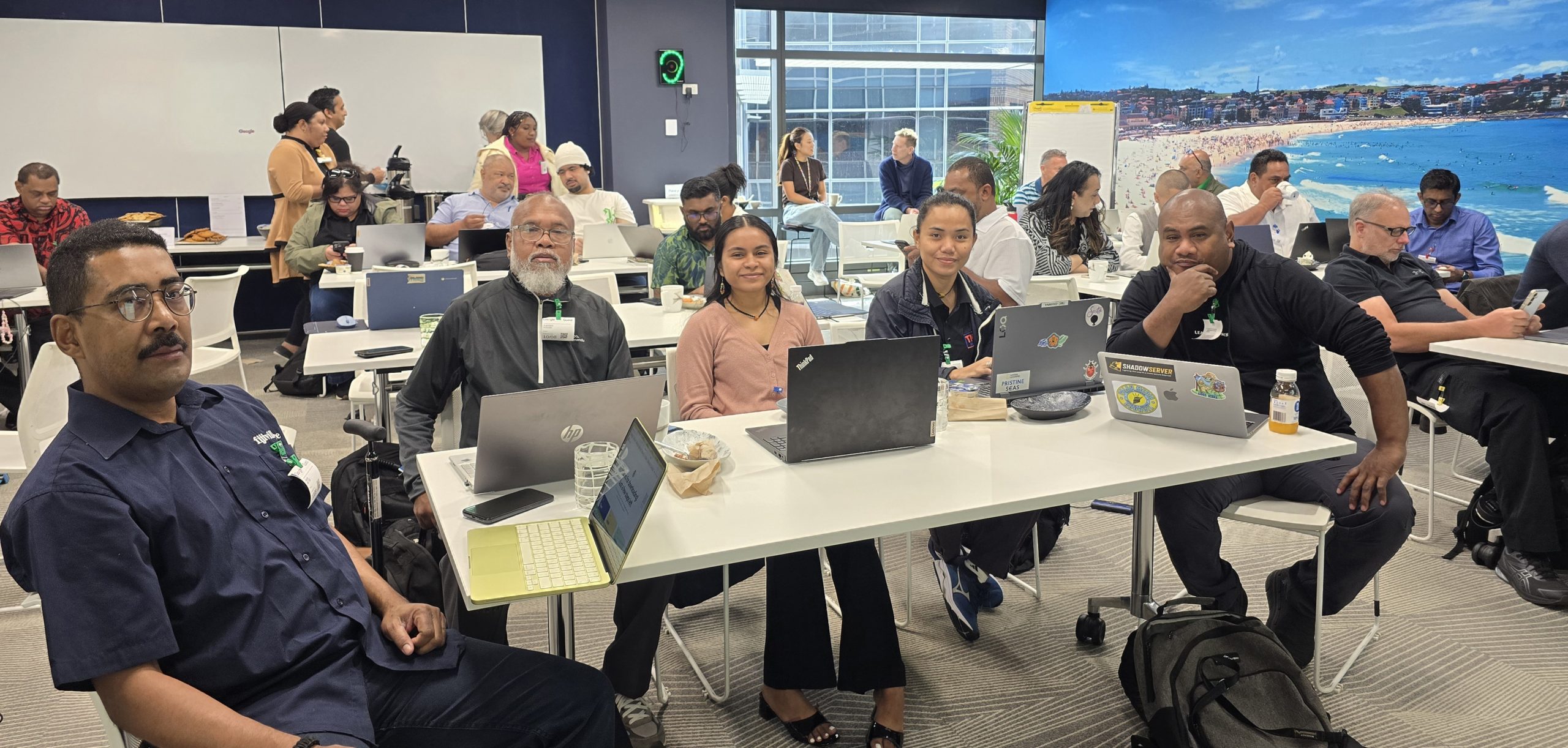
SYDNEY, Australia (October 8, 2026) — Three of Palau’s Media organizations from joined journalists from across the Pacific region in Sydney, Australia, for an intensive two-day Google News AI Lab workshop.
Island Times staff discuss AI tools to support news workflow
The regional training focused on practical, hands-on applications of artificial intelligence tools designed to assist small newsrooms with everyday operations—ranging from automated news production and broadcast scheduling to multi-platform publishing across print, TV, radio, and social media.
For many Pacific media outfits facing manpower shortages and resource constraints, the tools present immediate opportunities to streamline production, expand digital outreach, and preserve news coverage across diverse channels.
Overcoming Manpower Shortages and Automating Multi-Platform Workflows
At TMC Palau, staffing limitations often require employees to take on multiple responsibilities. Ohanna Galo, who serves as a video editor, photographer, social media manager, and reporter, noted that the workshop expanded her view of AI’s practical potential across formats.
“As a small company with a lack of manpower, it really is a big help to us,” Galo said. She explained that prior to the training, her primary use of Google Gemini was drafting news reports. Following the workshop, her team began prototyping multi-platform release workflows that can organize content scheduling across radio, television, and social media.
Galo also expressed interest in leveraging visual processing tools to protect proprietary news assets. “Everybody uses our pictures,” she noted, adding that TMC Palau aims to develop a prototype capable of tracking where their photography is published online.
Shared Challenges Across Pacific Island Newsrooms
The challenges facing Palauan outlets mirror those experienced by media organizations throughout the broader Pacific region, where lean staff sizes must cover vast geographical areas and deliver news across multiple dialects and broadcast mediums.
Participants from neighboring island nations highlighted similar priorities: leveraging automated tools to translate bulletins, extract key insights from government transcripts, and accelerate story output to better serve island communities without compromising coverage quality.
Data Privacy and Security Concerns
Despite the operational advantages, journalists across the regional cohort raised ongoing questions regarding cloud storage and content security.
Galo highlighted concerns about uploading proprietary photos and editorial details into AI systems. “I’m thinking it’s not really safe that you’re giving this info to AI… Where are they storing this data and what are they doing with it?” she questioned, reflecting broader regional anxieties surrounding digital privacy.
Ethical Standards in the AI Era
For veteran journalist Kambes Kesolei of Tia Belau Newspaper, the motivation to attend stemmed from finding ways to maintain newsroom production during staff transitions and supporting personal publishing projects.
“The world is moving, and that’s the trend right now. So you have to really learn it and take advantage of it to further your career and professional goals,” Kesolei said.
Addressing the ethical implications of technological integration, Kesolei emphasized that core media principles remain unchanged. “Being a journalist, there’s a standard of conduct. So whether you use AI or you don’t use AI, those standards remain the same.”
He highlighted advanced prompting techniques and interactive workspace features like Google Canvas as valuable tools for refining contextual output and driving newsroom productivity.
Exploring Diverse AI Platforms
While the workshop highlighted Google’s toolset, experienced attendees noted that Palauan and Pacific journalists are already experimenting with a range of AI platforms.
Ngewakl Soaladaob of TMC Palau noted that he has integrated AI agents into his routine for two years, utilizing specialized media tools like Manus and Higgsfield alongside standard language models.
Meanwhile, Natalie Nakamura of Tia Belau Newspaper emphasized that AI integration can significantly reduce project lead times, provided human oversight is maintained. “It’s just going to cut my time in half doing a project, doing books, or marketing,” Nakamura said, while adding that fact-checking remains essential: “You have to check for sure if everything’s correct.”