- Fishmeal was once a major shipping hazard because it could spontaneously combust, with at least 90 fires reported on ships and in plants worldwide from the 1950s through the 1970s.
- The industry largely solved the problem by adding ethoxyquin, an antioxidant that sharply reduced fishmeal fires but was later found to pose potential health and environmental risks and banned in the EU and several other countries.
- Ethoxyquin is still permitted in some countries and continues to turn up in imported seafood, including shrimp, salmon and tilapia sold in the U.S., though detected levels have been below the FDA’s safety limit.
- As producers shift away from ethoxyquin, they are increasingly turning to alternatives such as BHA, which has also raised carcinogenicity concerns and is now being reassessed by U.S. regulators.
See All Key Ideas
This article is from Food for Feed, a series investigating the global fishmeal industry. It is produced by the Outlaw Ocean Project, a news organization based in Washington, D.C., and excerpted by Mongabay.
On Jan. 8, 1966, a South African ship caught fire at sea. At port in Bristol, in the U.K., firefighters pried open the smoking container, and the conflagration spread and burned for five days.
A little over a month later, on Feb. 11, a Liberian steamship caught fire near Rotterdam. The blaze spread and ignited a storage area with barrels of petrol, raging for several days, before melting the deck and mast, and eventually sinking the vessel.
Then, on March 19 that same year, a Danish ship caught fire off Long Beach, California, injuring three firefighters and killing a longshoreman, and causing more than $1 million in estimated damages.
These were far from isolated incidents. Fishmeal powder is known for spontaneously combusting as it decays and oxidizes. From the 1950s through the 1970s, fishmeal cargo ignited at least 90 fires on ships and in plants around the world, according to a review of historical news coverage by the Outlaw Ocean Project, a news organization based in Washington, D.C.
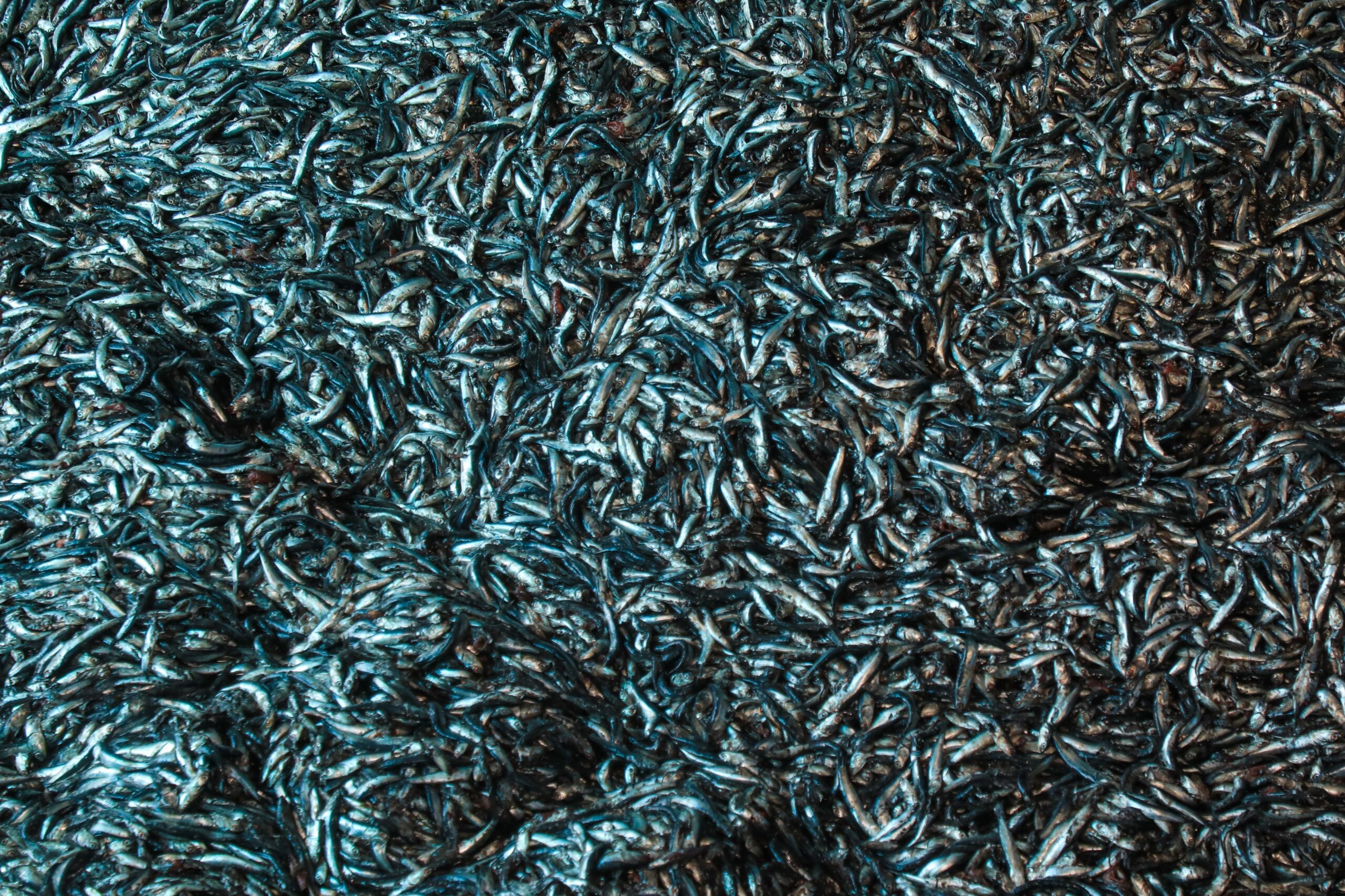
The culprit in each fire was fishmeal, a dark-yellow powder made by drying and pulverizing fish. More than half of the seafood consumed around the world is from aquafarms. Fishmeal or fish is crucial for farm-raised salmon, shrimp, tilapia, and other species.
Fishmeal. Image by Phu Thinh Co via Flickr. CC BY-SA 2.0.
For seafarers, insurers, dock workers, and port firefighters throughout the 1950s and 1960s, fishmeal’s combustibility was a serious worry. One feed manufacturer called it “practically as flammable as gunpowder,” causing fires that are “notoriously hard to control” and that can burn for multiple days, even in a flooded ship’s hold, according to a 1962 article in a California newspaper, the Independent.
In a 1963 annual report of casualty statistics, the chair of the Liverpool Underwriters’ Association, a major insurance group, cited fishmeal as a primary reason the 1960s were the “worst in living history” for ship losses.
But in 1967, U.S. feed producer Cargill announced a solution: a fire retardant called ethoxyquin. A Cargill official told the Los Angeles Evening Citizen News in 1970 that the company had finally found a way to “remove the fire hazard,” solving fishmeal’s primary drawback: “oxidation and resulting heating.”
Ethoxyquin, previously used to keep rubber tires from drying out and as a preservative on fruits and alfalfa, was soon ramped up for production.
After a trial shipment of 400 metric tons of ethoxyquin-treated fishmeal from Peru arrived safely in Florida, Cargill announced plans to ship 100,000 metric tons of Peruvian fishmeal to the U.S. annually. Its new “AO fishmeal” (for antioxidant) could now be shipped in bulk and transported “to more distant users in Washington, Oregon, Idaho, Utah, Colorado, and Southern California,” the newspaper reported.
Soon, feed companies marketed ethoxyquin-treated fishmeal as not just safer but also more nutritious. “It’s a fact!” a 1969 Red Rose Poultry Feeds advertisement claimed, “ethoxyquin protects vitamins A and E and pigments in the feed.” A Hubbard Milling Company advertisement added that with its ethoxyquin-containing feed, “the right feed at the right time means more profit for you!”
Most experts found that the chemical was highly effective. By the 1970s, media-reported fires dropped sharply — from a typical 16 ship fires a year, according to the Liverpool Underwriters’ Association, to five in 1967. A Florida newspaper wrote that ethoxyquin could “eliminate serious hazards of combustion” and make fishmeal “safe for transportation.”
“Antioxidant treatment has made bulk handling an easy matter,” the director of the Canadian Department of Fisheries told an industry publication in 1966, arguing it should be required for fishmeal shipments as it was “the more effective antioxidant,” despite being more expensive.
Bags of fishmeal produced in by the Diamante fishing plant in Callao, Peru. Image by Peru’s Ministerio de la Produccion – Produce via Flickr. Public domain.
By 1976, the U.S. Coast Guard had imposed mandatory ethoxyquin treatment for fishmeal shipments, and three years later, the United Nations body that oversees maritime activity recommended fishmeal be treated with ethoxyquin “to prevent spontaneous combustion.”
But a problem was soon discovered: ethoxyquin is carcinogenic.
As early as 1969, a group of U.N. food and agriculture authorities released a paper noting that “toxic effects had been observed in laboratory animals fed high concentrations of ethoxyquin,” and that “occurrence of dermatitis among fruit packers suggests that sensitization could be a problem among those who are handling ethoxyquin.”
As its use in animal feeds grew, a 1987 study by British researchers found the chemical “caused severe damage” and had a potentially “carcinogenic effect” in rats.
In 2015, the European Food Safety Authority said an impurity within ethoxyquin, known as p-phenetidine, was a possible mutagen, capable of causing mutations in genetic material. Two years later, the European Commission suspended authorization for ethoxyquin’s use in animal feed across the European Union.
Ethoxyquin has also been banned in the U.K. and by members of the European Economic Area, including Norway, Iceland, and Liechtenstein. Australia, Japan, South Korea, and the U.S. still permit its use in feed, but limit the maximum permissible level. While some countries, such as Peru and Vietnam, have not banned the chemical, their fishmeal industries have responded to the requirements of their major export markets by taking steps to ensure that aquafeed destined for certain parts of the world does not contain ethoxyquin.
In the US, ethoxyquin has been at the center of a half-dozen lawsuits, typically involving claims of false advertising.
In 2019, the NGO Toxin Free USA sued the J.M. Smucker Company and Ainsworth Pet Nutrition in Washington, D.C., alleging consumer protection violations for labeling pet food as “natural” and free of “artificial preservatives” despite containing ethoxyquin.
In a similar case in 2021, two national nonprofits, GMO Free USA/Toxin Free USA and Clean Label Project, sued Nestlé Purina Petcare Co. for marketing cat food as containing “no artificial … preservatives” when it also contained ethoxyquin. Both pet food cases were settled out of court.
Separately in 2021, a California resident brought a class-action suit against Champion Petfoods USA, alleging false marketing of its pet food as made with “wild-caught fish,” since ethoxyquin is only found in farmed fish. The court dismissed this claim.
Other lawsuits have targeted seafood companies for marketing their products as “sustainable” even though ethoxyquin was found in their products. Specifically, these cases have highlighted the potential risks that the additive poses to the environment.
In 2022, a New York resident brought a class-action lawsuit against German supermarket chain Aldi, Inc., alleging the “sustainable” label for its Atlantic salmon products was false due to “environmentally destructive” practices. The complaint cited the EU’s ban on ethoxyquin and a study linking the chemical to mortality and deformations in fish and crustaceans, noting it “poses a risk for aquatic life.” The case was settled out of court.
Aldi Food Market. Image by Mike Mozart via Flickr. CC BY 2.0.
Also in 2022, a New York and a California resident jointly sued Gorton’s Inc., a seafood company, for labeling its frozen tilapia as “sustainably sourced” despite containing ethoxyquin. This lawsuit also cited the “risk for aquatic life” and the European Union’s ban, and was settled out of court.
In a statement to the Outlaw Ocean Project, Cargill said that since 2005, it has “evaluated alternative antioxidants for use in fishmeal to support transport stability and respond to evolving customer and regulatory expectations” and doesn’t use ethoxyquin in its global salmon feed business or in any market where ethoxyquin is no longer authorized for use in aquafeed. It also said “antioxidants are applied by fishmeal production facilities before storage and transport; Cargill does not add ethoxyquin to fishmeal after receiving it for aquafeed production.”
Grain silos at a Cargill/Nutrena Animal Nutrition facility in Albany, New York. Image by Tyler A. McNeil – Own work. CC0 Public Domain.
Roughly 80% of the seafood consumed in the U.S. is imported, with China being the biggest supplier. In 2024, the U.S. imported 768 million pounds (348 million kilograms) of seafood from China, according to trade data from the National Oceanic and Atmospheric Administration. China is also among the biggest global users of ethoxyquin, as Asia is the largest market for feed antioxidants, with China the top regional consumer, according to a 2025 industry report.
The chemical’s prevalence is a concern for Beijing as the government works to clean up contamination on fish farms and in the nearshore ocean along China’s eastern coast. In 2018, Chinese researchers studying water pollution found ethoxyquin to be one of the most abundant contaminants in a Yangtze River reservoir that supplies more than half the drinking water in Shanghai.
Ethoxyquin is making its way into U.S.-consumed seafood. A review of more than 350,000 weekly Food and Drug Administration inspection reports from 2018-2022 showed trace amounts of the chemical in three seafood types: shrimp, especially from Indonesia and India; salmon, most often from Chile; and tilapia, frequently from China.
Aquaculture fish farming of salmon and mackerel in the Chilean fjords south from Castro. Image by Gordon Leggett / Wikimedia Commons. CC BY-SA 4.0.
While the levels detected were always below the amount the FDA deems safe, critics claim this safe level is weak compared to the EU’s standard, which bans any amount appearing in food. Though ethoxyquin is also used on fruits and vegetables to slow skin drying, FDA data indicate that seafood is more than 10 times more likely to arrive in the US containing the chemical compared to other tested foods, including asparagus, cucumbers, and tomatoes.
Since the European ban, producers and feed makers have increasingly shifted to alternatives, including natural additives such as rosemary extract and vitamin E compounds, as well as synthetic replacements such as butylated hydroxyanisole, or BHA.
“More and more destinations are not accepting ethoxyquin, starting with our local Peruvian market,” said James Frank, managing director of Peruvian fishmeal company MSI Ceres, during a 2022 webinar. He added that 100% of Peru’s fishmeal exports to Europe, Canada, the U.S., and Australia are now ethoxyquin-free, a shift also seen among companies in the U.K. and Norway.
BHA, the most popular alternative to ethoxyquin, is favored for its lower costs and strong antioxidant properties over fully natural additives like rosemary extract. But, in yet another cycle of unintended consequences, this replacement has raised serious concerns.
Like the chemical it aims to supplant, BHA has its own significant health risks, according to researchers. The U.S. National Toxicology Program identified BHA as “reasonably anticipated to be a human carcinogen” in 1991, and Japanese researchers found it caused malignant tumors in laboratory rats in 2008.
For the time being, European regulators have deemed BHA safe enough to use. In 2018, a panel from the European Food Safety Authority concluded there was “no concern for consumer safety” when BHA is used as a feed additive below the EU’s established limit of 150 milligrams per kilogram of feed.
The U.S. is reassessing the matter; the FDA took a more cautious approach, announcing in 2025 that it would reassess the safety of the substance as a food additive.
This story is excerpted and edited by Mongabay from Food for Feed, a global investigation into the fishmeal industry conducted by an international team of journalists at the Outlaw Ocean Project. Reporters examined more than 1,400 fishmeal factories across 64 countries — tracing supply chains from fishing vessels to processing plants, feed mills, fish farms, and seafood retailers. The reporting effort involved dozens of journalists visiting factories and farms and boarding fishmeal ships at sea. The project includes Bait to Plate, an online tool developed by the Outlaw Ocean Project that tracks the fishing and seafood industries.
Banner image: The Peruvian government launches the 2025 anchoveta season with a 3 million ton quota, the second-highest in the last 13 years. Image by Ministerio de la Produccion – Produce via Flickr. Public domain.
Citations:
Manson, M. M., Green, J. A., & Driver, H. E. (1987). Ethoxyquin alone induces preneoplastic changes in rat kidney whilst preventing induction of such lesions in liver by aflatoxin B1. Carcinogenesis, 8(5), 723-728. doi:10.1093/carcin/8.5.723
Fishmeal factories take Senegal’s fish from the dinner table
For Indian communities, fishmeal factories bring pollution, danger and protests
Cite this article
Ian Urbina (2026). A chemical kept fishmeal from catching fire. Then scientists raised cancer concerns. Mongabay Conservation news. DOI: https://doi.org/10.66709/news-331923