Synopsis: At the Inter-Parliamentary Union Assembly in Tanzania, Ouch Borith stresses accountability, trust-building and a rules-based global order to underpin lasting peace.
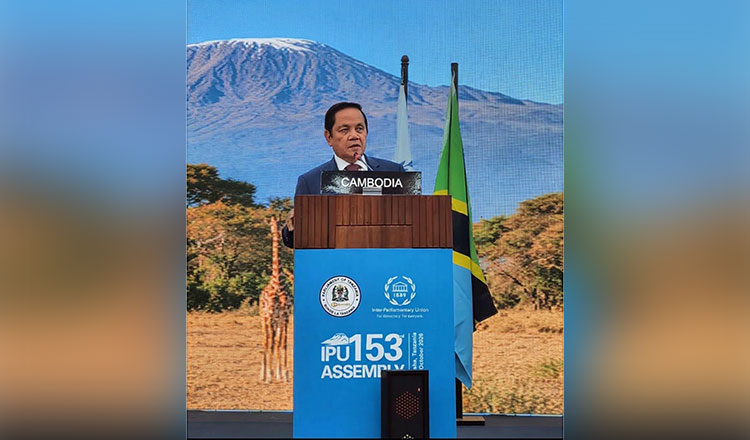
Cambodia has called for stronger adherence to international law, respect for sovereignty and territorial integrity and greater accountability as foundations for peace, good governance and sustainable development, Senate First Vice-President Ouch Borith said at the 153rd Inter-Parliamentary Union (IPU) Assembly in Arusha, Tanzania, on Wednesday.
Addressing the assembly under the theme “Enhancing Good Governance and Empowering Communities through Inclusivity, Trust and Opportunities for All,” Borith, who heads the Kingdom’s delegation, said Cambodia’s own experience demonstrated that lasting peace requires more than an end to armed conflict.
Borith said the Kingdom’s journey to peace had been shaped by sacrifice, resilience and determination, while stressing that good governance based on the rule of law, accountability, transparency, human dignity and public trust was essential to lasting peace.
He highlighted the successful implementation of the Win-Win Policy under the leadership of former Prime Minister Hun Sen, saying it had enabled the Kingdom to achieve national reconciliation and lasting peace and provided the foundation for inclusive development and greater opportunities.
“This experience has taught us that lasting peace and prosperity depend not only on the absence of conflict, but also on inclusive institutions, opportunity for all and the trust that binds society together,” he said.
Borith said the same principles should guide relations between states, particularly respect for sovereignty and territorial integrity, faithful observance of agreements, good faith, dialogue and peaceful dispute settlement.
“When commitments are not honoured or established mechanisms are abandoned, trust is weakened and the foundations for peaceful cooperation are placed under strain,” he said.
Turning to the Kingdom’s border situation, Borith said these principles had been put to the test along the country’s western border following the 2025 conflict.
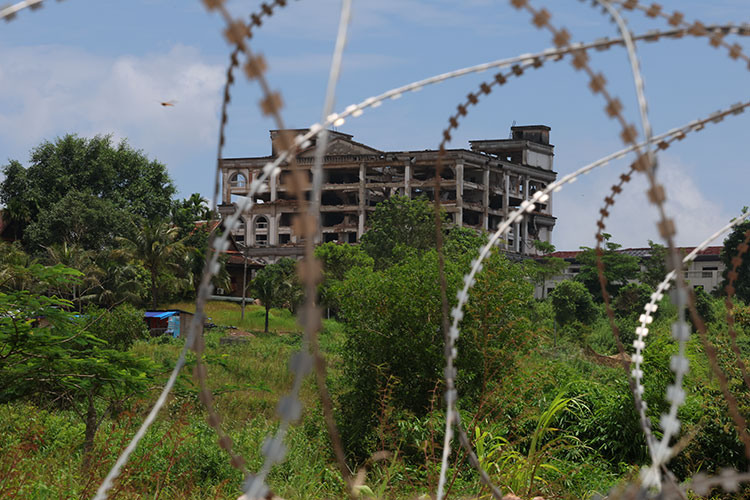
He claimed that certain areas of the Kingdom’s territory remained occupied, while military and civilian infrastructure, containers and barbed-wire barriers continued to be constructed. He also said restrictions were preventing displaced civilians from returning home safely.
He raised concerns over damage to Preah Vihear Temple, a United Nations Educational, Scientific and Cultural Organization (UNESCO) World Heritage Site amid reports concerning the use of prohibited weapons.
According to Borith, such concerns had been documented or raised in recent reports and assessments by United Nations (UN) human rights mechanisms, the UNESCO World Heritage Centre and International Council on Monuments and Sites (ICOMOS), as well as the Cluster Munition Monitor 2026.
Despite the situation, he said the Kingdom remained committed to peace and the peaceful settlement of disputes in accordance with international law, mutual respect, the UN Charter and the ASEAN Charter.
Borith referred to the Kingdom’s initiation of compulsory conciliation proceedings under the UN Convention on the Law of the Sea, following what he described as the unilateral termination of the 2001 Memorandum of Understanding, which Cambodia considers the only existing bilateral legal framework specifically established to address the maritime disputes.
He said the experience had reinforced the connection between peace, trust and the rule of law, both between States and within societies.
“Parliaments, as the embodiment of the people’s will, have a vital role in ensuring that these principles are translated into practice,” he said, stressing the importance of inclusive lawmaking, effective oversight and responsive representation.
Borith said parliaments could strengthen accountability, build confidence in public institutions and give communities a greater role in decisions affecting their lives.
In his remark, Borith outlined five priorities for advancing peace and good governance.
The first was consistent and good-faith adherence to international law, including compliance with binding decisions of the International Court of Justice and other international obligations.
The second was safeguarding sovereignty and territorial integrity through peaceful dispute settlement and respect for ceasefire arrangements in both their spirit and text.
The third was strengthening accountability by addressing serious violations of humanitarian and human rights law through appropriate national and international mechanisms.
The fourth was building trust through justice and humanitarian action, including protecting civilians, facilitating the safe and dignified return of displaced people, addressing humanitarian needs and providing remedies.
The fifth was empowering communities through meaningful participation, fair access to opportunities and resources, and the ability to shape their future within the framework of sovereignty, constitutional order and international law.
Borith said these principles could help advance a more inclusive, just and enduring peace, while strengthening trust between institutions, communities and states.