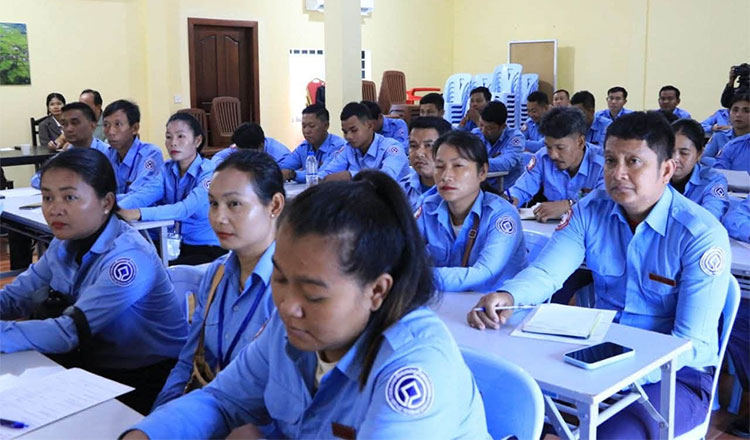
The APSARA National Authority (ANA) is conducting a two-day training course to strengthen knowledge of Angkor’s historical and cultural values and improve heritage education skills among officials and tourism agents working at the archaeological site.
The training, titled “Enhancing Knowledge of the Values of Angkor and Conservation Work,” began on Wednesday and concludes today, with 40 officials and tourism agents taking part.
The course provides in-depth knowledge of Angkor’s history, civilisation, inscriptions, Khmer literature, tangible and intangible cultural heritage, as well as the beliefs and traditional ceremonies of communities living in the Angkor area.
The ANA said the training helps tourism agents who work directly at the temples build a reliable knowledge base so they can provide accurate information and explain Angkor’s heritage to visitors and the public.
Im Sokrithy, Director of the Department of Research, Training and Communication, said the training is a bridge that connects Angkor’s glorious past with officials and staff who live and work at the heritage site.
He said the programme allows participants to further explore their ancestral history while strengthening the knowledge and skills needed to become responsible “heritage educators,” to contribute to the effective and sustainable management, conservation and development of Angkor.
Sokrithy added that heritage education should be an ongoing process rather than ending with a single training course. The ANA plans to continue supplementary training and study programmes, including a second course, in response to the officials’ and staff’s learning needs and interests.
During the two-day training course, four experts and distinguished guest speakers delivered in-depth educational presentations on key topics, including:
The study of history and the structure of ancient cities: Education on geography, healthcare/medical systems, education systems, and land-use planning in ancient times.
The history and procedures of conservation: The processes of research and study, the inscription of Angkor on the World Heritage List, and its Outstanding Universal Value.
The study of tangible and intangible cultural heritage: The relationship between people and temples, as well as the preservation of living heritage.
Inscriptions and the value of Khmer literature: Training to understand inscriptions as a “living archive of history” that records political, religious, economic, and social events in ancient times. At the same time, the course clearly highlighted the immense value of Khmer literature and language as an identity, a foundation of philosophy, and a tool reflecting the evolution of Khmer ancestor’s wisdom and knowledge from the past to the present. This fosters pride among officials and staff and encourages them to preserve national literature for future generations.