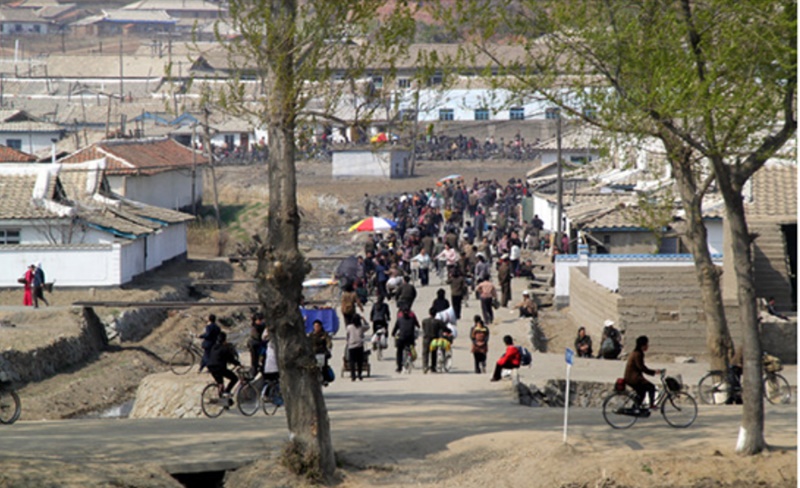
A “grasshopper market,” or unofficial market, in a village near Pyongyang. (Chinese blogger Lóng Wǔ*Láng Zhī Wěn)
A few years ago, two researchers – Dr. Andrew Yeo (Brookings Institution) and Dr. Justin Hastings (University of Sydney) – conducted a series of interviews with North Korean defectors to explore how marketization had changed interpersonal relationships in North Korean society. The vast majority of interviewees alluded to an extensive system of bribery and kickbacks, but virtually none of them expressed any outrage at the “corruption” of the system. Paying (and taking) bribes was simply part of daily life.
This unexpected attitude led Dr. Yeo and Dr. Hastings to conduct a follow-up investigation exploring what exactly North Koreans mean when they use the word bribe (뇌물) and the function that bribery plays in North Korea’s hybrid socialist-market system.
The Unification Media Group’s Rose Adams recently attended a seminar presenting their research and interviewed them about their findings. The interview (edited for clarity) is below.
Q: Could you define what “bribery” means in North Korea? What might be unexpected about it, or different from the definition our English-language readers know?
Andrew: One explanation that stood out came from a merchant we interviewed. He compared bribes to paying taxes in the South Korean system. In other words, bribes are just part of the cost of doing business.
When defectors talk about bribery in daily life, they usually mean a way to get something in short supply or to cut through administrative red tape. In the markets, almost every part of private business is illegal in North Korea, so the “service” the bribe recipient provides is often simply looking the other way.
Q: It’s easy to see the appeal of bribery when both parties get something in return. But what about the bribes people pay to avoid jail time after they’re caught doing something illegal?
Justin: We think of bribery in North Korea as falling broadly into two categories: horizontal and vertical. Horizontal bribes happen between people who are roughly peers, such as ordinary residents and low-level local officials. Here’s an example from the literature. One defector described the expectation that you give your doctor a pack of cigarettes as thanks for a vaccine. The patient does this because he knows the doctor isn’t paid enough to make a living. By staying in his government-assigned post and providing a public service, the doctor also misses out on more lucrative business opportunities.
These bribes are driven less by coercion or quid pro quo than by a shared understanding of what the other person gives up and how hard it is to make a living. Horizontal bribes are part of what we call the moral economy, where things like etiquette and empathy shape economic decisions. They work as a kind of mutual social support, based on the understanding that everyone at this level needs to survive. They also make North Korean society more stable and resilient. They keep services running that the state can’t support, and they let people run the private businesses they need to make a living.
Vertical bribery is different. These bribes aren’t between peers. They happen within hierarchies, where the recipient has significant power over the person paying. That doesn’t make them inherently extortionate. Sometimes you need to pay off someone high up with the authority to get a difficult task done, like moving a large volume of cargo or reducing a harsh prison sentence.
We spoke to North Koreans and to Chinese businessmen who traded with North Korean officials. In vertical relationships, both groups often drew the moral line at necessity. A demand for a bribe was generally seen as reasonable if the amount fit the task, or if the recipient asked for necessities like food or firewood. Participants called it “corruption” or extortion only when bribes were excessive or too frequent for the service provided, or when recipients asked for luxuries like alcohol or designer goods.
In reality, of course, these interactions are complex, and horizontal and vertical bribery networks can overlap. Still, it shows that the size of a bribe isn’t the only thing that matters. Social dynamics, and how people judge the other person’s needs, play a key role in how North Koreans understand the transaction.
Q: Your research focuses mainly on the marketplace, though you note that bribes are part of nearly every aspect of life in North Korea. What might a “typical” market bribe look like, and why does it matter?
Andrew: Let’s say you’re a market vendor selling condiments made in China. Individuals have no legal way to import goods for private business. So you pay off someone at a state-run company to order the goods for you, or, before Covid, you might have paid border guards to look the other way while you brought the goods across.
Next, you load your condiments into a truck. Until very recently, private vehicle ownership wasn’t allowed. That meant either hiring an unofficial delivery driver or paying off someone you know to lend you a vehicle. On the way into town, your truck will probably pass a security checkpoint, where you pay another bribe. Once the goods reach your home or storage space, you either pay rent for a stall in an authorized market or sell on the street and pay off any police who spot you.
In North Korea, there is virtually no infrastructure for private business. There are no private contracts or ways to enforce them, no private business insurance, and no escrow or formal credit systems.
A North Korean traffic police officer in blue uniform directs traffic on a main street in Pyongyang, standing next to a police patrol car with emergency lights. The scene shows typical urban traffic including public buses and private vehicles in North Korea’s capital city. Photo taken in 2018 during the inter-Korean summit. (Korea Summit Press Pool)
Bribes fill these gaps by showing credibility and commitment to the relationship. An official who takes a bribe and doesn’t follow through won’t make money for long. Even the more extortionate “pay me or I’ll throw you in jail” bribes, which people pay when they’re caught doing something illegal, are set by a kind of market force. If the price of staying out of jail is too high, people may find another line of work, and the enforcers lose income. If it’s too low, the bribe isn’t worth the enforcer’s risk. The bribe is an agreed price for the interaction, and it encourages reciprocity.
It’s easy to see these relationships as purely transactional, and in some cases exploitative. But repeated interactions, and the mutual risk that either side could inform on or blackmail the other, can create a lasting bond. Some of our interviewees described these people as “sort-of friends.” What’s notable is that bribes can build relationships that exist outside of, and often in contradiction to, state-controlled social structures. Bribery often sparks new connections. It expands what are essentially the only private networks outside the family in North Korea.
Q: Who benefits from those private networks? Some might say bribery also stabilizes the regime by keeping it from collapsing under its own inefficiencies.
Andrew: There’s some merit to that. It’s a contradiction that also came up in our research on China and the Soviet Union as their economies transitioned to markets. I don’t think it’s controversial to say that markets saved North Korea from collapse in the mid-1990s. You could also argue that the state benefits from bribery. It makes government and security jobs attractive careers even though the state doesn’t pay a living wage, and it indirectly brings the state some revenue.
At the same time, bribery is exactly what keeps the state from enforcing certain policies effectively. For example, it’s very hard to fully stamp out South Korean products when enforcers have a personal stake in letting a few people slip through for the sake of their own income.
And as we said, bribery is a key driver of private relationships outside the family and beyond state control. The stronger these networks get, the more they compete with the state and its services. Here’s a concrete example. Imagine you’re sending a letter, and you have two options. One is cheap but slow, and it will likely read and possibly censor your mail. The other costs more, but it’s fast and private. If you had a little money to spare, most of us would choose the second option. Before marketization, though, the state was the only provider of key services like this, so you had no choice if you wanted them. Bribery is the extra cost of better, more private service. In the North Korean context, it’s also what makes that alternative possible in the first place.
Q: One last question. A lot has changed in North Korea since Covid-19, and Kim Jong Un seems to be trying to turn the clock back to before markets, and widespread bribery, became such a powerful social force. Did you notice any changes in how bribery is practiced or perceived before and after Covid?
Justin: The re-centralization of the economy could certainly compete with bribery. Take cars. Private car ownership used to be banned. If you needed a car for personal use or private business, you had to bribe someone in the military or at your workplace who had access to a state-owned vehicle. Over the past two years, North Korea has revised its legal code to legalize private car ownership. People who only occasionally need a car may still pay bribes to borrow one. But much of the money that once went to those bribes will now go toward buying a vehicle. In turn, the state can earn a fair amount from vehicle imports, sales and registration.
At the same time, some offenses are much harder to bribe your way out of now. The prime example is cross-border smuggling. The Covid-19 border closures essentially wiped out individual, private smuggling. It may continue in a handful of cases, but smugglers have had to change how they use bribes and who they build relationships with. In the past, they might have paid off a few border guards at a strategic crossing point. Now they might bribe the manager of a trading company so they can formally register as an employee and import through state channels. This process is far more complicated and involves more palms to grease, which raises the cost of what is essentially the same task. I can imagine this leading to a situation where only people who are already wealthy can afford the bribes, locking ordinary residents out of opportunities they had before 2020.
“Pay to play” isn’t inherently wrong if the price is low enough for everyone to play. But government crackdowns have raised the risk for people taking bribes, which has pushed prices up. That narrows who has the means to make money. I think this mirrors, and may be a key part of, the broader trend of accelerating wealth inequality in post-pandemic North Korea.