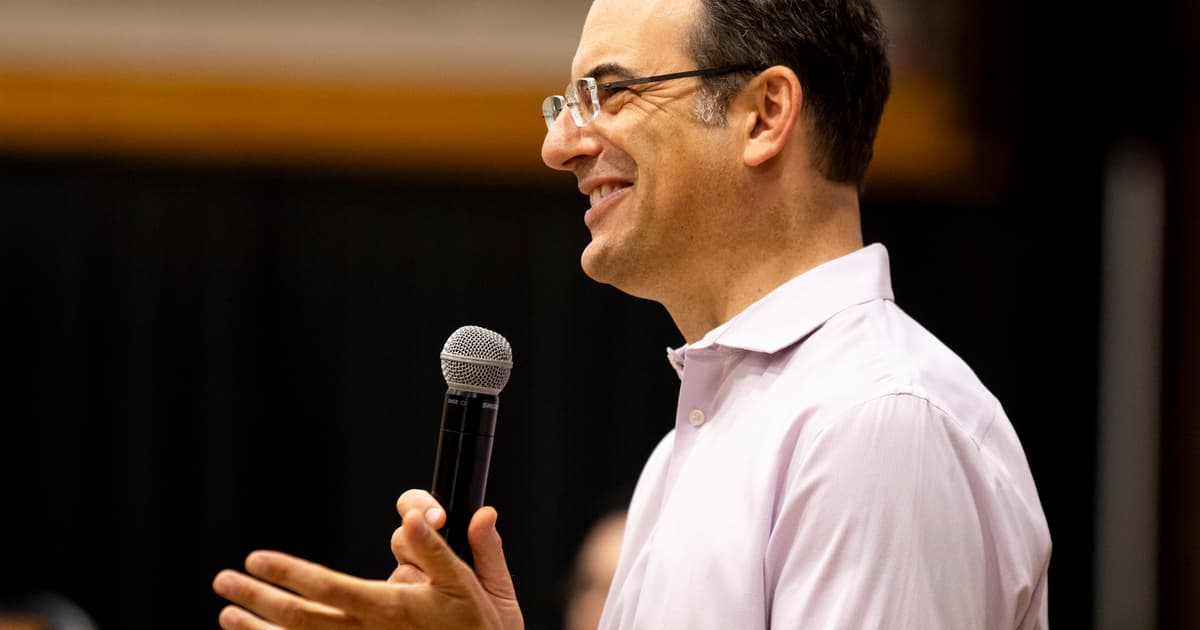
Phil Weiser has answers — more than 100 pages of them — for skeptics and supporters curious about what he would do as governor, but the Democrat says not every line of his Colorado Blueprint is going to roll out on day one.
“What this is, is a vision for governing over eight years,” Weiser told Colorado Matters Senior Host Ryan Warner. “This is how governing works. We don’t come in on day one and have everything everywhere all at once laid out. We work on it over time.”
The blueprint covers everything from housing to healthcare to a proposal to engage more young Coloradans in public service. What will it cost? That depends on what programs prove successful. Weiser says some, like reducing the number of inmates who re-offend, would drive down costs for the state while others may warrant a voter-approved tax increase at some point.
Weiser, who is Colorado’s current attorney general, faces Republican Victor Marx in the November general election. Marx declined an interview with Colorado Matters.
While Weiser may be at the head of tax discussions, should he be elected, he’s also weighing in on some this fall as a voter. One tax measure Weiser will support in November is Proposition NN, which boosts K-12 spending by raising the revenue cap allowed under TABOR. Weiser said his support for the measure is rooted in his commitment to funding education, as well as the fact that it was put on the ballot by the Colorado state legislature, which he said means it’s “gone through a level of deliberation that I believe puts it in a special category.”
“NN would be an effort to recognize a structural deficit, an unpaid IOU that’s leading us to have fewer school days or teacher salaries less than surrounding states,” Weiser said, referencing Colorado’s so-called budget stabilization factor that reduced school spending following the Great Recession.
Elsewhere on the ballot, Weiser said he’s eager to vote no on a bill that would ask Colorado law enforcement to share more information with immigration authorities. Presently, Colorado law restricts what kinds of information local law enforcement can turn over to ICE. This has led to clashes with the Trump Administration as well as local entities, including when Weiser briefly sued a sheriff’s deputy for violating the law. Amendment 81, which voters will consider this fall, would interfere with local law enforcement, Weiser said.
“It’s undermining due process and it’s not respecting the rights of victims,” Weiser said.
Weiser spoke with Colorado Matters about how he’d roll out his proposals, wrangling the Colorado state budget and where he stands on a vote to fund front range passenger rail.
Kevin J. Beaty/DenveritePhil Weiser, Colorado’s attorney general and Democratic gubernatorial candidate, stands outside the Laborers’ International Union of North America’s Labor Rising barbecue at the Douglas County Fairgrounds in Castle Rock. Aug. 30, 2026.
This interview has been edited for length and clarity
Ryan Warner: Let’s start with a recent debate in Grand Junction. This is your back and forth with Greg Lopez, unaffiliated candidate for governor, asking about your Colorado blueprint.
Greg Lopez: Attorney General Weiser, your website has a Colorado blueprint for people to read. It’s got 18 sections. It identifies four executive positions, seven new government offices, and 10 new programs. How much is it going to cost us?
What would you like voters to know about these plans, how they’d be rolled out and paid for? I feel like we can give you the time.
Phil Weiser: I want voters to know a few things. First, we listen to you and we put together a 109-page Colorado blueprint. And what this is, is a vision for governing over eight years. Some of what I want to do can be rolled out in a pilot, beta sort of way, like Colorado Corps, calling young people to service in law enforcement, teaching, nursing, counseling, and firefighting. We may be able to start with a baby step, if you will. And then, over time, we may need to go to the voters to ask for funding to be able to scale this program up. Similar with transportation, we have some ability to make improvements to our roads, but we’re going to have to work on a broader program. This is how governing works. We don’t come in on day one and have everything everywhere all at once laid out. We work on it over time.
All right. And have you done the calculus around everything in the blueprint to say, it is revenue neutral, it is revenue generating, it’s going to cost you. Folks are putting you in an important office. It’s the legislature that holds the purse strings. You’ll have to get their buy-in. What will you come to them with?
Weiser: Ryan, it’s going to be case by case. Some of the things I mentioned are going to help save us money. For example, how do we address Colorado’s problem that when someone leaves prison, within three years, there’s a 45% chance they’re back in prison. The national average for that rate, which is recidivism, is 37%. We’re not doing good enough helping people reenter society after prison. That’s going to help save us money. It’s going to keep us safer. So obviously that’s a program that would be net positive, if you will. I mentioned before, Colorado Corps, how we call young people to serve. If we want to be able to pay for their higher education as part of this service commitment, that’s going to cost money. So we’ve got to find a source of money, either it’s going to the legislature or in this case, probably more likely going to the voters.
There’s a TABOR involvement.
Weiser: The TABOR involvement. So this is a blueprint for governing. And what I want to do is continue to advance a conversation about what’s best for Colorado. My campaign has really been grassroots, listening to people. And what this blueprint does is takes the initiative we have on a range of topics from healthcare, from housing, to how we support our kids for a better future, to support a better economy. And yes, some of these are going to take some money, some of these are going to take some time. I want people to know what my vision is, and so they’ve got a chance to comment on it and help us get it done.
On green energy, the blueprint says “this work will not be cheap in the short term, but the faster we can address and mitigate climate change and pivot to a 21st century energy economy, the more affordability we can generate for Colorado families.” I certainly get the idea of spending now to save later, but you would be taking office in what’s likely to be a brutal budget year. There have been, in the last few years, major gaps. We’re looking into the maw of a $1.6 billion budget shortfall as we head into the next legislative session. Square those two realities, the reality of climate change and the reality of our budget.
Weiser: Let me start with wildfires. Right now, our failure to better protect against wildfires are causing home insurance rates to go up. It’s a threat to public safety. It’s a threat to public health. I, in this blueprint, promised leadership on wildfires with resilience. When I picked Lesley Dahlkemper, who’s going to be my lieutenant governor, part of why I picked her is because of her deep expertise in wildfire prevention and the type of collaboration we’re going to need at the state level to remove dead and dying wood from our forests and act in advance to prevent wildfires. If we do this, spending money — and by the way, there’s something on the ballot that would create funds for wildfire prevention — we can actually save money because when you have these terrible wildfires, it’s very costly. You hear this a lot: an ounce of prevention is worth a pound of cure. That’s going to be one of my approaches to the budget. If we are smart, if we’re targeted, we are going to be in a better position. And climate change, I want to make this point clear, it’s not some future threat. Wildfires and drought make it clear it’s here and we got to deal with it.
A water question for you. As Attorney General, you have a role on the legal side of Colorado River Negotiations. At the same time, per your financial disclosures, you were making money from the utility holding company, JW Water, which operates in Arizona. Their CEO is also a donor of yours. Was that a conflict of interest?
Weiser: Well, I want to be very clear. This is an investment that I got out of years ago that I’m no longer involved in.
Were you involved in it as attorney general?
Weiser: I got out of it while I was still attorney general, but I got out of it before the current controversy. So what you’re getting at now is that we have a potential litigation between Colorado and between Arizona. And what I can say is my job is always to serve the people of Colorado. And when you look at the work I’ve done as attorney general, it’s very clear. I know who I’m working for. And I’ve been very clear as we’ve looked at potential litigation with Arizona or Nevada, who’s actually filed suit, that my job is to defend Colorado and make sure our rights are protected. That’s always going to be my true north.
Did you get out of the investment because you saw legal proceedings on the horizon?
Weiser: No, there was an exit event. The company was sold and I was no longer involved once the sale happened. And as it turns out, I don’t have any conflict because it’s been sold. And what I’ll say is there’s a larger principle. If there’s any threat that I could have a conflict on any issue, I’m going to recuse myself because I recognize how important it is to avoid either actual conflicts or even perceived conflicts of interest.
Molly Cruse/CPR NewsAttorney General Phil Weiser makes a speech after declaring victory in the Democratic primary for governor at his election night watch party in Denver. June 30, 2026.
Okay. Moving on. I suppose in a way, going back to this $1.6 billion budget gap, this now seems like the norm, maybe since COVID. What fundamentally do you think is going on here and does a Weiser administration bring more than a year-to-year patchwork?
Weiser: Obviously, we’re in a budget challenge right now and we really do need creative problem solving. I’m going to bring some important principles to bear and I’m going to work hard with members of the joint budget committee and we now have a Medicaid commission because a lot of this budget challenge comes from Medicaid spending.
Medicaid in the not too distant future may swallow the budget whole.
Weiser: The level of Medicaid growth is a part of what the budget challenge is, which is why the legislature, I believe very smartly, set up a Medicaid commission focusing on this critical question: How do we make sure that we are serving the public responsibly and thoughtfully? I just want to highlight this about Medicaid. Sometimes a problem, when you’re dealing with budgets, is you look at numbers, you’re not thinking about people. And our challenge is to understand how do we protect people? How do we make sure we keep a safety net in place? And with H.R.1, the “Big Bad Bill” coming from Congress, how do we make sure we protect rural healthcare institutions? So, I am well aware that we’re in a budgetary challenge of very, very significant proportions. The way through, I believe, is to follow some key principles, which is to make sure we’re listening to everybody to understand how we make whatever cuts we need to in the most humane, sensible way possible, how we look for whatever savings we can creatively, efficiently. We’ve got to look this square in the eye and say, how do we get to a more sustainable place?
I mean, we learned the state was overpaying for Medicaid transportation by tens of millions of dollars. And yet given the gap here, how much of these problems can be fixed by better management?
Weiser: I will have to take this on as I become governor and look at, as you put it, a range of scenarios. And as you noted, one scenario is the state is literally paying more for people than we should. Inexcusable. We’ve got to look hard and long, analyzing where there is that type of misspending. Then there’s other situations where providers are engaging in fraudulent activity, taking the liberty, if you will, of billing for services that they didn’t offer. That’s not okay. We’ve got to find out and we’ve got to hold them to account and protect the public spending. And then finally, there’s a question about what’s the prudent level of service to be offering? And sometimes if there’s more services being offered than are necessary, we can ask, is it really appropriate?
I suppose it’s not a winning message to say exactly what the cuts would be now.
Weiser: It’s important to be responsible. It’s important to go about this in a measured, deliberate way. And so for me, that’s my true north.That’s how I’m going to work this problem. The legislature has a key role right now. They’ve got a commission. They’re working up their analysis, their recommendations. There’ll come a time when I can weigh in. We’re going to have a bit of time for back and forth. I’m going to make sure that those affected have a chance to be heard. This is going to be hard work. I recognize what I’m signing up for.
And that commission delivers a report no matter who’s governor.
Weiser: That’s correct.
I want to play just a bit of a conversation I had recently with J.J. Ament. He leads the Denver Metro Chamber of Commerce.
J.J. Ament: What I’d say is whenever you have single-party control of every lever of government, it’s risk-creating. And whether that’s Republicans all running Washington, D.C. or Democrats all running Colorado, the Chamber prefers when there’s a little bit more diversity in political leadership. What I say in speeches is that where everyone thinks the same, very little thinking actually occurs. And that’s what you see on some of the momentum legislation that a caucus, whether it’s a Republican caucus in Washington or a Democrat caucus in Colorado, they start doing what the caucus wants and they don’t really think about all of the people that that’s impacting downstream. And we have legislation and rulemaking sometimes that frequently are made in the name of a consumer, but aren’t actually helping consumers.
What do you take from that?
Weiser: Ryan, I think there are two questions here: who governs and how do you govern? As for who governs, voters this fall are going to have a choice. I’m going to be the Democratic nominee for governor. Victor Marx is a Republican nominee for governor. What Republicans are asking about Victor Marx is why is he not showing up for debates like Club 20 in the Western Slope? We may never have had a Club 20 debate in Grand Junction where the Democratic candidate for governor was there, but the Republican wasn’t. I’ve put forth, as you talked about, my Colorado blueprint, serious plans for governing. I am committed to addressing a range of challenges. I don’t believe politics is like professional wrestling and the goal is to be as entertaining as possible. The goal is to be prepared and serious. And so when voters just decide who governs, I don’t believe they should be asking, is it a Democrat or Republican because I want (a) divided government.
They should be asking, who’s the best person? And I’m putting myself forward because I believe I am. How you govern is a separate question, Ryan. And what I can say about how I’ll govern is I’ll govern in a way that we’re listening to everybody. I believe in dialogue. I believe in the discipline that (former governor) Roy Romer talked about: “All truth is partial.”
What that means is I’m going to want to hear from Republicans. I’m going to want to hear from all Coloradans, how do we make the best decisions for Colorado? And my ability to do that isn’t because I’m a Democrat or a Republican. It’s because that’s how I operate.
Jeremy Sparig for CPR News, McKenzie Lange/CPR NewsGubernatorial candidates Victor Marx, left, and Phil Weiser, right.
Let’s put it to the test. What’s an idea you’ve heard from Victor Marx that you think is reasonable?
Weiser: Victor Marx hasn’t shown up for any forums, so I haven’t actually heard his ideas. It’s really unfortunate that he’s not showing up for this campaign. I believe voters deserve candidates who show up for them, who are willing to listen to them and answer questions. And right now, Victor Marx isn’t passing that test.
He did suggest that there be a forum without a moderator, presumably without a journalistic moderator, that it’d be, I guess, a little bit more freewheeling. Did you at least consider that approach?
Weiser: There are multiple forums with respected hosts, including the one we just had in Club 20. That’s a notoriously more conservative audience. I can’t understand why he’s not showing up unless he knows the questions in advance. I just don’t operate that way. I believe in showing up all across the state. We’re going to have another debate in Pueblo. We had one in Colorado Springs. My message to all of Colorado, to those communities: I’m here for you. I’m listening for you. And what I don’t think what voters appreciate is candidates who say, “Well, I’m not going to show up to answer your questions at a local debate when it’s campaign time,” because when they see that, they’re asking, “Wait a minute. If you’re not showing up now when you’re running for office, how can I trust you’ll show up when you’re actually governor?”
Politics is a spectrum, and I wonder where you place yourself on that spectrum in relation to Democratic Socialists.
Weiser: Well, I’m not a socialist. I believe in the free market system. I believe in responsible regulation.
Are there ideas that you’re hearing percolate in these races that include Democratic Socialists who caucus with Democrats? Are there ideas that you embrace? Are there ones that you find wholesale inoperable?
Weiser: Well, let me talk about an idea that I embrace that I’ve heard, and this is an idea I’ve actually heard across the spectrum. We’ve got a problem with corporate money in our politics. I don’t believe corporations should be able to contribute and try to influence political campaigns. Citizens United, Justice (Ruth Bader) Ginsburg, who I worked for in the U.S. Supreme Court, said (Citizens United) was the worst decision of her lifetime. Turns out, we can do something about this in Colorado and we can decline to authorize corporations to spend in political campaigns. That’s an idea that I’ve heard on the far left. I’ve heard it on the right as well.
Is that from the executive? How would that be administered?
Weiser: We would have to pass a law in Colorado and the law would basically say we’re not authorizing corporations under their charters in Colorado to spend in political campaigns.
But that would be presumably a drop in the corporate bucket, right? A lot of companies aren’t chartered here.
Weiser: The way this works, it’s an interesting one, Ryan, and we put an op-ed out there that people can read, myself with Javier Mabrey, who’s a state representative. There’s a law and there’s a requirement that if you have a corporate charter requirement in Colorado — corporations are not allowed to do X — other companies doing business here have to respect those limits too.
Do you think that that would drive companies away?
Weiser: I don’t think companies have any business trying to influence candidates and no.
A higher court disagrees with you.
Weiser: I’m aware and I’m aware that we have an ability in Colorado to do something about Citizens United. It’s important to me to be responding to what I hear broadly, a concern that, are our elected officials responsive to the grassroots? I’m really proud that we are building a grassroots movement in Colorado. I’ve had overwhelming support from Coloradans to support my campaign and I’ve made this proposal a key part of my campaign. And as governor, I look forward to acting on it.
Could the state action have any bearing on federal candidates though? In other words, for U.S. Senate or for the members of Congress?
Weiser: The questions that are going to have to get worked out are going to perhaps involve some challenges that might happen. And Montana and Hawaii are looking at comparable proposals is what I’m talking about. So I’m not alone on this, but my commitment is clear: We need people powered politics and corporate money in politics has been a problem since Citizens United. I want to do everything I can in Colorado to address it.
Bente Birkeland/CPR NewsPhil Weiser, Colorado attorney general and Democratic candidate for governor, meets with Mesa county Democrats in Grand Junction. Sept. 19, 2026.
Your Colorado blueprint, indeed more than a hundred pages long, contains extensive plans for housing, but we noticed very little discussion of homelessness. I believe the word “unhoused” appears just once. What do we do about people on the street now? And maybe in answering that, you can talk to me about how you see the state’s role because Governor Polis has largely said this is not a state issue. It’s a local issue of the unhoused.
Weiser: I disagree with that statement. Colorado has an opportunity — and it’s going to not obviously be done necessarily principally at the state level but the state can play a critical role to be responsive — when someone loses their home and is living on the street or in a car, that’s a call to action and we’ve got to ask what happened there to the extent there are forms of protections against people being evicted and losing their homes or rental assistance that can help people stay in their homes. To the extent that we don’t have enough housing that people can afford, we’ve got to look at those issues and we’ve got to work on them. It may not, like I said, be principally or solely at the state level, but the state can and has had relevant programs. I want to lift up a second point: A lot of people who might be living on the street are people who are struggling with addiction.
And as attorney general, I’ve made it a top priority of mine to work on this opiate crisis. And I did go after Big Pharma and brought back $900 million to Colorado, and we’ve used that money to support treatment and recovery services. And right now we don’t have near enough treatment available for people struggling with addiction. We’ve got to keep working on this issue because it’s part of why we have people who are experiencing homelessness. And then finally, mental health services are a real concern. Whether people are struggling with post-traumatic distress or other types of conditions, we’ve got to make sure we’re being responsive. Our failure to provide effective re-entry supports for people leaving prison also leads into a challenge of people who are experiencing homelessness, because if you give someone $45 when they leave prison and you haven’t supported them in lining up a job or a place to live, it shouldn’t be any surprise they could end up homeless.
I’m picking up on a theme. So when we’ve talked about opioids, when we’ve talked about bad actors in the housing space, those who would seek to make money improperly off of Medicaid, there’s a real prosecutorial framework that you bring to this job. I mean, that makes sense as attorney general. Will you be a prosecutorial governor?
Weiser: One of the values that I’m going to bring is a sense of honoring people’s sense of justice and sense of injustice. To have a just Colorado means those who harm people are being held accountable. There are lots of ways that our state government can and should operate in a way that enforces the law. If someone is a polluter, if someone’s engaging in defrauding Medicaid, or if someone is taking advantage of vulnerable tenants, we need to make sure that we’ve set up the right systems that hold people to account. On the flip side, I want to get to another point: If someone is a responsible business who is treating workers well, who’s adding to community, my job as governor is to celebrate that. So I’m a huge fan of responsible actors. I want to celebrate them. I want to support them. But to your question, if they’re irresponsible actors who are preying on Coloradans, our state government does need to hold them to account.
Republicans have not fared well as candidates in Colorado, but they have enacted policy through ballot initiatives. Advance Colorado has garnered incredible influence over state fiscal policy with ballot measures and sometimes even just threatening to place them, dealing with taxes, for instance. Are they undermining a spirit of Colorado’s ballot initiative process?
Weiser: Anyone has the right to put measures on the ballot and it’s going to be up to the public to make determinations as to what they want for Colorado. I said this morning at an event, the number of ballot propositions this year is really going to ask a lot of the public. And what I will say is one of the reasons I’ve worked so hard to protect our election system is that people deserve to get their ballots early, have time to evaluate what’s on the ballot and to make thoughtful, deliberate, informed decisions. And Coloradans now have that opportunity. Fourteen ballot propositions just on the state level, there can be some more that are on the local level. That’s asking a lot of people and we need to recognize that.
But the access that Advance Colorado has, you fundamentally believe in, it sounds like. So let’s get specific. What is a ballot measure that you’re excited to vote yes for and name one that you’ll be happy to say no to?
Weiser: We have something that was referred by the legislature and any ballot measure referred to the legislature, this one’s called NN, it’s the letters. It’s gone through a level of deliberation that I believe puts it in a special category. In this case, it’s protecting money for education that is desperately needed. For people who haven’t followed this, let me give you the quick background. For 15 or so years, we had what was known as the BS factor, and I’ll define this one. It stands for budget stabilization.
Yes, the negative factor.
Weiser: The negative factor.
An IOU to schools.
Weiser: Yeah, except we’ve never paid the IOU is a little bit of the problem here. So NN would be an effort to recognize a structural deficit, an unpaid IOU that’s leading us to have fewer school days or teacher salaries less than surrounding states or higher student-to-teacher ratios or essentially hollowed out career and technical education programs. So there’s a lot in education right now we have failed to fund because of this negative factor, because this IOU. NN funds it. So I’m excited to support that effort.
What I’m really unhappy about is there’s a measure, it’s quite misleading, it’s about immigration and it would require any law enforcement office to report any arrests to ICE. Let me tell you why that’s so problematic: Because the way ICE is operating, and we’ve had even incidents where conservative Republican district attorneys have criticized ICE for what I’m about to say, ICE hears about an arrest and they take somebody and they literally start a process that we don’t know what happens, and that’s disrupting both due process and the criminal justice system.
Victims have a right to know that assailants, perpetrators are being held to account. And if this information is required to be given to ICE and ICE operates in the way they’ve been operating, irresponsibly, without communication, without collaboration, just grabbing people and who knows where they’re going, it’s making us less safe. It’s undermining due process and it’s not respecting the rights of victims.
That is Amendment 81. I want to ask you about data centers. So you have said that you are generally okay with them if there has been consideration of the water resources, energy, local zoning concerns. I note that in Colorado Springs, four people were arrested at a city council meeting during a public hearing for a data center proposal. As the backlash has intensified, has your position at all evolved?
Weiser: Let me re-articulate my position because I remember we chatted about this in the spring. Number one, we should not be forcing data centers on communities that don’t want them. And there are plenty of communities that don’t want them, we shouldn’t force it.
So would a Weiser administration step in to say no? What does it mean when you say a community wants? Do you mean the city council?
Weiser: The details have to get worked out, but I want to tell you one of the threats that has come up is some local communities had as-of-right zoning for anyone in an industrial category. And what that did is it literally prevented or didn’t allow the community input. And so that’s something we’ve got to address. We’ve got to make sure that communities are given notice. A data center’s going to be here. What do you think? Communities should be able to make deliberate decisions on whether they want data centers, yes or no. Second, it’s really important we protect the ratepayers, protect consumers from rates going up to actually pay for data centers. That’s unacceptable to me and we need to make sure we’ve addressed that concern. And the third concern, you talked about this, is our clean energy commitments, our protection of water. If we have those concerns protected and there’s an interest in a data center, take for example, Craig, Colorado in northwest Colorado, you could imagine a data center being powered by geothermal power and the people losing jobs in a coal plant, getting jobs in a geothermal plant.
That’s part of what it means to have a just transition away from coal. That’s part of how we protect fellow Coloradans who could lose their jobs. And if that’s welcomed in Craig, then that’s welcoming to me too.
In smaller communities where an AI data center might be located, there may not be the staff, the resources, the time, the energy, and the money to do an honest assessment. And there have been suggestions of perhaps moratoria in place and that when a proposal arises, there’d be state support for those local folks to do that kind of surveying. Is that a proposal you’re aware of? Is it something you’d support?
Weiser: We are going to, in Colorado, work on passing a law that captures the three principles I mentioned, and that’ll put Colorado in a good position so that some of the unwanted data centers that are leading to the backlash you noted don’t happen here.
Kevin J. Beaty/DenveritePhil Weiser, Colorado’s attorney general and Democratic gubernatorial candidate, speaks during the Laborers’ International Union of North America’s Labor Rising barbecue at the Douglas County Fairgrounds in Castle Rock. Aug. 30, 2026.
Things have gotten easier for Colorado since Governor Polis released Tina Peters. Grant money has been unfrozen. Disaster declarations have been recognized, if partially. Everyone denies this was a quid pro quo, but I’m wondering if in hindsight you think the governor made the right decision there.
Weiser: There’s no question he made the wrong decision. First and foremost, if you think you’re up against a bully and you’re going to get something by cooperating with a bully, you’re kidding yourself. What the bully thinks is “I’m coming back for more.” This administration has been lawless and they have been a bully. My view is we stand strong for our principles and Tina Peters committed a serious crime. There was a serious sentence and before the legal process played out, Governor Polis essentially interjected into it, commuting the sentence in a way that I said at the time was wrong and inappropriate and I still believe that.
I want to talk about the difference between the poetry one campaigns in and the prose that one governs in. Naturally, I think that in campaigning, promises are made, people are listened to and the natural reaction is, “Let me help you. Let me solve that. The state can play a role.” You’ve had the experience of campaigning as attorney general and then becoming attorney general. You may have the experience of campaigning as governor and then becoming governor. Be honest with me about what is promised and hoped for in the campaigning that sometimes has to die on the vine once you get to the actual office. What did you learn in that transition as attorney general that you think may make that transition less sobering if you make it to the governor’s match on?
Weiser: There are two or three points here that are really important for people to think about. And this is another big distinction between what Victor Marx would offer and what I offer. I have heard this from a lot of people: you ran to be attorney general, you articulated what you were going to do and why you were going to do it, and you did what you said you were going to do. For people who wonder, can I trust that Phil Weiser can deliver? It’s not a hypothetical. You can actually look back at my last eight years and ask yourself, have I delivered on what I said I would? And I have a record of accomplishment, doing what I said I would. The second point I want to make here is: I know state government inside and out. I’ve represented every agency in state government. I am prepared to deliver on how we meet the challenges.
Now, I’m going to set some ambitious goals
On housing, for example, on healthcare, on how we improve our kids’ future, on economic development. I’m going to do my very best to meet all those ambitious goals. And I’m going to be transparent about how we’re doing, what we’re doing, and I’m going to involve the public because everything I’m doing pretty much, it’s not like I can snap my fingers. You mentioned this earlier, things I’m going to have to say to the legislature, can we work together on this? There are things I’m going to go to the public and ask for support at the ballot. There are things I’m going to say to local governments, I need your help. And so governing as governor, probably more than as attorney general, it’s going to be really a team sport. Now I’ve done some of this as attorney general on the opiate crisis where we had a framework to invest the funds we got from taking on Big Pharma, it’s praised as the best in the US. So I know what cooperative governing can look like. I’m ready to take this on. I’m excited to take this on.
Will you ride COCO?
Weiser: I am always open to riding when I can make it work. I do have to acknowledge if I’m governor, the state patrol is going to have a thing or two to say about what I am able to do in terms of my transportation. But I am someone who’s been looking at trains and seeing some real opportunity there,
Will you vote for COCO?
Weiser: On the COCO measure that’s on the ballot. I think a big question people are going to be looking at is, we’ve got some money that’s already set up for part of that effort and how’s that going to work? So we’ve got a lot of work to do to make trains work, make RTD work better. Part of what’s going to be a promise here is with respect to the new Bronco Stadium. We could have a vision of people coming from Fort Collins down to the Broncos game going back and forth. That’s exciting.
I’m not sure I know whether you’re voting for COCO or not.
Weiser: I have questions about how this is going to work and I haven’t publicly said what I’m doing.