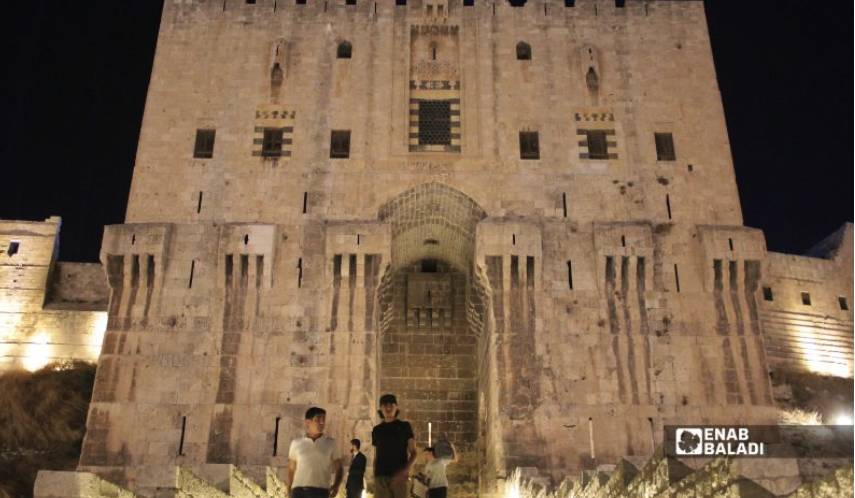
Aleppo Citadel hosted the launch event for the “Touristech” project on Sunday, September 27. The project uses technology to promote Syrian heritage and improve the visitor experience, and it coincided with World Tourism Day celebrations.
The event, which Enab Baladi attended, was held under the patronage of the Ministry of Tourism and the Aleppo governorate, with the participation of Minister of Tourism Mazen Al-Salhani and Aleppo Deputy Governor Ali Hanoura. It was organized by the International Junior Chamber (Beroya) and the Northern Region Tourism Chamber, in cooperation with the Directorate of Antiquities and Museums, and sponsored by the Qatani Group.
The program included performances by Circassian, Armenian, and Kurdish troupes, along with a heritage revival troupe, as part of an effort to highlight the cultural diversity that distinguishes the city of Aleppo.
What Is the “Touristech” Project?
According to the project’s introductory presentation during the ceremony, “Touristech” aims to change how archaeological sites are visited, starting with Aleppo Citadel, without altering anything tied to the sites’ identity or history. Instead, it uses technology to bring history closer to visitors and make it clearer and more interactive.
The project turns a visit to the citadel into a journey with multiple stops. At each stop, visitors can learn the story of the place through interactive units and screens, and they can also use a QR code to access additional information and materials, including photos, maps, and site-related content.
As a result, the visitor’s experience is not limited to viewing an archaeological site. According to the presentation, it helps visitors understand what happened there, who passed through, and why the site gained its historical importance.
The experience does not begin at the citadel gate, as the project also includes an online platform and an open digital archive for Aleppo Citadel.
The platform allows access to the project’s content from anywhere before, during, and after a visit, with the aim of presenting the citadel’s history in a simpler and more accessible form.
The content is offered in Arabic and English, given that the story Aleppo Citadel carries is not limited to the city’s residents but forms part of Syria’s history and heritage.
Moving Toward “New Tourism”
During the ceremony, which Enab Baladi attended, Minister Salhani said that tourism is an engine of the economy, a space where cultures meet, and a source of job opportunities.
According to Minister Salhani, the choice of “Digital and Artificial Intelligence to Redesign Tourism” as the theme for World Tourism Day reflects the future direction of the sector.
He said the challenge lies in turning archaeological sites into sustainable economic value that benefits citizens, society, and the state.
He pointed to what he described as tangible achievements in the recent period, including a return to growth in arrivals, the reopening of a number of tourist facilities, and a rising pace of rehabilitation and investment.
According to him, these indicators are not merely dry figures but reflect a return of confidence and the tourism sector’s ability to recover.
On investment, Minister Salhani said the ministry has moved to managing projects by controlling economic returns and protecting public funds, and has launched what he described as high-caliber projects. He said these reflect a shift toward building integrated tourist destinations rather than settling for individual tourist facilities.
Minister Salhani added that the ministry does not want Syria to return to old-style tourism. Instead, it is working to establish a new tourism based on quality before quantity, one that treats the local community as a partner in development rather than a recipient of its effects.
He noted that work has begun on building a modern oversight and quality system that relies on data, monitors the performance of facilities, and encourages them to keep going. The work also includes a transition from paper-based to digital management and the linking of tourism offices within a unified national structure that collects information and handles bookings, payments, services, and visas.
According to Minister Salhani, artificial intelligence will be part of this vision in the coming phase – not as a substitute for humans, but as a tool for analyzing markets, improving the visitor experience, and directing investments.
The national tourism plan, according to the minister, aims to diversify the Syrian tourism product to include cultural, religious, medical, and rural tourism, and to put Syria back on the global tourism map. It also aims to create new job opportunities and expand the benefits of tourism activity for local communities.
Minister Salhani pointed to Syria’s return to international exhibitions and to the global tourism dialogue, as well as work on building partnerships, opening markets, and attracting investment.
He also called on investors to view Syria as a destination offering opportunities in hotels, resorts, restaurants, and cultural routes.
Aleppo a Priority
During a press conference he held with media outlets on the sidelines of the event, which Enab Baladi attended, Minister Salhani said there are directives from Syrian President Ahmad Al-Sharaa to make the city of Aleppo one of the top priorities in the coming phase.
He added that a large number of projects will be launched in the city, noting that tourist routes will be introduced to coincide with the “Aleppo Summer Season” and the “Aleppo Tourism Season.”
Minister Salhani considered tourism in Syria to be much better than before, in his words, with modern technologies and artificial intelligence now being employed in the sector. According to him, these factors will help encourage tourists to visit Syria.
He also spoke of programs to develop and rehabilitate hotels, aimed at providing accessible tourism at prices he described as reasonable and suitable for different groups.
Digitizing Sites
Bishr Hawout, head of the International Junior Chamber (Beroya) Foundation, said the “Touristech” project is an initiative to digitize tourism that began at Aleppo Citadel. It places six platforms at different points in the citadel, with screens and QR codes that let visitors access information about the site and its story.
Mr. Hawout told Enab Baladi that the information available through the platforms, whether published on websites or included in video material, was verified and approved by the Directorate of Antiquities and Museums. He said the information is available in seven languages approved by the Ministry of Tourism.
The project’s points in Aleppo Citadel are distributed across the Bashoura, which is the citadel’s entrance, Imam Al-Khidr, the Great Mosque, the Byzantine Hall, and the Throne Hall.
Mr. Hawout said that presenting the story of each site aims to turn visitors from recipients of information into people able to share their experience and what they saw with others, thereby helping to promote tourist sites.
According to Mr. Hawout, the project is preparing a procedures guide for digitizing tourist sites that could be adopted nationally. Applying it would allow different tourist and archaeological sites across Syria to be digitized, and the project intends to expand the experience to include Samaan Citadel, the Great Mosque, and other sites.
The project was launched to coincide with World Tourism Day. According to Mr. Hawout, it is meant to be an experience that can be expanded to other sites, as part of an effort to create a sustainable impact from tourism digitization in Syria.
A Unique History
In this context, journalist Nour Haddad said that, through the World Tourism Day event, Aleppo Citadel bears witness to the city’s deep-rooted heritage and history. She considered that Aleppo, given its heritage and historical distinctiveness, deserves to be at the forefront of tourism attention.
Ms. Haddad told Enab Baladi that over time, the city has seen a clear difference in the condition of its roads and in organization, despite criticisms and remarks. She added that Aleppo is generally experiencing a revival, with work and efforts underway to improve conditions there.
She considered that Aleppo’s distinctiveness and the stories tied to its long-standing character make it a city that deserves more support and care, noting that directing tourism attention to it could introduce visitors to its history and heritage.
She noted that the Ministry of Tourism and the Aleppo governorate are working to support and encourage tourism in the city by holding events, concerts, and activities that encourage people to visit, adding that real work is underway but requires more effort.
Ms. Haddad pointed to the importance of the role of the city’s residents and media workers in promoting Aleppo and highlighting the work taking place there, considering that spotlighting these efforts helps draw the attention of visitors from outside the city.
This article was translated and edited by The Syrian Observer. The Syrian Observer has not verified the content of this story. Responsibility for the information and views set out in this article lies entirely with the author.