Since the fall of Bashar Al-Assad’s regime on December 8, 2024, the new Syrian government has redrawn its network of foreign relations on a wide scale.
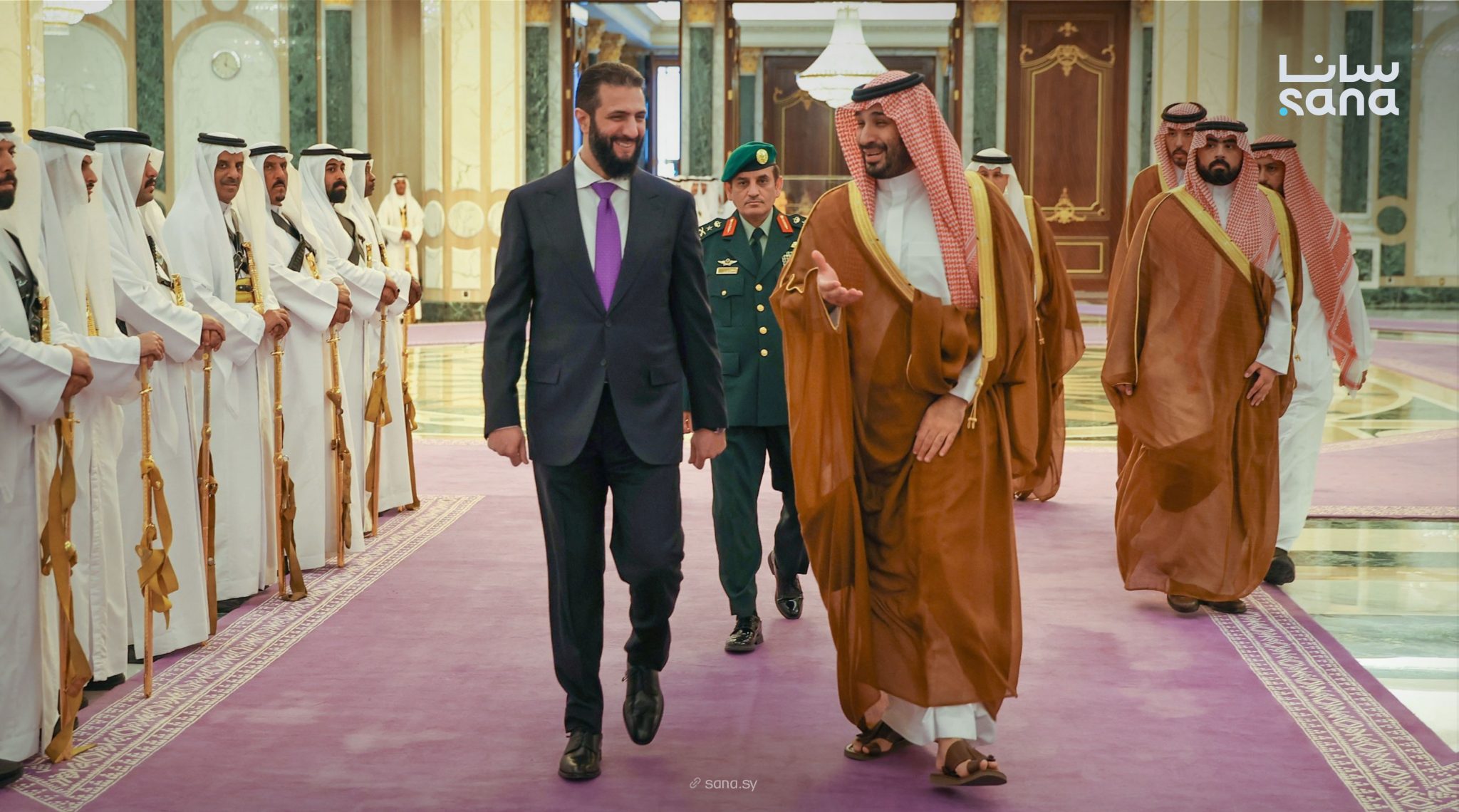
Damascus opened up to Arab countries, Turkey, the United States, and Europe. In a step that stirred a degree of controversy, it also reopened a page with Russia, which was among the most prominent political and military backers of the Assad regime and whose forces took part directly in the war after its military intervention in 2015.
But this Syrian pragmatism has so far stopped at Iran. Relations between the two countries have remained frozen, despite nearly two years since the fall of the ousted regime. During that time, the new Syrian government has been busy reviving Syrian diplomacy and working under a balance-of-power theory, through strong relations with the main international and regional actors and with other states of economic or geopolitical importance.
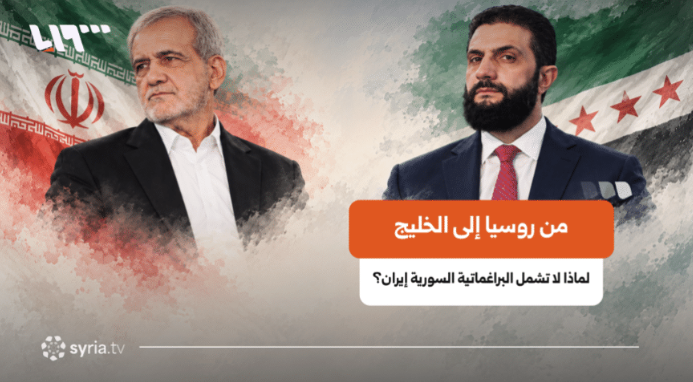
The question of the future of Syrian-Iranian relations returned to the fore after remarks by Iranian President Masoud Pezeshkian in an interview with Al Jazeera from New York in September 2026. He said his country had not been able so far to establish a relationship with the new Syrian government because of what he described as “the impression they created.”
He expressed hope that Damascus would act on the basis of “Islam, religion, justice, and fairness,” adding that working according to religion and the Sunnah of the Prophet, in his view, would remove the problem.
The Syrian response came quickly from Mohammad Al-Jafal, adviser for Afro-Asian affairs at the Syrian Foreign Ministry. He tied the possibility of establishing future relations with Tehran to the latter’s review of its policies and its respect for Syria’s sovereignty.
In a statement to the Syrian Arab News Agency (SANA) on Sunday, Mr. Jafal affirmed that Damascus’s position on Iranian policy is not tied to a passing political circumstance. He said it rests on an experience spanning about 14 years, during which, according to him, Iran supported the ousted Assad regime through the years of war in Syria.
He said Tehran’s alignment with the former regime contributed to complicating the Syrian crisis and increasing Syrians’ suffering, adding that this background cannot be bypassed when discussing the future of relations between the two countries.
He explained that Syria today follows a policy open to countries around the world but does not see the possibility, at the same time, of ignoring what the country witnessed over the past years or bypassing Syrians’ rights.
Mr. Jafal added that any Iranian move to build a new relationship with Damascus should be based on respect for the sovereignty of the Syrian state and the will of its people, along with a review of past policies and work to rebuild trust between the two sides.
The Syrian official stressed that Syria is “not an arena of influence for any country” and that its foreign relations will be built on mutual respect, national interests, and equality. He affirmed that Damascus does not seek hostility with any country, nor does it accept subordination to any party, but looks forward to building balanced relations that respect its sovereignty and its people’s choices.
The new Iranian statements appear to have forgotten or ignored what the Iranian regime did over 13 years in Syria, as if nothing had happened. Meanwhile, some try to present Russia and Iran as equivalent in their political and military backing of the regime against the Syrian Uprising.
In truth, Russia was not far from the Syrian war, and its intervention was no less impactful. It is in fact well known that it came at Iran’s direct coordination and request, after the enormous losses the regime suffered at the hands of rebel factions. But the matter grows more complicated when we get into the details. Why should the Syrian government restore relations with one state and not the other, when until recently both were enemies of Syrians and caused the forced displacement, flight, and killing of tens of thousands of them, if not hundreds of thousands?
What Did Iran Do in Syria?
Iranian influence in Syria did not begin in 2011, although the Uprising marked the moment when this influence moved from political alliance and cultural and religious infiltration to direct, wide-ranging military intervention.
For decades before the Uprising, Iran worked to build a gradual religious and cultural presence inside Syria, benefiting from its close relationship with the Assad regime. Syrian researcher AbdulRahman Al-Haj documents the stages of this expansion in his book The Shia Baath in Syria 1919-2007. He traces it from limited religious activity to the building of a broader network of hawzas (Shia seminaries), husseiniyas, and educational and religious institutions, particularly in Damascus and around the Sayyida Zainab shrine.
Mr. Haj notes that the Bashar Assad era, especially since the turn of the millennium, saw noticeable expansion in the creation of hawzas and institutions linked to Shia activity, some of them outside the traditional frameworks of the Syrian Ministry of Endowments.
Iranian cultural institutions, including the cultural attaché’s office and cultural centers, played a role in this soft presence. It ran alongside investment in religious shrines and the hosting of Shia clerics, students, and visitors from Iran, Iraq, Lebanon, and other countries.
The Sayyida Zainab area also gradually expanded into a regional religious center, according to the Washington Institute. It came to include hawzas, educational and religious institutions, and economic networks tied to religious tourism.
With the outbreak of the Syrian Uprising in March 2011, Iran’s role moved to an entirely different level. From the first weeks, Iranian official discourse treated the Syrian protests as an external conspiracy rather than an internal protest movement. In April 2011, Iranian Foreign Ministry spokesman Ramin Mehmanparast described the protests as “the product of Western, American, and Israeli interference,” adding that they “do not reflect the will of the majority.” At the time, Tehran was backing protests and revolutions in other Arab countries and describing them as an “Islamic awakening.”
Although Iranian rhetoric later shifted somewhat, and Foreign Minister Ali Akbar Salehi described the protesters’ demands as “legitimate” in August 2011, the strategic position remained aligned with the survival of the Assad regime. That position was based on Syria’s place in Iran’s regional influence network and its relationship with Hezbollah. In March 2012, Iranian Supreme Leader Ali Khamenei declared clearly that his country would defend Syria, linking this to its role in what Tehran calls the “axis of resistance.”
As the Conflict widened and the regime’s forces weakened, Iran did not settle for political and economic support but moved to direct and indirect military intervention. It sent advisers from the Revolutionary Guards and the Quds Force, provided weapons and funding, and helped build and support sectarian armed formations. It also played a pivotal role in the Lebanese Hezbollah’s entry into the war alongside the regime.
But one of the most sensitive elements of Iranian intervention within Syrian society was the bringing in of militias from outside the country, within formations with a clear sectarian identity.
The militias Iran brought into Syria included Iraqi, Lebanese, Iranian, Afghan, Yemeni, Palestinian, Bahraini, and Syrian militias. The most prominent were Lebanese Hezbollah, the Iranian Revolutionary Guards, the Afghan Fatemiyoun Brigade, Harakat Al-Nujaba, Kataib Hezbollah (Iraq), Asaib Ahl Al-Haq, Kataib Sayyid Al-Shuhada, the Abu Al-Fadl Al-Abbas Brigade, the Imam Ali Brigade, and Saraya Al-Khorasani. Dozens of other formations brought the total to more than 30 official groups. This diversity and reach reflected how heavily Iran relied during the Syrian war on a broad network of cross-border armed forces, rather than on its regular forces alone, according to the Carnegie Center.
This branded the Syrian Uprising with a sectarian dimension that Syrians were far from. It also deepened among wide segments of Syrians the belief that Iran was not merely defending a political ally but reshaping the country’s security and social sphere through cross-border forces.
Perhaps the worst part of those sectarian militias’ discourse was the raising of slogans about “defending the shrines,” as if these shrines had not existed before the founding of the Iranian republic. A number of shrines and their surroundings, particularly in Damascus and Rural Damascus, turned from religious spaces into points of military and security importance. Areas such as Sayyida Zainab became centers of gravity for fighters tied to Tehran and its allies. Sectarian rituals carried out around the Umayyad Mosque in Damascus added to the popular resentment.
How Did Iran Work to Change Syria’s Demographic Composition?
As the war progressed and millions of Syrians were displaced by Iranian and Russian bombardment backing the regime’s army, a more complicated issue emerged, concerning demographic change and property ownership.
Reports and studies discussed efforts by Iran and its allies to entrench a loyal population presence in strategically important areas. These included the area around Damascus and the road extending toward the Lebanese border, as well as areas in Deir-ez-Zor and Al-Boukamal, according to the Middle East Institute in Washington.
Sources spoke of property purchases, exploitation of residents’ departure or displacement, and the settlement of families tied to Shia fighters or loyal to Iran in some areas, according to an Atlantic Council report.
Reports also addressed the benefit that Iran- and Hezbollah-linked entities gained from urban reorganization laws, including Law No. 10 of 2018. The law drew wide criticism over fears that displaced people and refugees would lose their properties if they were unable to prove ownership rights or return to their areas.
Studies pointed to extensive property purchases in Damascus and its surroundings by entities linked to Iran or its allies, while noting the difficulty of independently verifying all the figures in circulation on the issue, according to Human Rights Watch.
This coincided with the expansion of Iranian religious and cultural institutions’ activity in several areas, and with the establishment of husseiniyas, hawzas, schools, and religious centers, particularly where Tehran-backed groups held military and security influence. A U.S. State Department report on religious freedom also recorded activity by Iran-backed groups encouraging conversion to Shia Islam in parts of the Euphrates Valley.
Hence, for Tehran’s opponents, talk of Iranian influence in Syria was no longer only about bases or military advisers but about a broader project encompassing religion, education, the economy, real estate, and the demographic structure.
Control of the Economy
Alongside its military and sectarian presence, Iran sought to entrench long-term economic influence. Tehran provided the Assad regime with credit lines, oil supplies, and billions of dollars in financing. It later worked to obtain concessions and investments in multiple sectors, including telecommunications, energy, construction, and real estate.
Studies indicate that Iranian economic activity was not separate from its political strategy but part of an attempt to convert military influence into a long-term presence that would be hard to dismantle even after combat operations ended.
In the real estate market specifically, the economic collapse, widespread displacement, and falling property prices gave entities linked to the regime and its allies the opportunity to buy properties at low prices. Reports also pointed to forced sales by Syrians who feared confiscation or could not return to their areas. Individuals or networks tied to Iranian entities or to the militias benefited from these sales.
For this reason, it is hard to reduce the former Syrian-Iranian relationship to an alliance between two regimes alone, or to military, financial, or political support. Reports and research indicate that Iran’s role extended from political backing of the regime to direct military participation, the bringing in of foreign fighters, and the building of parallel armed formations. It also included the expansion of religious, cultural, and economic networks and an attempt to secure long-term influence in areas of geographic and social sensitivity.
This makes the Iranian legacy different in nature from a mere external relationship with a state that supported Assad. It is a legacy intertwined within society, institutions, security, and the economy itself, which explains a key part of the difficulty of moving directly to a normal diplomatic relationship with Tehran.
Even so, when the Deterrence of Aggression operation advanced and managed to topple the regime, its forces preserved the safety of diplomatic missions, attaché offices, and properties belonging to the Iranian embassy in Damascus. The rebels did not act with retaliatory reactions, and no religious shrine was harmed, whether by armed factions or by Syrian citizens associated with the Uprising.
What Are the Similarities with Russia?
The comparison with Russia remains the most complicated knot in explaining Damascus’s position on Iran. Moscow was no less clear in its alignment with Bashar Assad’s regime, and its intervention in Syria was not merely political or diplomatic. It entered the war militarily and directly on September 30, 2015, and its air force decisively shifted the balance of power on the ground in the regime’s favor.
The Syrian Network for Human Rights notes that Russian forces, from their military intervention until the fall of the Assad regime, caused the deaths of thousands of civilians, including children and women. The network documented hundreds of massacres and more than 1,000 attacks on vital civilian facilities, including schools, medical facilities, and markets. It also says a pattern of documented Russian violations amounts to war crimes and crimes against humanity.
Amnesty International, for its part, documented attacks on residential areas, hospitals, and civilian facilities from the first months of the Russian intervention. It said some Russian strikes appeared to have directly targeted civilians or civilian objects, and that some may amount to war crimes.
Thus, the resumption of relations with Moscow cannot be explained by absolving Russia of its legacy in Syria or by considering its intervention less bloody. On the contrary, Syrians are still raising the issues of the violations and crimes Russia committed against Syrians, the handover of Assad, and compensation for damages.
Russian influence, despite its violence, its wide-ranging violations, and the unequal interests it imposed during the Assad era, remained at its core a geopolitical, military, and economic influence led by a state. It operated through official bases, agreements, military institutions, and economic contracts, some of which may be subject to review under the new rule.
The Iranian model went beyond that, building an influence network in which the state overlapped with the Revolutionary Guards, Hezbollah, Iraqi, Afghan, and Pakistani militias, and local formations. This ran in parallel with religious, cultural, and sectarian activity that predated the Uprising and expanded after it, amid the Iranian government’s continued denial of all of it.
The reports documenting the Russian presence in Syria show no parallel structure of hawzas and husseiniyas, and no organized religious activity aimed at changing the sectarian identity of Syrian society. Nor does Russian strategy show anything comparable to the use of religious shrines or the bringing in of armed groups under sectarian slogans such as “defending the shrines.”
Likewise, although the Russian intervention was tied to massive displacement and forced migration resulting from bombing and military operations, the sources I reviewed provide no evidence that Moscow adopted an organized project to reshape the sectarian composition of the population. They also show no plan to replace displaced residents with groups tied to it as a Russian strategic goal. This differs from the accusations and reports linked to the influence of Iran and its allies in several Syrian areas, particularly regarding property purchases, the settlement of families tied to loyal fighters, and the expansion of religious and cultural institutions in strategic areas.
Although Russian airstrikes continued until December 7, 2024, Moscow ultimately refrained from entering an open military confrontation to save Assad. After his fall, it began looking for a formula that would preserve its interests with the new authority. Meanwhile, Iranian Foreign Minister Abbas Araghchi was in Doha on the eve of the regime’s fall, discussing how to persuade the Russians to work to save it.
Is the Rupture Final?
If we try to approach the Iranian file with a purely pragmatic political logic that transcends all that has passed, the official Syrian position does not point to closing the door on Iran permanently. But it ties any future relationship to Tehran’s review of its policies and its respect for Syria’s sovereignty and the will of its people.
Even so, restoring relations does not appear beneficial to Damascus politically, economically, or socially under the current circumstances. The new Syrian government has built a different network of regional relations, based on strengthening ties with Saudi Arabia, the Gulf states, Turkey, and the West. These parties still have deep disagreements with Iran and its armed networks. The U.S.-Israeli war against Iran has also heightened the sensitivity of any Syrian rapprochement with it, at least for now, as Syria is neither for the war nor with Iran.
Added to this is the security dimension. Tehran still maintains ties with groups and networks formed during the era of the ousted Assad, whether through its allies in Iraq and Lebanon or through some parties inside Syria. This raises fears that these ties could be used to influence internal stability.
For this reason, the issue is currently not only about reopening an embassy or diplomatic mission, or about taking a photo of a meeting. It is about whether Iran is ready to deal with Syria as an independent state outside the “axis of resistance” framework and without armed instruments of influence parallel to the state. Until that becomes clear, the cost of resuming relations appears higher than its potential benefits for Damascus.
This article was translated and edited by The Syrian Observer. The Syrian Observer has not verified the content of this story. Responsibility for the information and views set out in this article lies entirely with the author.