Want to bookmark your favourite articles and stories to read or reference later? Start your Independent Membership today.
Join today
Already a member?
Log in
Your support helps us to tell the story
From reproductive rights to climate change to Big Tech, The Independent is on the ground when the story is developing. Whether it’s investigating the financials of Elon Musk’s pro-Trump PAC or producing our latest documentary, ‘The A Word’, which shines a light on the American women fighting for reproductive rights, we know how important it is to parse out the facts from the messaging.
At such a critical moment in US history, we need reporters on the ground. Your donation allows us to keep sending journalists to speak to both sides of the story.
The Independent is trusted by Americans across the entire political spectrum. And unlike many other quality news outlets, we choose not to lock Americans out of our reporting and analysis with paywalls. We believe quality journalism should be available to everyone, paid for by those who can afford it.
Your support makes all the difference.Read more
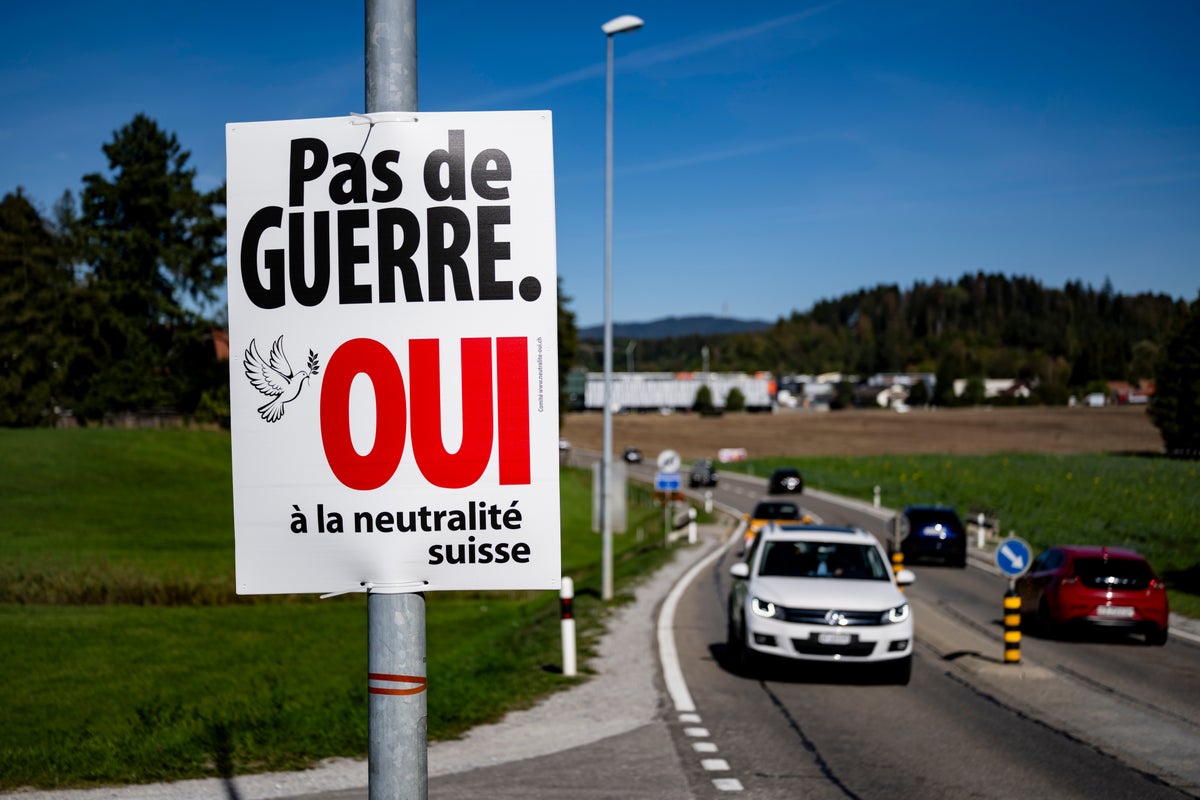
Voters in Switzerland are deciding Sunday on a proposal to strengthen the country’s vaunted neutrality. The referendum is supported by a right-wing populist party that insists the Swiss government has gravitated too close to the European Union and NATO, notably over Russia’s war in Ukraine.
Backers of the plan championed by the Swiss People’s Party want Switzerland to reinforce its commitment to neutrality that has been enshrined in the constitution since the mid-19th century and has faced years of debate over what that neutrality really means.
The party, which has the most seats in parliament and counts some members with pro-Russia leanings, has bristled over the Swiss federal government’s decision to join EU sanctions against Russia over what the government calls Russia’s “war of aggression” against Ukraine.
The measure would prohibit the government from joining sanctions against any belligerent country except sanctions approved by the United Nations. Russia wields a veto on the U.N. Security Council as one of its five permanent members.
Switzerland is not a member of any military alliance. Passage would bar the Swiss government from cooperating with any alliance — as it has with NATO for three decades, including through joint exercises — except in cases of threat.
Supporters say Switzerland’s commitment to neutrality must be reaffirmed and defended in light of every conflict, and claim that the government has moved “dangerously close” to the EU and NATO in ways that threaten Switzerland’s security and independence of action.
Opponents, including the federal government and parliament, say the constitution already gives the federal government the leeway it needs to protect national interests.
In Swiss democracy, voters typically cast ballots four times a year as a way to give the public a direct say in policymaking.
The Swiss government is led by an executive branch whose seven members come from across the political spectrum and make decisions by consensus.
The Swiss presidency rotates each year among its members and the largely ceremonial role of president, currently Guy Parmelin of the Swiss People’s Party, is considered a first among equals.