The clock is ticking, the election campaign is in full swing, and political rivals are answering a series of questions in front of television cameras, seeking to present themselves to voters in the best possible light.
TV debates have been held in many countries for more than six decades, from the United States, where the format originated, to the United Kingdom, France and several countries in the Balkans.
In Serbia, the format has been largely neglected in recent years, with face-to-face encounters between political rivals reduced to the occasional programme.
Ahead of Serbia’s snap parliamentary election on 25 October, TV debates between opposing candidates are among the most talked-about issues. For years, Serbia has lacked genuine dialogue between different political camps, as opponents are obstructed through various tactics – often interruptions, disinformation and loud speeches, says Dobrivoje Stanojević, a professor of stylistics and rhetoric at the Faculty of Political Sciences in Belgrade.
“Even when something meaningful is said, it cannot really be heard properly, which is indicative of the lack of a culture of dialogue,” Stanojević told BBC Serbian.
Since 2012, when the Serbian Progressive Party (SNS) came to power, there has not been a single traditional TV debate, despite invitations being extended.
Ahead of the 25 October election, Aleksandar Vučić, Serbia’s president, the lead candidate on the ruling Serbian Progressive Party (SNS) list and its former leader, challenged Ilija Srdanović, the lead candidate on the ‘Students Will Win’ list, to a TV debate. Srdanović declined the invitation.
The appearance of dialogue – and far more monologues
In recent years, there have been verbal clashes between political rivals in Serbia in front of television cameras, primarily on programmes broadcast by the public broadcaster, Radio Television of Serbia (RTS), which is partly funded by taxpayers.
Even when some form of debate takes place, it is not conducted on an equal footing, because the majority of Serbian media outlets do not allow both sides to participate on an equal basis, Stanojević says.
“What I particularly notice in media outlets close to the authorities is that there is one side and another that merely pretends to be the other side, when in substance it is not. Dialogue is a circular flow of words, whereas here you have attempts to persuade and repetitions of what amounts to propaganda,” he adds.
The view that Serbia has more monologues than dialogue is also shared by Krešimir Macan, who for many years served as a media adviser to Andrej Plenković, the prime minister of Croatia.
“The president appears frequently, but he generally appears on his own. Genuine debates could be a breath of fresh air for viewers and an opportunity for them to hear something new, and I believe they would watch them,” he told BBC Serbian.
Can they encourage undecided voters to turn out?
The first televised face-to-face debate between two political candidates was held in the United States on 26 September 1960.
John F. Kennedy, the charismatic and persuasive Democrat, successfully “outperformed” the nervous Republican Richard Nixon, who had been ahead in opinion polls and surveys. The verbal duel gave Kennedy a boost, and he went on to be elected US president.
Something similar happened in Serbia in 2008.
Tomislav Nikolić, then the presidential candidate of the newly established Serbian Progressive Party (SNS), which had emerged from a split in the Serbian Radical Party (SRS), saw his ratings rise after a debate with Boris Tadić, who was seeking a second term. What Nikolić failed to achieve then, however, he accomplished in 2012, when he was elected president of Serbia.
2008 TV debate between Boris Tadic and Tomislav Nikolic
The purpose of a televised debate is to allow the leading political candidates to present themselves directly, without intermediaries, and to show voters what they are really like, Macan, a political marketing consultant in Croatia, explains.
“During election campaigns, participants focus heavily on TV debates, which are generally aimed at undecided voters or those who are unsure whether to vote at all. However, research has shown that economic issues have the greatest influence on such voters,” he adds.
Research shows that the impact of this kind of media content and political performance on undecided voters is very small, says Nick Anstead, a professor at the London School of Economics and Political Science. “They are less politically engaged, so they are also less likely to watch this kind of content. But in countries where debates between political opponents are not particularly common, TV debates attract more interest than they would if they were simply part of the normal electoral culture,” he said in a written response to BBC Serbian.
Can televised debates encourage voters in Serbia to turn out in greater numbers, given that this will be the 15th election in 36 years since the introduction of a multi-party system?
The likelihood of television programmes mobilising voters under the current circumstances is small, Professor Stanojević believes, because there are more and more people who are disillusioned and no longer trust anyone.
“Such debates cannot have much of an impact, because you cannot hear the arguments of both sides – these are one-sided conversations, generally between a media-dominant side and a powerless one. When there is no equality, and it can sometimes be difficult to establish even in more orderly societies, there can be no genuine dialogue either. All we have is a duel in which we already know the winner,” Professor Stanojević says.
People are also becoming increasingly polarised, he adds, which means they do not approach this kind of content objectively.
Psychological research has shown that 90 per cent of people do not question whether they should vote or not, said Kaja Damnjanović of the Department of Psychology at the University of Belgrade’s Faculty of Philosophy.
“People make their choices on the basis of two factors: ideology and the image of the politician, which includes their humanity, honesty and ability to be a leader. When things are uncertain, we tend to change. When we are comfortable, we do not like to change,” she explained ahead of the December 2023 election.
Character matters more than content
Since Kennedy and Nixon, politicians around the world have become increasingly aware of television’s influence, paying ever greater attention to their non-verbal performance in front of the cameras.
The focus was primarily on political issues, the tone was sometimes sharp, but generally civil.
And people watched. Research shows that from the 1960s to 2016, such programmes in the United States attracted between 60 million and 90 million viewers. Much has changed in America since then, including the way political communication is conducted, often accompanied by personal insults – something that can cost candidates an election.
A particularly telling example was the 2020 debate between Democratic candidate Joe Biden and Republican Donald Trump. Whether or not the debate influenced voters, Biden went on to enter the White House in 2020. Four years later, however, Biden’s speech difficulties and apparent confusion were so conspicuous that he did not continue in the presidential race, Ben Sullivan of the Media and Journalism Political Science Centre noted.
2020 debate between Democratic candidate Joe Biden and Republican Donald Trump
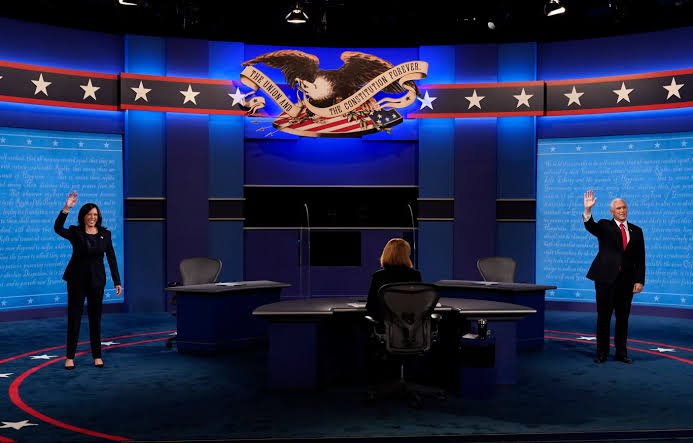
The Democratic Party leadership decided to put forward Kamala Harris, then US vice-president, as its presidential candidate instead. The first televised debate between Trump and Harris was marked by fierce criticism and personal insults.
“Harris used skilful rhetoric and composure to dampen Trump’s aggressiveness, provoke a reaction from him and divert attention away from political issues,” Sullivan wrote in Debates or Dramas?: How TV Debates Are Changing in US Elections.
Nevertheless, this did not help Harris, as Trump won and returned to the White House for a second time. The importance of how a candidate presents themselves is also illustrated by an example from the Balkans in 2010.
The candidates for president of Croatia that year were Milan Bandić, who later became mayor of Zagreb, and Ivo Josipović. “There was a set of questions about the European Union and Bandić simply said that he did not know the answers and had not prepared. Preparation was what made the difference,” Macan says.
Ivo Josipović won that year, and Croatia joined the European Union (EU) in 2013.
Debates, yes – but only if they serve a purpose
In some countries, such as Canada, TV debates are regulated by law and are mandatory, Professor Nick Anstead points out.
In other countries, they are organised ad hoc, and there have been election cycles in which no debates took place at all. In the United States, for example, there was a 16-year gap between the Nixon-Kennedy debate and the next televised presidential debate.
Politicians generally agree to debates when they believe they stand to benefit from them, he says.
“Why are they absent in some countries? Because there is a political actor with veto power who sees debates as a potential risk. Usually this is someone in government, although it can also be someone from the main opposition. It takes an unusual combination of circumstances for both sides to conclude that they will benefit from such a confrontation,” he adds.
Krešimir Macan is convinced that many people would want to watch a debate between Vučić and a representative of the student list.
“How it would be moderated and organised is another question. But it should be understood that, if it happens, going up against Vučić will not be easy,” Macan concludes.
(BBC Serbia, 25.09.2026)
https://www.bbc.com/serbian/articles/c3y0z75j497qo/lat