Want to bookmark your favourite articles and stories to read or reference later? Start your Independent Membership today.
Join today
Already a member?
Log in
Your support helps us to tell the story
From reproductive rights to climate change to Big Tech, The Independent is on the ground when the story is developing. Whether it’s investigating the financials of Elon Musk’s pro-Trump PAC or producing our latest documentary, ‘The A Word’, which shines a light on the American women fighting for reproductive rights, we know how important it is to parse out the facts from the messaging.
At such a critical moment in US history, we need reporters on the ground. Your donation allows us to keep sending journalists to speak to both sides of the story.
The Independent is trusted by Americans across the entire political spectrum. And unlike many other quality news outlets, we choose not to lock Americans out of our reporting and analysis with paywalls. We believe quality journalism should be available to everyone, paid for by those who can afford it.
Your support makes all the difference.Read more
For months now, European leaders have been incrementally raising the alarm about the threat of Russian strikes on a Nato member.
The concerns are not unfounded as airspace violations across Europe have been increasing at an accelerating speed.
In one of the starkest warnings by a western security service yet, Danish intelligence said on Thursday that Moscow could launch an attack against Nato in months. It described the threat as of a “low but growing risk”.
A report by America’s Central Intelligence Agency (CIA) released on the same day suggested that Russia is preparing to carry out drone strikes in Europe targeting France, Spain and Italy from the sea.
In the same week it emerged that Russia has boosted its shadow fleet by more than one third as it looks to keep oil flowing.
Several European governments have been passed information about the Kremlin’s plans to escalate its interference on the continent, according to comments by an unnamed source close to the Lithuanian ministry of defence in Spain’s El Mundo.
Last week Poland voiced serious concerns that Russia’s hybrid attacks could launch into a real attack.
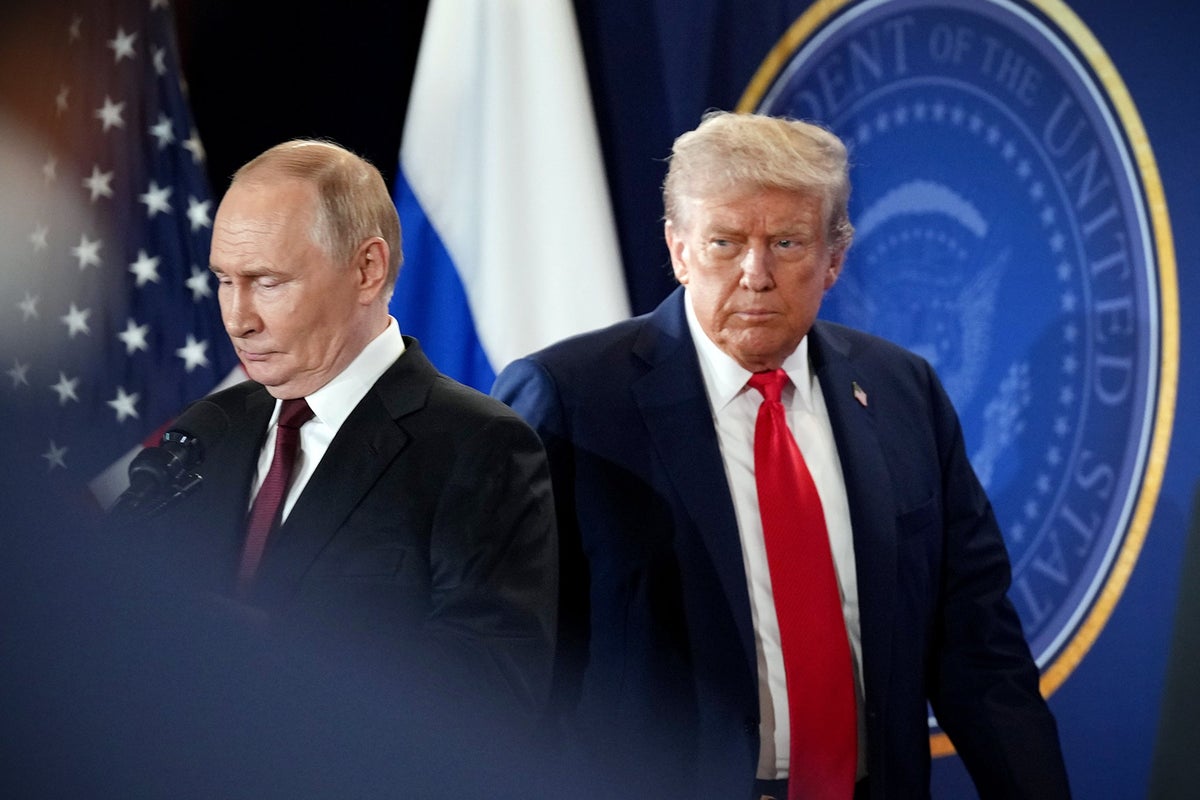
Putin is testing Nato’s resolve and Washington must side with the alliance, say experts (Getty)
But in an assessment of Russia’s ongoing kinetic campaigns against Europe, the Institute for the Study of War warned that despite the alerts “action is lagging behind words”.
Experts told The Independent that Europe has a number of weaknesses that could leave it exposed, including military shortages and political ambiguity that could cause in-fighting between supposed allies.
Weak critical supplies such as electricity, transport, communications and water could also pose a threat to the continued functioning of society.
What could a Russian attack on Nato look like?
“The danger is not a full-scale Russian invasion of Nato territory but a limited operation designed to test where the Alliance’s red lines really are — and whether its members could agree on how to respond,” says Katia Glod, deputy head of foreign
A limited kinetic attack to test unity
“The danger is not a full-scale Russian invasion of Nato territory but a limited operation designed to test where the Alliance’s red lines really are — and whether its members could agree on how to respond,” says Katia Glod, deputy head of foreign affairs at the New Eurasian Strategies Centre.
Glod says that Moscow would “try to present it as an accident or deny its involvement”, in a similar manner to what has already been seen with airspace violations across Europe. The aim of such a strike would be to “discover how far it could go without triggering a decisive collective response from Nato.”
“It could be a more overtly kinetic attack: a drone or missile strike on critical infrastructure or military facilities, an attack on maritime or undersea infrastructure, or another geographically limited operation,” she says.
A suburban train burns after it was hit by a Russian drone strike, amid Russia’s attack on Ukraine, in Kharkiv region, Ukraine September 18, 2026. (Reuters)
Ports and critical infrastructure impacted
Daniel Schatz, a Swedish political scientist who has previously held visiting scholar positions at Harvard, Stanford, Columbia and Georgetown, says that Russian military action could look like “a drone strike, an attack or critical infrastructure or a limited incursion”.
With Russia renowned for its attacks on Ukrainian transport and energy infrastructure throughout its invasion of Ukraine, Schatz says that Nato “must also protect the ports, railways, power supplies and communications on which its response would depend”.
“The military operation might be small, but the political stakes would be enormous,” he says. “A divided response could encourage further aggression; a miscalculation could trigger a much wider war.”
A view shows a damaged multi-storey apartment building following a drone attack in Kotelniki in the Moscow region on September 20, 2026. (AFP/Getty)
Sabotage and subterfuge
Experts also point to what Russia is already doing as another indicator of its risk.
“There’s the sabotage, the murders, all the stuff that’s been going on for years,” says Keir Giles, associate fellow of the Russia and Eurasia Programme at Chatham House and author of American Overthrow: Moscow’s endgame in its long war with Washington.
“There are the credible intelligence warnings where a Russian plot has been either detected before it’s been launched or has been intercepted by law enforcement, and that includes things the drones against southern Europe or putting incendiary devices on in cargo shipments indicating a willingness to inflict mass casualties.”
The threat of division
“Western intelligence warnings deserve serious attention, but war is not inevitable,” says Schatz.
“Putin does not have to believe he can defeat the alliance to take a dangerous gamble. He only has to believe he can divide it.”
With clear fractures between Nato and the US under Trump’s rule, the most powerful member of Nato could serve as a weak link in the unity of the alliance.
“Washington must leave no doubt that it will stand with its allies,” he says.
Glod adds that military weakness is only “part of the problem” and that Russia is “also adept at exploiting political ambiguity”.
“An attack can be carefully calibrated to leave governments arguing over whether it amounts to an armed attack and what the consequences should be,” she says.
A multipurpose helicopter NH90 of Bundeswehr is seen while landing during the “Red Storm Charlie” military exercise on September 24, 2026 in Hamburg, Germany. (Getty)
Is Europe ready?
Military weakness
In a defiant address at the United Nations General Assembly, Polish foreign minister Radoslaw Sikorski told Russia’s veteran foreign minister Sergei Lavrov: “You can still kill a great many people, but you cannot win.”
He pointed out that Vladimir Putin’s campaign has not been as successful as expected.
Sikorski warned: “Poland’s GDP is almost half of yours, Europe’s GDP is ten times larger and Nato’s GDP is 25 times larger.”
He added: “Stop threatening Europe and the world. Stop destroying Russia’s future. Sergei, I know you can hear me – tell your boss enough is enough.”
But despite the resources and a commitment by members to up their defence spending at the Nato summit in July, there are significant gaps in the defences of European countries.
“The West needs stronger air and drone defences, deeper ammunition stocks and reinforcements that can move quickly,” says Dr Schatz.
“Nato as a whole is more powerful militarily than Russia. But that should not obscure weaknesses in European preparedness,” says Glod.
“Britain, for instance, is only now expanding its homeland air and missile defence. Also years of post-Cold War cuts have left parts of the Armed Forces with limited mass (troops). Russia may choose to probe these gaps rather than confront Nato where it is strongest.”
Civil preparedness
(AFP/Getty)
Glod warns that readiness also extends “beyond the battlefield”.
“Preparedness is not measured only in missiles, aircraft and warships; it must also be judged by whether a society can continue functioning when critical supplies (electricity, communications, transport or water) are disrupted,” she says.
“Several European countries have placed much greater emphasis on civil preparedness, including advising households on how to cope independently during the first few days of a crisis.
“Britain has begun moving towards this whole-of-society approach, but there is still a considerable gap between acknowledging that requirement and making the population genuinely resilient.”
She warns: “If Russia believes it can cause disproportionate disruption by striking critical infrastructure, then this vulnerability could become an incentive to act.
“On the contrary, a society that can absorb and recover from disruption is harder to intimidate and less attractive to probe.”