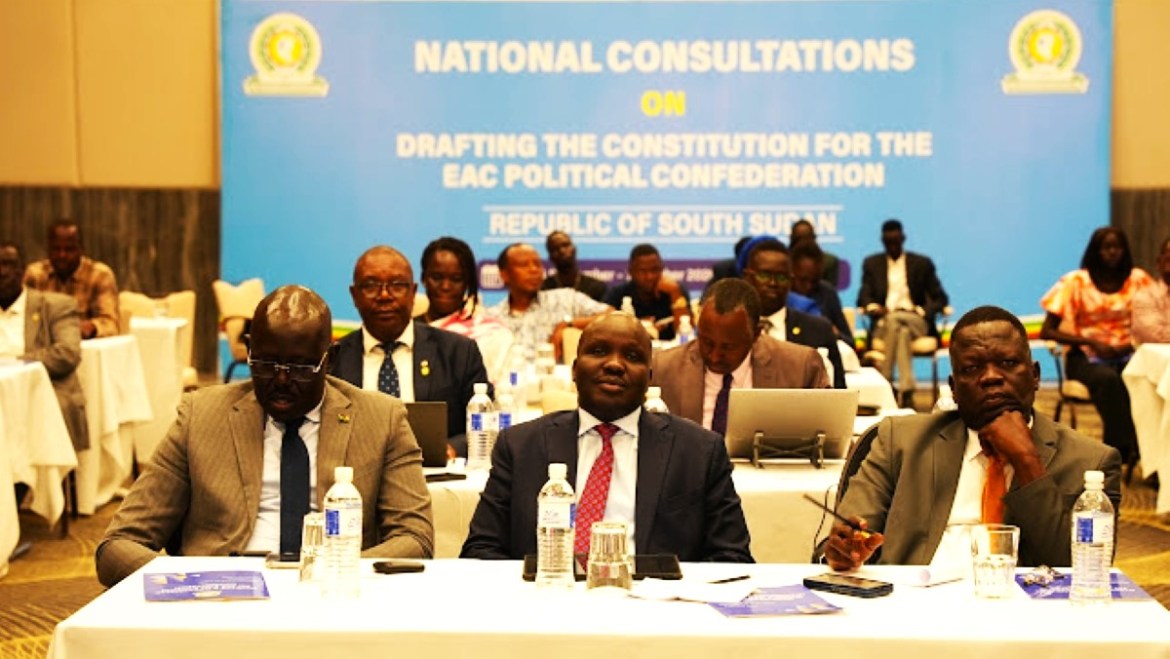
The East African Community’s political integration agenda has taken another step forward as the Republic of South Sudan begins national consultations on the drafting of the Constitution for the EAC Political Confederation.
The consultations, launched in Juba, South Sudan, on 24th September 2026, will run until 7th October 2026 and aim to gather the views, aspirations and expectations of citizens on the proposed Political Confederation, ensuring that East Africans actively participate in shaping the future direction of the region.
The Political Confederation is a transitional model towards the ultimate goal of a Political Federation of the East African Community.
It is intended to provide a framework for deeper political cooperation, coordination and governance among EAC Partner States.
The consultations will be conducted by a Team of Constitutional Experts coordinated by the Ministry responsible for EAC Affairs in the Republic of South Sudan.
The Experts will conduct public hearings in Juba, covering both the Federal and Central Equatoria governments, as well as in Rumbek, Wau and Bor.
Speaking during the launch, South Sudan’s Minister of East African Community Affairs, Michael Makuei Lueth, reaffirmed South Sudan’s commitment to the regional integration process and welcomed the opportunity for citizens to contribute directly to shaping the future of the Community.
“As South Sudan, we are committed to participating actively in this consultation process and ensuring that the voices, aspirations and interests of our people contribute to shaping a Constitution that will guide the establishment of the EAC Political Confederation,” he said.
The Minister encouraged citizens to openly share their views and expectations on the proposed Political Confederation, noting that public participation would be critical in shaping a constitutional framework that reflects the interests of East Africans.
The EAC Secretary General, Stephen P. Mbundi, started by recognizing the importance of the ongoing political transition and democratization process in the Republic of South Sudan.
He congratulated the leadership of Salva Kiir Mayardit on the progress made in implementing the Revitalized Agreement on the Resolution of the Conflict in the Republic of South Sudan.
“The East African Community stands in solidarity with the people of the Republic of South Sudan and wishes them a successful and peaceful election,” he stated.
He further highlighted that the consultations will bring together a broad spectrum of stakeholders, including government institutions, Parliament, the Judiciary, academia, civil society, the private sector, youth, women, persons with disabilities, faith-based organisations, political parties and the media.
South Sudan is now the 5th EAC Partner State to conduct the national consultations, which have taken place in the Republic of Uganda, Republic of Kenya, Republic of Burundi and Republic of Rwanda.
The Chairperson of the Constitutional Experts Team and Chief Justice Emeritus of Uganda, Benjamin Odoki, highlighted the importance of citizen participation in strengthening the draft Constitution.
“The Constitution belongs to the people of East Africa. We therefore encourage all stakeholders to actively participate and share their views so that the final document reflects the aspirations, interests, and expectations of our citizens,” he said.
On his end, East African Community’s Deputy Secretary General responsible for Infrastructure, Productive, Social and Political Sectors, Hon. Andrea Aguer Ariik Malueth, noted that despite being EAC’s youngest nation, the people of South Sudan have a lot to offer in this constitution-drafting process.
“From the power of regional solidarity and unity of purpose during the struggle for independence to dialogue, tolerance and peaceful resolution of disputes during the country’s civil war, the lessons and best practices are many,” he stated.
South Sudan’s Undersecretary in the Ministry of East African Community Affairs, Mr. Kawaja Kau Madol, reaffirmed the Government of South Sudan’s commitment to the process and assured the experts of the support of the Government in both the consultations and implementation of EAC’s political integration agenda.
The journey towards the current consultations dates back to 2004, when the EAC Heads of State established the Wako Committee to examine ways of fast-tracking the East African Political Federation and accelerating the regional integration process.
This was followed by extensive consultations across the Partner States to gather the views and aspirations of East Africans.
Subsequent consultations revealed broad convergence among East Africans on the need for a gradual and practical approach to political integration.
As a result, the EAC Heads of State, at their 18th Ordinary Summit in 2017, adopted a Political Confederation as the transitional model towards the eventual Political Federation and directed the commencement of the process to develop a Constitution for the East African Political Confederation.
A regional launch of the Constitution-making process was subsequently held in Entebbe, Uganda, in 2018 under the guidance of Ugandan President, Yoweri Kaguta Museveni, who was appointed by the Summit to provide political leadership to the process.