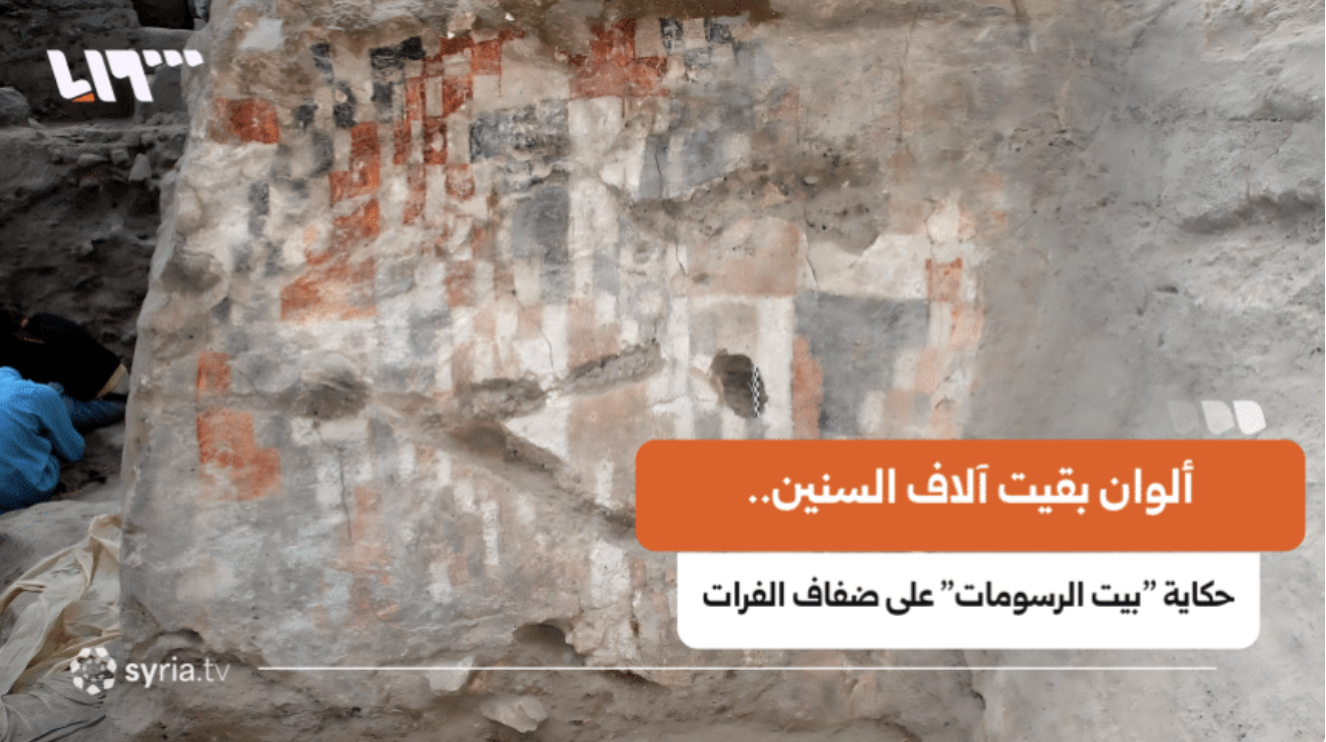
On the banks of the Euphrates River, near the Syrian city of Manbij, people who lived thousands of years ago left a different kind of trace: colours and geometric shapes painted on the walls of a building later known as the “House of Paintings.” At the site of Jaada Al-Mughara, the wall became a space for expression, and the paintings still testify to an early relationship between humans, place and art.
Reading history often leads us to temples, palaces and tombs, or to statues of gods, carved faces of kings and tablets that preserve teachings and record battles. This discovery, however, opens a window onto another side of ancient human life: how did people prepare their walls for painting? And what drove them to decorate a place where they gathered with others?
The site takes its name from Jaada Al-Mughara, a village inhabited by Arab tribes on the shores of the Tishreen Dam lake, about 100 km north-east of Aleppo and about 30 km from Manbij. Here, excavations uncovered a building and paintings that allow researchers to trace an early chapter in the history of painting on man-made walls.
A Discovery That Began With an Archaeological Survey
The site came to light through archaeological surveys carried out by Syrian and foreign missions along the Euphrates, a river whose banks humans settled in the distant past.
Interest in these surveys grew with the construction of the Euphrates Dam in Raqqa province. Work in the area uncovered numerous archaeological sites, and as the lake’s rising waters submerged sites from different eras, survey and rescue excavations expanded.
These efforts covered the entire Syrian course of the river, from Jarablus (Carchemish), where it enters Syrian territory, to Al-Boukamal, where it continues into Iraq. Jaada Al-Mughara was among the sites covered by successive surveys.
In 1989, the site caught researchers’ attention during a survey conducted by Miquel Molist and Marie-Claire Cauvin. Two years later, a specialised French mission led by Eric Coqueugniot, of the University of Lyon and the French National Centre for Scientific Research (CNRS), began excavating it.
Annual excavation seasons continued until 2010, then stopped with the outbreak of the Syrian Uprising in 2011. Over those years, the work revealed multiple phases of settlement. Among the most significant results of the cooperation between the French and Syrian teams was the full uncovering, in 2006, of the “House of Paintings” and its coloured murals.
When the Wall Became a Canvas
The story of the paintings begins with simple materials supplied by the surrounding environment: earth, water, stone and natural pigments. People mixed earth with water, prepared clay to coat the stones, and then created a surface on which to paint.
Using red and black on a white background, they painted interlocking geometric shapes, including squares, rectangles, triangles and circles. These colours have survived for thousands of years, offering a chance to contemplate what people of that era chose to leave on their walls.
To today’s viewer, these compositions may recall works of modern abstract art, including paintings by Wassily Kandinsky and Paul Klee. The visual comparison prompts wonder at the similarity of some shapes, even though the eras, contexts and meanings behind them differ.
Architecture That Embraces Colour
According to the mission’s description, the “House of Paintings” is circular, with a diameter of about 5.7 metres. Part of it was built below ground, while the rest rose above the surface.
Its interior does not form a single open hall. Instead, it contains small square or circular cells, irregularly distributed and each measuring about one and a half metres. At its centre stands a post that supported a roof made of wood and tree branches.
The builders used large limestone blocks for the foundations and coated the interior walls with layers of plaster, which formed a surface for painting. The paintings covered three walls, some of them up to two metres high, making the colours and geometric patterns part of the structure itself.
The inhabitants used natural materials to produce pigments, then mixed them with substances that helped them bind and preserve their colours. In doing so, they left behind not only paintings but also evidence of their knowledge of the materials around them and their ability to put them to use.
This article was translated and edited by The Syrian Observer. The Syrian Observer has not verified the content of this story. Responsibility for the information and views set out in this article lies entirely with the author.
The post On the Euphrates: “House of Paintings” Traces the Origins of Mural Art first appeared on The Syrian Observer.