“Do you see my yard right now?” asked Cory Silverkorn, pointing to the dry lawn that covered part of his front yard in the mountain town of Eagle. “Everything is dead.”
The low winter snowpack and the summer water restrictions have left behind a brittle, pale yellow grass. And it’s part of the reason he joined a local program to harden his family’s home against wildfires.
People with the program, REALFire, came by to do a risk assessment of Silverkorn’s log house and outlined the actions he should take. After that, he got some money from Eagle Country to do some of the work.
Silverkorn has cleared some of the high dry grass around the base of his log home, replacing it with gravel. He’s a DIY-er, so he’s doing a lot of the work himself, which is taking more time.
“We want to create a fire-free 5 feet next to this exterior wall,” explained Eric Lovgren, community mitigation manager for Eagle County, pointing to one side of the home where the work has been done. “Then you could see below he’s got 6 plus inches of concrete foundation exposed there as well. So any embers that land into this area will have minimal impact, almost no impact on creating a home ignition problem for this log home.”
When Lovegren started the job in 2006, getting people to think about hardening their homes was “a tough sell.” He joked that he didn’t get invited to lots of neighborhood parties where he might point out all the wildfire hazards at their homes.
“Twenty years later, we have people beating a path through our door,” he said, rattling off a list of destructive and fast moving wildfires. “I can just say Spokane, I can say Lahaina, I could say Marshall, I could say Altadena. And these are like household names now. So that’s kind of the change. It’s like the problem is only getting worse and impacting more people.”
There are a couple of current bills in Congress aimed at supporting what’s known as fire-adapted communities, including a bill from Colorado Rep. Joe Neugse. Those are among the hundreds of bills introduced by members of Congress in past years to deal with wildfires in some way, shape or form — from tax credits for home hardening, to better pay for wildland firefighters, to grant funding for mitigation efforts.
Caitlyn Kim/CPR NewsCory Silverkorn’s log home in Eagle County, where he’s DIY-ing a project to protect the house from fire, Aug. 12, 2026. On the left, the brush has been cleared away from the side of the house and replaced with gravel; the other side still needs work. Aug 12, 2026.Caitlyn Kim/CPR NewsEric Lovegren, with Eagle County, points to areas where prescribed burns were carried out to prevent uncontrollable fire. Aug 12, 2026.
There’s the bipartisan Fix Our Forests Act, which included identifying high priority firesheds, improving state, local and tribal government partnerships, and funding and making it easier to use more prescribed fires. There are also bipartisan bills to improve firefighter health and safety, and House Democrats have introduced a Wildfire Response and Readiness package, led by Neguse.
“Colorado has experienced some of the most devastating wildfires in the country — and as we’ve worked together to recover and rebuild, we’ve also drawn from hard-earned lessons in the wake of these disasters to introduce this comprehensive package of policy proposals,” Neguse said in a statement.
For the people addressing the issue on the ground in Colorado, many of these bills are welcomed, but they also know many will not become law. What they’d really like Congress to focus on is centered around a few buckets: funding, better transparency and stronger partnerships.
Driving around Eagle County, Lovegren pointed out work where they’ve done prescribed burns, forest thinning and where the county has created fire breaks.
A recent study found that for every dollar spent on removing fuels can save up to $7 on the suppression and recovery end. And every $1 invested by the government to harden homes can save $3 in recovery efforts.
Given the return on investment, Tim Pinnow, CEO of the West Region Wildfire Council, whose mission is to build wildfire resilient communities in six Western Slope counties, would like to see more funding and focus on hardening homes.
“There’s almost no money anywhere for the home hardening piece, which is actually in terms of saving homes, the most important.”
Grant funding could be used for home hardening, fuel reduction programs — like removing beetle kill — and prescribed burns. Many groups and local governments have shovel-ready projects ready to go if and when funding comes through.
Caitlyn Kim/CPR NewsJohn Rizza (left) and Travis Holder stand in Little Salt Wash Park, in Fruita, where a fuel reduction project cleared out brush to prevent wildfires. Aug. 14, 2026.
Funding, fires and some tough questions
Travis Holder is fire marshal with Lower Valley Fire District in Fruita. He said the U.S Wildland Fire Service, a new creation during the Trump administration that seeks to unify federal wildfire management, is also doing more on the mitigation side. “They’re putting that in the forefronts of most of their fires that they’re suppressing now.”
He and John Rizza with Two Rivers Wildfire Coalition, which works to lower the risk of wildfires in Mesa County, showed off an area where they reduced a lot of hazardous fuels in partnership with local government, other partners and the Bureau of Land Management.
“From where we’re standing, what, three months ago, you couldn’t see any of that. This was thick, thick, thick,” he said, pointing down to a small shallow valley in Little Salt Wash Park, where a flow stream runs through.
The project took out a lot of timber and brush, which they burned on site using an EcoBurn system that prevents smoke from getting into the environment. And Rizza and Holder worked with local residents who loved the trees and owls that could be found in the area.
It’s not a barren landscape. There’s a frisbee golf course in the area now, and kids bike through it. And if necessary, a fire truck can also get down there.
They’re keeping as many native plants as possible and have left clusters of trees to provide shade, and kept the owls’ homes, but there’s space between the tree tops. “So that the fire, like you mentioned, can’t get in the canopy and continue to carry. We can stop it in a place where we can defend upon it.”
Two Rivers Executive Director Rizza agreed funding is key, but so is streamlining the process and providing consistency when it comes to grants and laws. “How the stuff is written, how it’s delivered, how it comes out of these programs. One year it says this, the next year it’s the complete opposite.”
Matt McCombs, Colorado’s state forester, pointed out there’s one funding program in particular he’d like to see renewed.
“Community Wildfire Defense Grant was a program that came out of the bipartisan infrastructure law,” he explained. “That has pumped $50 million into wildfire risk reduction and community resilience in the state of Colorado since its inception.”
He said that funding often goes to places that might not be able to afford to undertake mitigation work on their own. “That’s another great example of where those big federal investments, in leverage with state investments and community-based investments, start to get to the type and the quality and the intensity of the work that we know is necessary to try to respond to not what’s coming, but what’s here.”
He’d also like to see a program renewed and strengthened that allows state and local governments to continue to working with federal partners. It’s called the Good Neighbor Authority, and a number of lawmakers have agreed to introduce bills that do just that.
“The Good Neighbor Authority was invented in Colorado. We are hardwired for collaboration in a state. So let’s keep leaning into doing the most work in the highest risk places as fast as we can because of the speed and intensity of the problem that we’re facing,” he said.
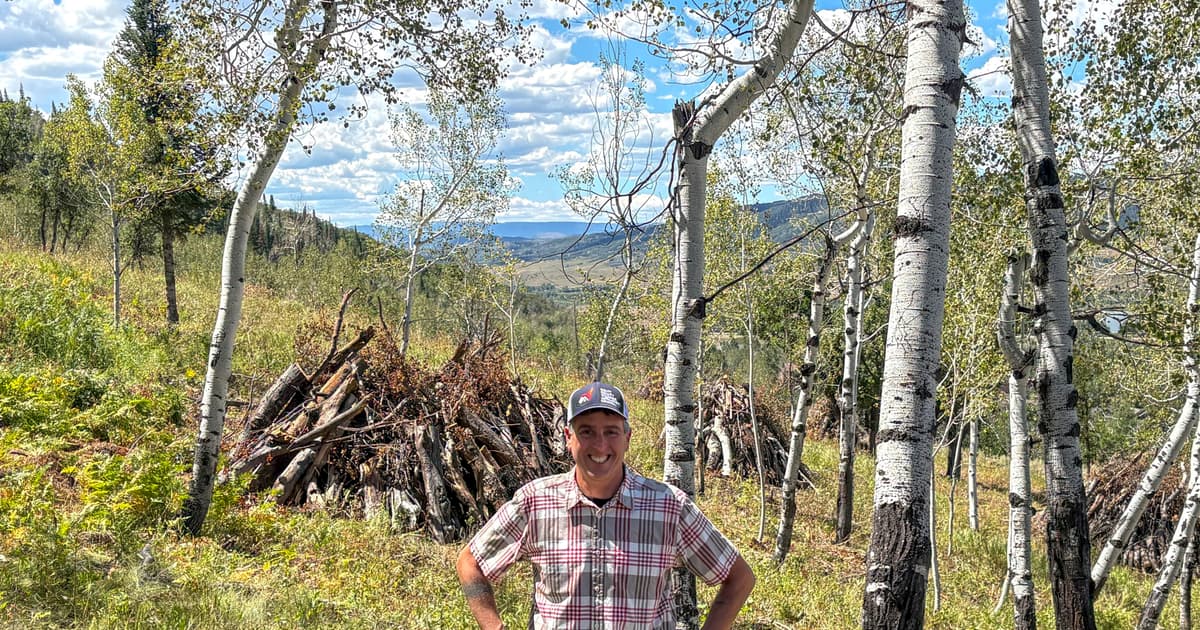
Caitlyn Kim/CPR NewsBrush and logs are stacked in piles near Steamboat Springs, part of a fuel-reduction project to prevent wildfire. Aug. 17, 2026.
Like many people working the issue in Colorado, McCombs and others praise their local federal partners. But if there’s another ask right now of Congress, it would be to ensure there is adequate and qualified federal staff to help get their mitigation projects off the ground.
Pinnow, of the West Region Wildfire Council, said one project they’re working on that’s funded by the federal government requires an archaeological survey.
“Right now, the U.S. Forest Service in this area has no archeologist. And so those projects have been on the shelf and just waiting for more than nine months,” he said. “We borrowed a BLM archeologist to actually approve it on the federal level, but the U.S. Forest Service still has to sign off because that’s where the money came from. They don’t have anyone to even sign off.”
He’s worried that the funding will have to be returned because right now there’s no way to move it forward.
And talking to people on the ground, it also means more education and outreach, including the use of prescribed fires.
“A lot of the legislation you’re seeing from the delegation here in Colorado and really on both sides of the aisles calling out the need to have more capacity for prescribed fire in the state of Colorado or what I often call applied fire,” said McCombs, who also used to work for the U.S. Forest Service
McCombs added he’s not sure which, if any, of the bills introduced this Congress will become law, “but they’re critical signals to everybody that we need to move out and move out together and move out at the speed and the intensity of the problem we’re facing.”
Walking up a little billy goat trail on a ridge above Steamboat Springs, Josh Hankes stops on a hillside where several burn piles sit dotted up and down. It is part of a 38-acre fuels reduction project, funded through the BLM.
“This would represent an area where fire suppression could take a stand. And by removing these fuels, an approaching fire would lose energy and just wouldn’t come down this hill with the fury that it might otherwise,” he said. That would give firefighters a place to fight a fire and residents more time to evacuate down the one road that snakes up the hill.
Hankes is executive director of the Routt County Wildfire Mitigation Council. He’s waiting for the snow to fall before burning the piles. And while he’d like to see more funding, he also said he’d like to see action on something Congress hasn’t been able to agree on.
“It would be heavy and swift action toward climate and reducing carbon emissions because it’s certainly not the only factor here,” he said, “but climate is really hurting us.”
Caitlyn Kim/CPR NewsColorado chief forester Matt McCombs stands enar his office in Fort Collins. Aug. 19, 2026.