Arab economic engagement with Syria advanced on two parallel tracks Monday, as Amman and Damascus hosted moves aimed at expanding regional partnerships, developing the banking sector, and opening new channels for investment. At the same time, Syrian–Saudi discussions focused on strengthening cooperation in agriculture and financing projects tied to food security and rural development.
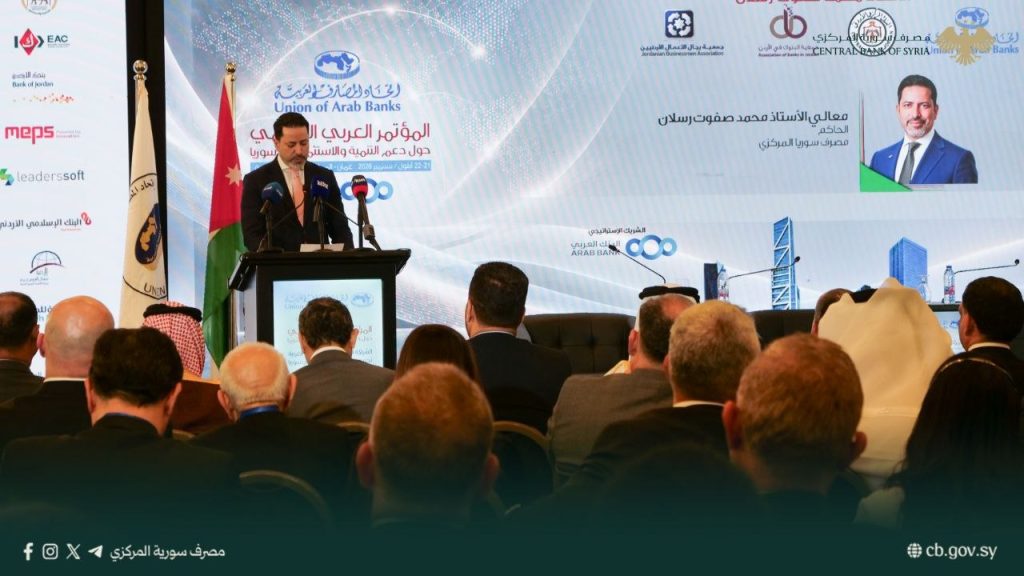
In Amman, the Arab Regional Conference on Supporting Development and Investment in Syria convened under the auspices of the Union of Arab Banks, with participation from the Central Bank of Syria, several private Syrian banks, and a range of Arab financial institutions. The conference’s agenda centers on modernizing the banking sector, enhancing financial stability, updating legislation and regulatory frameworks, rebuilding regional banking ties, and developing payment systems. (
Central Bank Governor Safwan Raslan said the coming phase requires moving beyond presenting investment opportunities toward establishing concrete projects and partnerships that support production, create jobs, contribute to reconstruction, and drive sustainable economic growth. He underscored the importance of expanding economic and banking cooperation with Arab countries.
On the sidelines of the conference, Raslan held bilateral meetings with representatives of several Arab banks—including the National Bank, Bank al-Etihad, the Commercial Bank, and Blom Bank—in the presence of private Syrian banks. Discussions focused on opening new channels for banking cooperation, licensing issues, and the potential entry of new Arab banks into the Syrian market.
These efforts align with Damascus’s broader push to attract Arab and foreign capital and reintegrate Syria’s financial system with regional banking institutions after years of isolation and restrictions that limited its ability to finance trade, investment, and reconstruction.
Meanwhile in Damascus, Minister of Agriculture Bassel al-Suwaidan met with Saudi Ambassador Ghazi al-Anazi to explore opportunities for expanding agricultural cooperation, particularly in investment and projects that could bolster food security and rural development.
Al-Suwaidan said Damascus is working with Saudi authorities on a joint strategy and intensifying communication to identify and finance a set of agricultural projects. He highlighted the importance of continued cooperation on production inputs—especially pesticides and fertilizers—following the signing of a memorandum of understanding in this sector.
For his part, Ambassador al-Anazi emphasized the significance of Saudi investment in Syrian agriculture, noting the sector’s potential role in strengthening food security and supporting economic activity.
The talks build on previous contacts between the two countries. In June, al-Suwaidan met Saudi Minister of Environment, Water and Agriculture Abdulrahman bin Abdulmohsen al-Fadley on the sidelines of the “Saudi Water Week” conference in Jeddah to discuss cooperation in agriculture and water.
The developments in both the banking and agricultural sectors reflect a Syrian strategy to expand Arab economic partnerships through two interconnected tracks: building a financial and banking infrastructure capable of absorbing investment and financing projects, and attracting direct investment into core productive sectors.
If these understandings translate into tangible projects, the ability of Syrian institutions to provide a stable regulatory environment, facilitate capital flows, grant licenses, and ensure clarity in investment rules will be decisive in determining the scale of Arab participation in Syria’s next phase of reconstruction and development.
This article was translated and edited by The Syrian Observer. The Syrian Observer has not verified the content of this story. Responsibility for the information and views set out in this article lies entirely with the author.