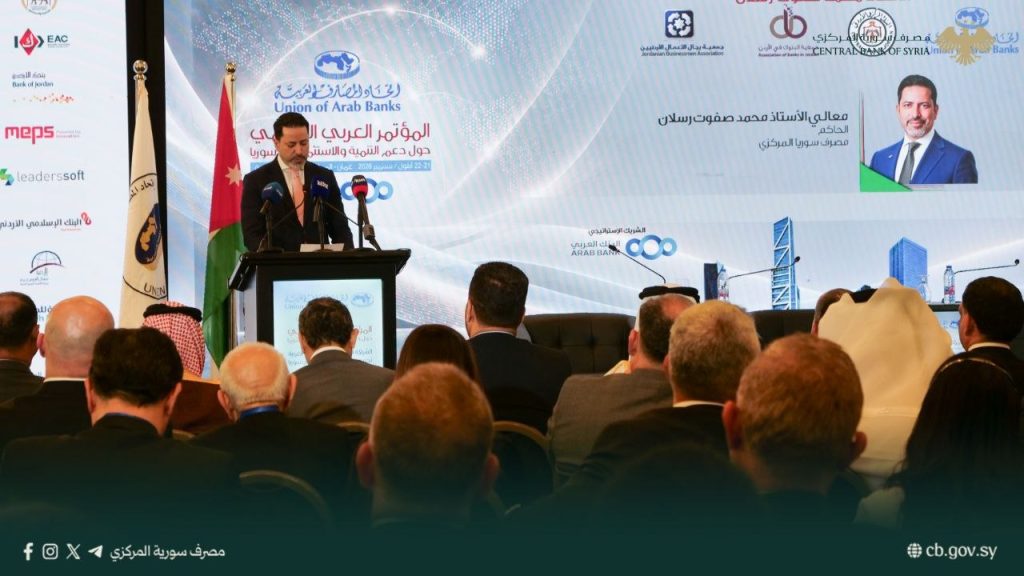
The economic figures presented by Syrian President Ahmad al-Sharaa at the Arab Media Summit in Dubai have ignited debate over the true size of Syria’s economy and the credibility of its recovery trajectory. Al-Sharaa said GDP stood at roughly $20 billion in 2024, rose to $32 billion in 2025, and is expected to reach $50 billion in 2026 and $60 billion in 2027—while expressing an ambition to expand the economy to around $200 billion within five to ten years.
Yet moving between these nominal dollar figures does not necessarily mean that Syria’s actual production of goods and services has grown at the same pace. Dollar-denominated GDP is shaped not only by real output, but also by price levels, exchange rates, and the statistical methods used to calculate national accounts. Economic researcher Younis Abd al-Karim cautions against interpreting the jump from $20 billion to $32 billion as a genuine 60 percent growth rate, noting that reported real growth for 2025 was far lower.
This caution is especially relevant amid ongoing revisions to Syria’s national accounts and persistent data gaps. In its August assessment, the International Monetary Fund (IMF) said Syria’s recovery is accelerating, projecting double-digit growth for 2026 and strong momentum into 2027, driven by improvements in agriculture, hydrocarbon and electricity production, trade and services, the return of refugees, rising visitor numbers, and government spending. At the same time, the IMF stressed the need for better statistics, stronger fiscal and monetary policies, and banking sector reforms.
Nominal Growth vs. Real Output
The divergence between nominal output and real growth becomes sharper when examining the target of $50 billion in 2026. A rise from $32 billion to $50 billion represents an increase of nearly 56 percent in a single year—a proportion that cannot be explained by announcements of investment projects or memoranda of understanding. Signing an investment agreement does not automatically translate into GDP, and even capital that begins implementation is not fully counted as output. What matters economically is the actual production, value added, wages, taxes, and local purchases generated by a project.
For this reason, the number or value of signed agreements is not a reliable measure of recovery. The more pressing questions are how many investments have materialized on the ground, what volume of output they generate inside Syria, and how much of that output remains in the domestic economy rather than flowing out through imports, profit repatriation, or external payments.
Foreign trade offers a key test. According to figures cited in the report, Syrian commodity exports reached about $3.34 billion in 2024, compared with imports of roughly $6.28 billion. This imbalance underscores that building a larger and more sustainable economy requires expanding productive and export capacities, not relying primarily on consumption and imports.
The $200 Billion Ambition
Reaching $200 billion presents an even greater challenge. Starting from an economy sized at $60 billion in 2027, achieving $200 billion within five years would require a compound annual growth rate of around 27 percent. Extending the timeframe to ten years reduces the required rate to about 13 percent. If the starting point is $50 billion, the required growth rates are even higher.
Such figures imply large-scale expansion across industry, agriculture, energy, services, and productivity, alongside massive capital inflows and sustained political and financial stability. Obstacles extend beyond output volume alone: Syria’s public finances remain severely constrained, the informal economy has expanded, and financial and tax institutions have been weakened by years of conflict. Rapid growth is therefore tied as much to rebuilding state institutions as to attracting investment.
Investment Is Not Output
This distinction is particularly important in discussions of reconstruction. The World Bank estimates the cost of repairing Syria’s damaged physical assets at about $216 billion, with direct damage around $108 billion. Yet this figure does not represent the size of the Syrian economy, nor can it be added to GDP. It is an estimate of the cost required to restore war-damaged infrastructure.
Abd al-Karim notes that economic recovery is not measured by the number of towers or investment complexes announced, but by the restoration of electricity, water, transportation, communications, and the reactivation of factories and agricultural land—followed by the expansion of industries and services capable of generating value added, exports, and employment.
Evaluating whether the economy has reached $50 or $60 billion therefore requires monitoring indicators far more telling than nominal GDP: real GDP at constant prices, industrial and agricultural output, energy production, exports, productivity, real wages, employment, the trade deficit, and the stability of prices and exchange rates.
$60 Billion Today Is Not $60 Billion Before the War
The target of $60 billion in 2027 introduces another challenge. Before the war, Syria’s economy hovered around that same nominal figure. But returning to $60 billion today does not mean returning to pre-war economic conditions.
The real value of the dollar has changed due to inflation, and Syria’s demographics, income levels, living costs, and economic structure have all shifted. According to the World Bank, per capita gross national income stood at roughly $830 in 2024, with about a quarter of Syrians living in extreme poverty and around two-thirds below the poverty line for lower-middle-income countries.
Thus, reaching a nominal GDP of $60 billion will not, on its own, restore pre-war living standards, purchasing power, or employment opportunities. The report notes that $60 billion in 2010 values corresponds to a significantly higher figure in 2026 prices, making nominal comparisons misleading.
A Recovery Measured by Reality, Not Dollar Figures
In summary, al-Sharaa’s figures reflect ambitious economic goals and a desired recovery path, but available data is insufficient to classify these nominal jumps as equivalent to real production growth. While IMF estimates indicate that Syria’s economy has entered an accelerated recovery phase, the true depth of that recovery will be determined by what happens in factories, fields, power grids, markets, export hubs, and household incomes—not by dollar-denominated GDP alone.
This article was translated and edited by The Syrian Observer. The Syrian Observer has not verified the content of this story. Responsibility for the information and views set out in this article lies entirely with the author.