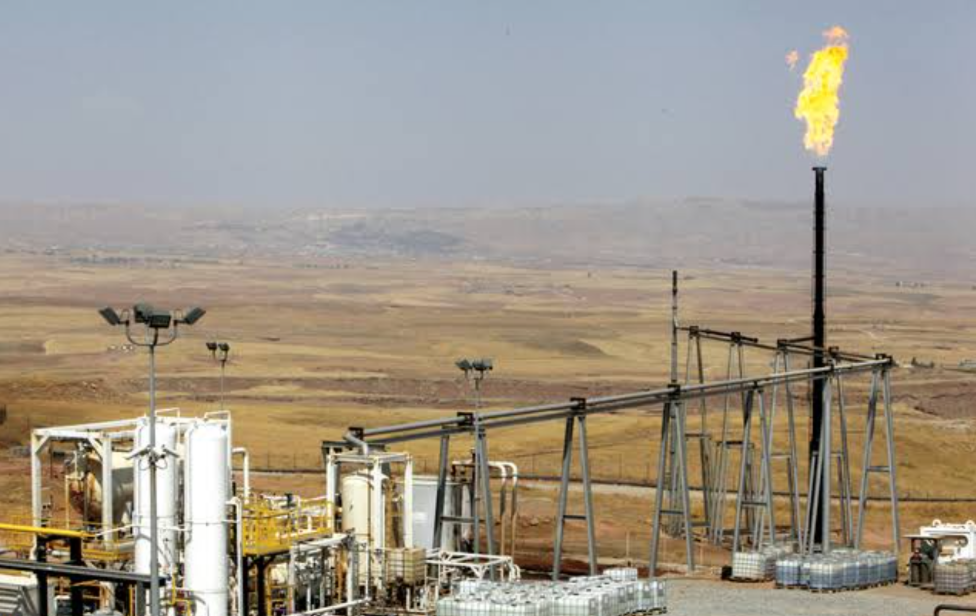
DEIR E-ZOR — The Syrian Petroleum Company’s report struck an optimistic note: “From rubble to a functioning production line” was how engineers at the al-Tabiyah gas plant, better known as “Conoco”, summed up three months of repairs. Officials and pro-government media have since celebrated the plant’s reported return to production. In the official report, engineer Issam al-Sarraj said the plant would produce three key products: dry gas, cooking gas (LPG) and gas condensates used to improve crude oil.
That fanfare is understandable. There is an urgent need to restart the facility and restore domestic production. According to the government, the gas plant is a “first step” towards restoring Syria’s gas production. Winter is fast approaching and gas import contracts with Azerbaijan are nearing expiry. Once the plant is fully operational, it is expected to supply the gas network with “one million to 1.5 million cubic metres of gas per day.” Since the fall of the Assad regime, Syria has received natural gas from Qatar and signed agreements with Egypt and Jordan. Prior to the war, Syria was close to being self-sufficient in gas, but now the country is suffering from gas shortages. Against a backdrop of recent fuel protests and growing anger over the cost of living—with 90 percent of Syrians living below the poverty line, according to UN estimates—the government can ill afford further shortages of cooking gas.
But away from the official celebrations, a Syria Direct investigation has uncovered a facility beleaguered by engineering problems, alleged corruption and a toxic work environment dominated by an Assad era old guard. The problems at al-Tabiyah go beyond one gas plant. Its troubled restart is an early test of whether Syria’s new government can restore essential infrastructure after 14 years of war and reduce its dependence on imported gas while rebuilding the country’s own technical capacity.
Following publication of these revelations in Syria Direct, the head of the Syrian Petroleum Company Youssef Qablawi held a press conference denying allegations of mismanagement and shoddy repairs.
Read More: Oil flows, fuel runs dry: Syria’s paradox as a new energy corridor
The al-Tabiyah plant was built nearly two decades ago by US company ConocoPhillips from which it takes its commonly used name, ‘Conoco’. Its importance lies in its critical role in extracting and processing natural gas and separating its components: dry gas for thermal power stations, liquefied petroleum gas for household use, and condensates for use in gasoline, known locally as “red petrol.”
Despite changing hands repeatedly, the plant continued operating throughout much of the 14-year war. Syria’s acute need for fuel and electricity meant that gas flowed even under Islamic State (IS) rule. The production cycle was disrupted when the US-led coalition targeted the plant in 2016. After IS was defeated, the plant became a US base and a headquarters for the US-backed Syrian Democratic Forces (SDF).
Repairs that amount to little more than welding
However, recent leaks obtained by Syria Direct suggest that the contract with Gulcon, a Syrian company registered in Qatar responsible for maintaining the gas facility, has been terminated. Its workers were dismissed by the Central Authority for Control and Inspection over alleged corruption. Several other companies and contractors’ assets were frozen pending investigation.
A technical expert inside the plant, speaking on condition of anonymity, likened Gulcon’s repair work to that of a ragtag welding crew instead of a company capable of fixing the plant’s gas-processing systems. According to the expert, the company’s work amounted to laying five kilometres of pipeline, welding damaged sections together and resorting to rudimentary measures such as using fans to cool equipment. The expert said this ad hoc approach reflected a failure by the executive management to draw up a clear maintenance plan.
Syria signs gas development agreement with ConocoPhillips, Novaterra. 16/062026 (Photo: SANA)
The engineering problem and US involvement
Another technical expert, who also spoke on condition of anonymity, told Syria Direct that the al-Tabiyah plant cannot properly remove water from its gas due to the dehydration equipment being out of order, making the gas unsuitable for Jandar power station in Homs, and risky to transport over long distances in winter. Unless this is resolved, the problem could further strain Syria’s energy supplies as winter approaches.
As a temporary solution to the looming problem, a petrochemical engineer working at the Tuwainan oil field told Syria Direct that he had proposed installing temporary Russian water-removal equipment at al-Tabiyah, while acknowledging that it was unlikely to work because “the unit was originally designed for marine vessels and unsuitable for use at an onshore processing plant.”
“Remove all the modifications currently being carried out because they do not meet safety standards.”
The technical impasse coincides with the arrival of ConocoPhillips and NovaTerra Energy. The latter is owned by the British-Syrian businessman Ayman Asfari. NovaTerra has recently established accommodation and facilities for visiting engineers expected to carry out a complete overhaul of the gas plant.
A NovaTerra expert told Syria Direct that the company planned to “remove all the modifications currently being carried out because they do not meet safety standards.”
If accurate, the assessment contradicts official statements that the plant’s dehydration systems are preparing to come back online. More importantly, it raises questions as to whether Syria can attract the foreign capital and expertise needed for reconstruction if investors associate Syria’s industry with poor technical standards.
New engineers shut out
The plant’s problems are not confined to pipelines and damaged equipment. Tensions among workers are hampering maintenance efforts. New engineers and workers—hired after the fall of the Assad regime—have lodged complaints alleging deliberate marginalisation, bullying and “systematic exclusion” in decision-making. They say they are being kept in the dark about a work plan they will be expected to implement within days.
Syria Direct shared these concerns with the plant’s director, Ziad al-Hamad, who rejected them. He said the main pipelines and gas-processing equipment had been repaired and that the plant’s control system would be working soon.
Hamad said Gulcon’s role had been limited to supplying equipment and placed responsibility for the newer workers’ marginalisation on the workers themselves.
“Some of the newer staff want information handed to them without making any effort.”
“Some of the newer staff want information handed to them without making any effort,” he said, adding that he would open his door and provide what they needed if he saw “initiative and a genuine search for knowledge.”
The engineer who relayed the complaints rejected Hamad’s assessment, saying it overlooks the way technical knowledge and access to operational plans can become an instrument of control for the plant’s old guard. By withholding information, he added, veteran staff could preserve their positions as the indispensable backbone of the facility, without whom the plant cannot operate. This is taking place in a context where public employees who served under the previous regime have been subjected to mass layoffs.
Al-Tabiyah’s rusted pipelines and damaged dehydration units can eventually be repaired or replaced with sufficient investment and technical expertise. The harder task at al-Tabiyah may be institutional: creating systems that work, retaining technical expertise without reproducing old hierarchies and convincing foreign companies that Syria’s energy sector can operate safely and transparently—and is worth investing in.
Whether Damascus succeeds will help determine not only whether domestic gas production can increase this winter, but whether Syria’s much-heralded reconstruction translates into more reliable electricity, heating and affordable fuel for ordinary Syrians.
This week, Energy Minister Muhammad al-Bashir said Syria aims to achieve oil self-sufficiency by 2028 and gas self-sufficiency within seven years. The problems at al-Tabiyah offer an early indication of the scale of that challenge.