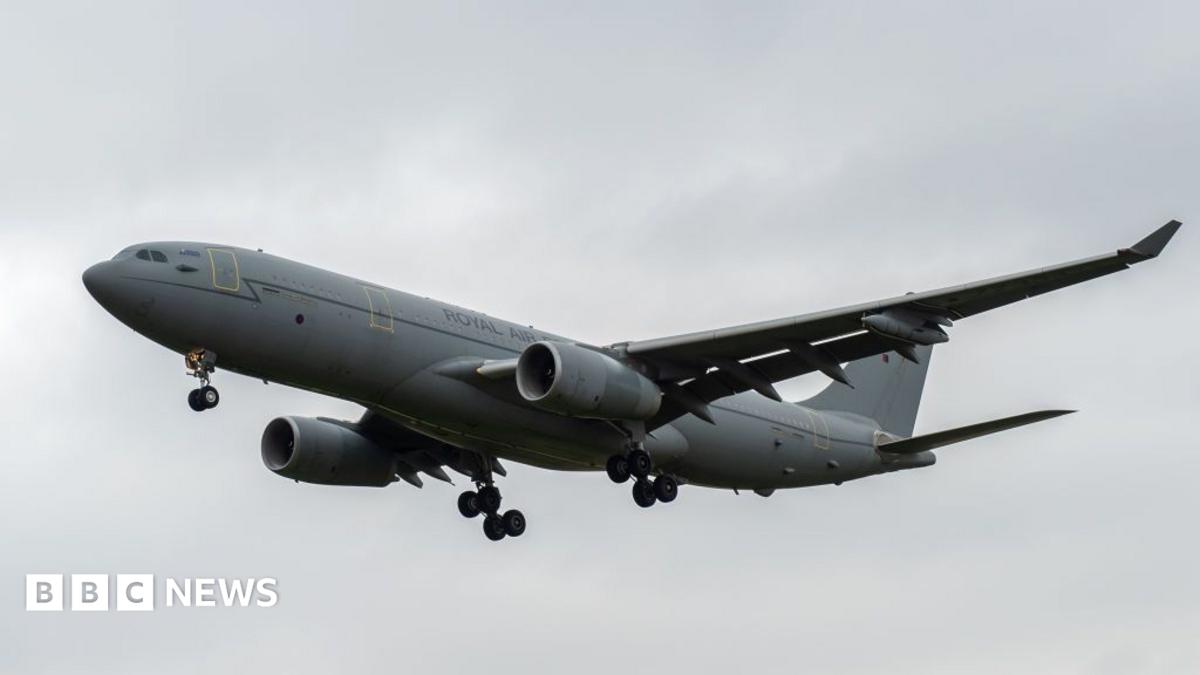
Explaining the nature of the deployment, Pollard told BBC Radio 4’s Today programme: “We’ve agreed to the Saudi request for air-to-air refuelling” that would keep Saudi jets “in the air longer”.
“The defensive action that Saudi Arabia takes against the Houthis will cover a range of activities, including shooting down those drones and missiles,” he said.
He insisted the UK support fully conformed with international humanitarian law, and was about “being true to our allies”.
The singular Voyager aircraft is part of a core fleet of nine – eight military registered and another civilian registered – on the Royal Air Force (RAF)’s books.
The RAF also has five others available for military recall if needed.
Speaking to reporters travelling with him on the way to the United Nations General Assembly in New York, Burnham linked cost of living pressures to the decision.
“I go back to the point I made about cost-of-living pressures and acting to secure the interests of Britain and the wider region,” he said.
“Because of course Saudi Arabia has been experiencing attacks, is looking at potential further disruption, and we need to keep those pathways open, and hence our agreement to the request.”
Pollard added the UK support would “ensure there’s not further escalation in the Red Sea, which could further risk our fuel prices”.
Petrol prices in the UK jumped to their highest for nearly four years in August, the Office for National Statistics said, while diesel also rocketed.
Shipping routes through the Red Sea are a vital artery of the world economy.
The Houthis recently seized control of the strategic port city of Mokha and Perim Island, a gateway to the Red Sea – a key shipping route used by Saudi Arabia.
As “military support” goes, Britain’s offer of a single Voyager refuelling aircraft is at the lighter end of the spectrum. Some may even see this as a performative gesture to an ally in trouble.
Saudi Arabia is struggling to fend off attacks by Yemen’s Houthis who seem to have an inexhaustible supply of drones and missiles to fire at their large and vulnerable Saudi neighbour to the north.
British officials have said this offer is, as they put it, “time-limited”.
But Yemen has been at war, on and off, since 2014 and this latest upsurge in fighting is made more complicated by the fact the Houthis are backed by Iran which is in its own on-off war with the US.
The risk for Britain here is limited but wars have a habit of drawing nations in with a steadily increasing involvement. That may well suit the Saudis but it is unlikely to please most people in Britain.
In a BBC interview last week, Nato Secretary-General Mark Rutte hinted that European support for Saudi Arabia was also likely.
He said: “I would not be surprised if some phone calls were taking place between European allies, ‘hey, how are we going to deal with this?’.
“Let’s see what happens, and if Nato can help, we will always be helpful.”
Energy Minister Martin McCluskey last week told MPs that the UK was “providing air defence support” to Saudi Arabia through the defence partnership that they have, although would not be drawn on questions of operational military activity.
In January 2024, the UK joined the US in launching air strikes against Houthi targets across Yemen.
Then-Prime Minister Rishi Sunak said the UK “acted in self-defence” following the Houthis’ targeting of ships, including a Royal Navy warship.
He also said the strikes were “necessary, proportionate, and targeted” to protect lives and commercial shipping.
Further joint air strikes from the UK and US followed in 2024, external.