After 18 Years Away
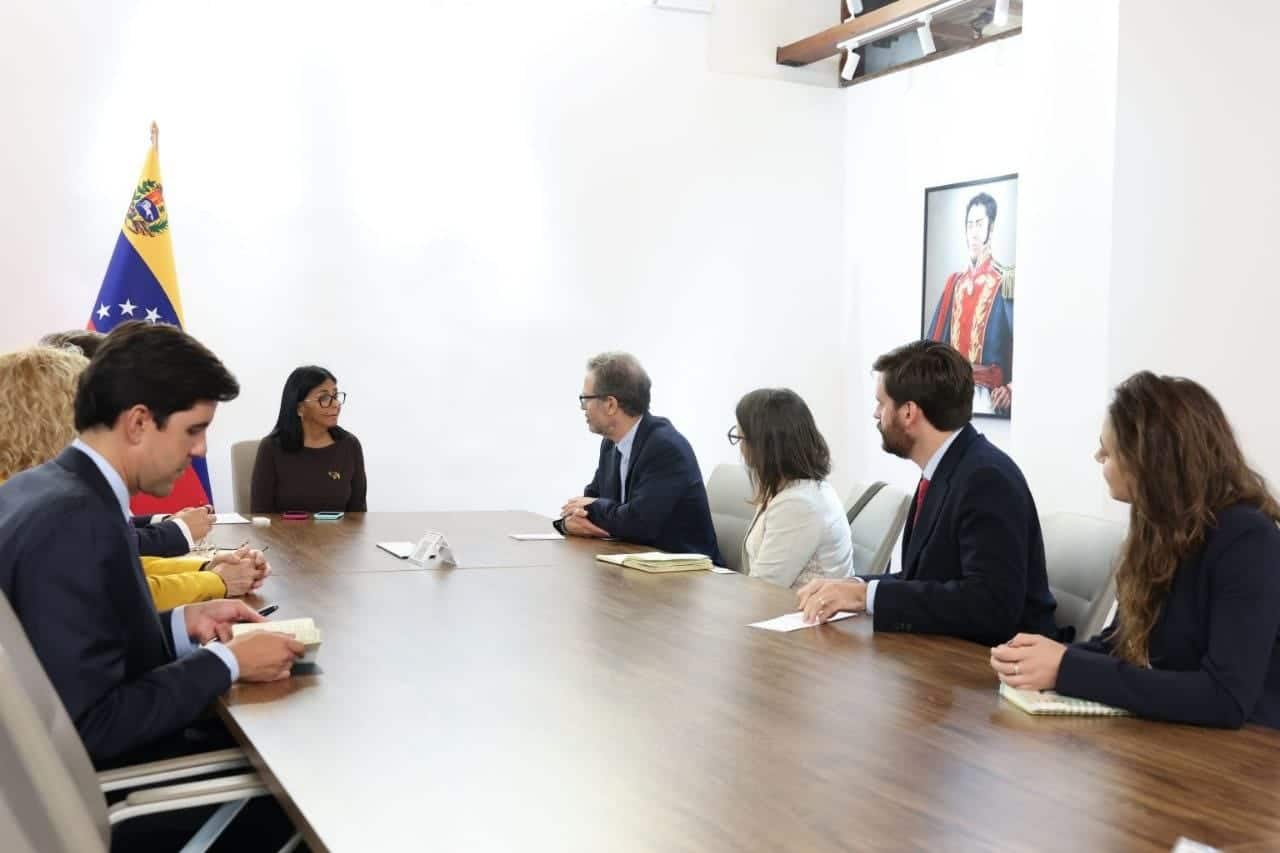
The Human Rights Watch delegation meeting with Venezuela’s acting president Delcy Rodgriguez.
It is the organization’s first official visit to the country since 2008, following the expulsion of its then Americas director, Jose Miguel Vivanco.
By Reynaldo Mozo Zambrano (Efecto Cocuyo)
HAVANA TIMES – The international organization Human Rights Watch (HRW) has returned to Venezuelan soil after nearly two decades of a de facto ban, a barrier that had been in place since Jose Miguel Vivanco, then its Americas director, was expelled in 2008 on the orders of President Hugo Chavez.
On its official return, the delegation met with acting president Delcy Rodríguez, the diplomatic corps accredited in the country, opposition figures, and civil society representatives to assess the human rights situation on the ground.
Federico Borello, deputy executive director and chief programs officer at HRW, presented the findings from the visit during an interview on Friday, September 18, on the program Efecto Paz, hosted by Luz Mely Reyes, director of Efecto Cocuyo, and Rafael Uzcátegui, co-director of the NGO Laboratorio de Paz. In his assessment, Borello acknowledged that there has been a pause in the persecution but warned that the situation is not definitive because the laws and mechanisms of repression remain intact.
The delegation’s arrival in the country coincided with the start, on Thursday, September 17, of the second round of talks between part of the opposition and the interim government, aimed at resolving the institutional crisis through agreements that include renewing the Supreme Court of Justice (TSJ) and the definitive release of political prisoners.
What the Delegation Observed
A Temporary Halt to Harassment
The organization’s initial assessment points to a change in the country’s political and civic climate, marked by a decline in the persecution that had kept dissidents under constant threat.
Borello said that this new climate has allowed opposition members, after spending as long as one or two years in hiding, to return to the streets and reunite with their families and has even prompted some exiles to return. The HRW official noted that social actors now have greater room to maneuver in the face of state control.
“Civil society and the opposition can operate more freely than before,” the human rights advocate said.
Incomplete Prisoner Releases and the Risk of Reversal
Although the delegation documented steps that have provided some breathing room in the country, such as the lifting of digital blocks on at least 14 media outlets and the release from prison of hundreds of political prisoners, the organization’s representative emphasized that these gains lack firm legal guarantees.
Borello explained that detainees released from jail remain subject to ongoing criminal proceedings and precautionary measures, meaning they cannot be considered fully free and remain vulnerable. One example of this fragility occurred in Lara state, where, despite HRW’s presence in the country, former Carora mayor Javier Oropeza was detained and subsequently released.
The HRW representative stressed the need to consolidate these advances through serious and far-reaching reforms so that they endure over time. “None of this is irreversible. This is a moment to make these gains permanent through serious and profound institutional reforms,” he said.
HRW Agrees with the UN That the Repressive Apparatus Remains in Place
Far from seeing the dismantling of structures of persecution, HRW concurred with the findings of the new report by the United Nations Fact-Finding Mission, which was released during the NGO’s visit to the country and states that individuals accused of responsibility for serious human rights violations remain in their posts.
Borello warned the interim authorities that the legal framework used to suppress dissent remains in force, preventing any real guarantees that abuses will not be repeated. The human rights advocate emphasized that the punitive laws have not been changed. “The laws that have allowed the authorities to act repressively are still in force,” he said.
Rodeo I and the Anti-Terrorism Law
The HRW team gathered information about corruption within Venezuela’s prisons, which, in addition to still holding detainees for political reasons, also house common prisoners who have already completed their sentences but are required to pay money in order to be released.
Borello said the judicial system operates as a mechanism of extortion, with people who have already served their sentences being asked to pay as much as US $3,000 in exchange for their release, while other inmates suffer from serious illnesses or were imprisoned through irregular procedures.
To put an immediate end to these abuses, the deputy executive director called for the permanent closure of the Rodeo I prison, which he described as a place of torture, and proposed repealing the Anti-Terrorism Law as the fastest way to deliver justice.
“If that law were repealed, hundreds of pending cases would fall away, and neither a commission nor anything else would be needed to resolve them,” he said.
The Interim Government Asked HRW for Lists
In response to HRW’s proposals to the interim authorities, the government asked the organization to submit the cases it had documented. Although Borello said he understood civil society’s concern about this request, since the state already possesses information about the people whose rights it has violated, he said HRW would send a list of between 10 and 20 names as a test to evaluate the government’s response, while also demanding that the lists compiled by local NGOs be addressed.
At this stage, the international delegation will place special emphasis on citizens who were prosecuted solely for their activity on digital platforms, such as the case of teenager Gusmari Zapata.
Borello rejected arrests prompted simply by sharing content on social media. “There are people who are being detained for exercising their freedom of expression, for sending a photo, others for sending a TikTok. That is absolutely unacceptable,” he said.
Two Parallel Paths Toward a Transition
HRW proposed that Venezuela’s leadership move forward on two fronts to demonstrate a genuine willingness to change. According to Borello, urgent measures should include granting full and unconditional freedom to all political prisoners and citizens who have been arbitrarily detained, eliminating any reporting requirements or other restrictions.
He argued that, to ensure these releases cannot be reversed, the country needs agreements that alter the foundations of state power. “The medium-term path is to reform institutions and laws and reach an agreed electoral calendar, which is a very clear demand from Venezuelans,” he concluded.
First published in Spanish by Efecto Cocuyo and translated and posted in English by Havana Times.
Read more feature articles here on Havana Times.