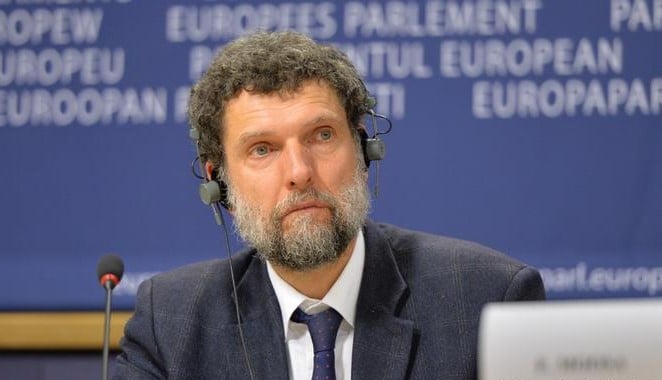
The Council of Europe’s Committee of Ministers has given Turkey until October 14 to explain what concrete steps it has taken or plans to take to secure the release of jailed businessman and philanthropist Osman Kavala.
The committee made the request after reviewing Turkey’s compliance with three European Court of Human Rights (ECtHR) judgments concerning Kavala at a meeting in Strasbourg on September 15-16.
Kavala, 68, has been imprisoned since October 2017 and is serving an aggravated life sentence for allegedly attempting to overthrow the government by financing and organizing the 2013 anti-government Gezi Park protests. He denies the charge and says the case against him is politically motivated.
In the latest judgment, issued on August 25, the ECtHR Grand Chamber ruled that Turkey must release Kavala at the earliest possible date and eliminate all the consequences of his conviction.
The Strasbourg court said Kavala’s prosecution and imprisonment were intended to punish and silence him for his involvement in the Gezi Park protests and his work as a human rights defender.
It found no evidence linking Kavala to violence during the protests and said he had been convicted for activities protected by the European Convention on Human Rights, including peaceful advocacy, public debate and support for civil society.
The court described the proceedings as a “flagrant denial of justice” and said the conviction should be treated as “null and void” under European human rights law.
Following that ruling, Kavala earlier this month asked the İstanbul 13th High Criminal Court to reopen his case, suspend his sentence and order his release.
The İstanbul court has asked the Justice Ministry’s human rights department to provide information about the ruling and send it a Turkish translation before it examines Kavala’s application.
The Committee of Ministers said it deplored the fact that Kavala remained in prison despite three judgments from the Strasbourg court and repeated calls for his release.
It described his case as exceptionally serious, saying the proceedings against him had been “from start to finish, flagrantly unjust and politically motivated.”
The committee reminded Ankara that Council of Europe member states are unconditionally required to comply with ECtHR judgments.
The October 14 date is a deadline for Ankara to report planned or completed measures to the committee. It is not a deadline formally ordering Kavala’s release by that date.
The committee will review the case again at its human rights meeting in December and said it could consider further action depending on the information submitted by the Turkish government. No new sanction was announced at this stage.
It also asked Ankara to explain how it plans to remove the other consequences of Kavala’s conviction.
The committee noted that Turkish law allows criminal cases to be reopened following an ECtHR judgment and said this mechanism could be used to erase the effects of the conviction.
Kavala was acquitted in the first Gezi trial in February 2020 but was taken back into custody on separate allegations before he could leave prison. His acquittal was later overturned, and he was convicted following a retrial. Turkey’s Supreme Court of Appeals upheld his sentence in September 2023.
The ECtHR first ordered his immediate release in December 2019, finding that his detention lacked reasonable grounds and had been used to silence him.
Turkey’s refusal to carry out that judgment led the Committee of Ministers to launch infringement proceedings, a rarely used process against a member state.
In July 2022 the ECtHR Grand Chamber found that Ankara had failed to meet its obligation to comply with the 2019 judgment.
The August ruling went further by examining the trial and conviction that followed, finding multiple violations of Kavala’s rights, including his right to liberty, a fair trial, freedom of expression and freedom of assembly and association.
The Committee of Ministers said the case also exposed larger problems in Turkey’s justice system, including the use of criminal law against political opponents, journalists and human rights defenders, overly broad interpretations of criminal and counterterrorism laws, arbitrary detention and a lack of judicial independence.
It asked the Turkish government to submit a new plan by March 2027 explaining how it intends to address those problems.
President Recep Tayyip Erdoğan and members of his government have repeatedly denied claims that Kavala’s imprisonment is politically motivated, insisting that Turkey’s courts operate independently.