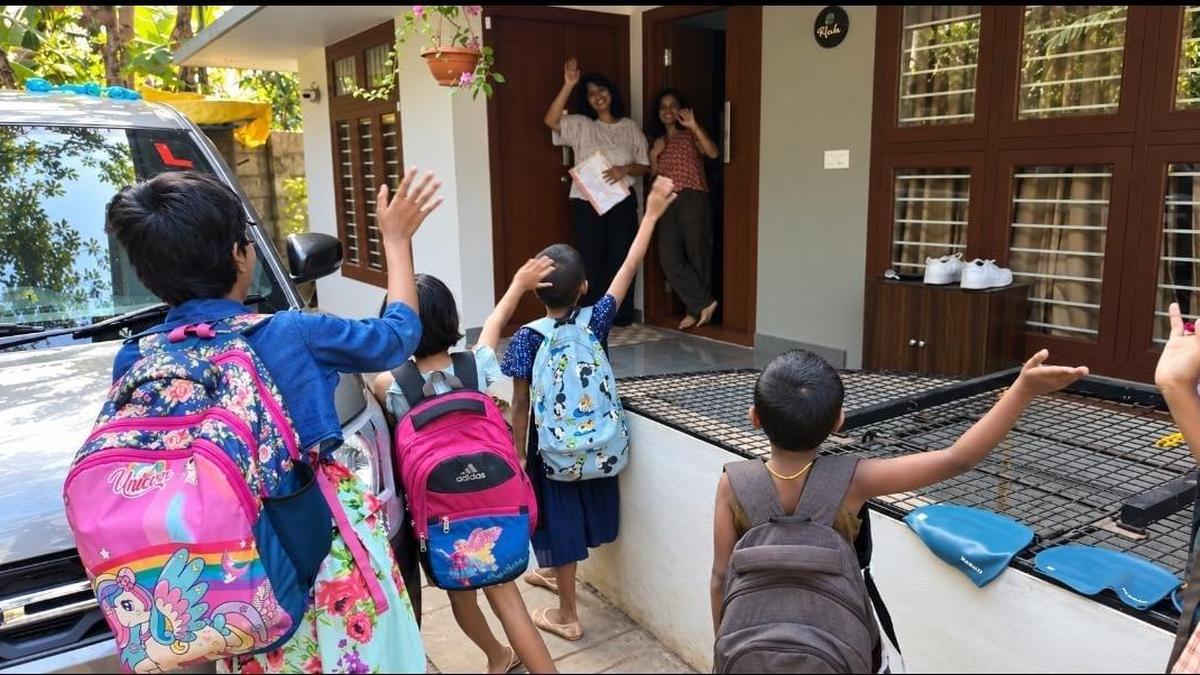
Some of the children, caregivers and their Amma in the front courtyard of RUH at Thenhipalam
| Photo Credit:
K_ RAGESH
A five-cent plot with a two-storey house at Thenhipalam in Malappuram is home to a family like any other. As the afternoon heat begins to subside, Achu (name changed), 7, is playing cricket with some of his “siblings” and other family members in the front courtyard. “I want to be a cricketer like Virat Kohli. I go to a cricket academy for practice,” says the budding southpaw as he mimics a textbook cover drive.
This is a family without blood ties. Yet the eight children — whose lives were once marked by abandonment, trauma and uncertainty — now live with their “Amma” (mother) and three “chechis” (elder sisters/caregivers), sharing the bonds and rhythms of everyday family life under one roof.
Achu was brought to Rise Up Home (RUH) about six months ago following the intervention of the Malappuram district Child Welfare Committee (CWC). RUH, a pioneering initiative of the Gen Z-led, volunteer-driven Rise Up Forum (RUF), established in 2023 to provide children and the elderly with the stability, dignity and affection of a family.
Like Achu, the youngest of the eight, his seven “siblings” study in classes up to Class X and take part in extracurricular activities. Their three caregiver “chechis”, also pursue their studies and careers, while the group lives together with their elderly “Amma”, Santhakumari, who continues to pursue her passion for stitching even after moving to RUH. The caregivers and Santhakumari live full-time at RUH and provide their services voluntarily.
First of its kind in State
According to A. Mammu Master, chairperson of the Malappuram CWC, RUH at Thenhipalam is the first group foster-care home in the State. “Unlike conventional children’s homes, several of which are run by religious and caste-based organisations, children at RUH live in a much more family-based setting, both in terms of their environment and socialisation. What makes this initiative particularly encouraging is that it is being run by a group of young people. They have succeeded to a large extent in providing children with the atmosphere and bonds of a family, even if it cannot give the complete support of a biological family,” says Mr. Mammu.
The group’s story dates back to the 2018 Keralam floods, when youngsters who came together through social media formed a community and volunteered to help people in distress, eventually leading to the formation of the NGO. The RUF, now with over 1,000 members, has since taken part in relief and rehabilitation activities across India. The youngsters’ ideas further evolved, and the first RUH home was established through collective efforts, including scrap collection, volunteering and contributions from piggy banks. The RUH model, according to the group, seeks to create a living ecosystem in which children in need of care and protection, elderly mothers and responsible young people live together, not as beneficiaries of charity but as members of a nurturing, interdependent household.
Family environment
At RUH, which is recognised by the State government as a group foster-care home and has a mixed-gender setup, children receive personalised care, including education, healthcare and nutrition, while living in a family environment. “RUH is a family built by choice rather than blood, where members care for and support each other on a long-term basis. We do not see this as social service, but as a responsibility. And by caring for children, we ourselves cultivate empathy, responsibility and emotional maturity, becoming more socially conscious adults,” says Vishnavi, a permanent caregiver at RUH, Thenhipalam, who is also pursuing a B.Ed.
The caregivers say the family-based setting has helped the children overcome difficult phases in their lives. “Many arrived with learning gaps or emotional struggles, but with continued support, they have made remarkable progress. Watching that change is one of the most fulfilling parts of our work,” says Punya, a caregiver and a law graduate, adding that the family, particularly the children, has a cordial relationship with the neighbours. The improvement in the children has also been noticed by officials. “We have observed positive changes in the children during our visits. When Achu was brought to RUH, he had been suffering from attention-deficit/hyperactivity disorder (ADHD), but he has shown considerable improvement since then. It is more appropriate to call it a home than an institution,” says Mr. Mammu.
Besides the foster care home at Thenhipalam, the NGO has opened its second RUH in a rented facility at Feroke in Kozhikode, which accommodates six children. RUF runs the facilities with the support of donations. “We are proud that our boys and girls grow up together like siblings. They learn to respect and support each other and share responsibilities,” says Jesna, a permanent caregiver at RUH, Feroke, who is pursuing a B.Ed degree.
According to Heshikesh, founder of RUF, opening the second RUH last year strengthened the group’s belief that the model can be replicated. “We did not know initially whether this idea would work or be sustainable. RUF had shown that people from different backgrounds could live together as a family without blood ties, and we realised the same could be done for children. All it needs is commitment. Children should not grow up in institutional isolation. They should grow up as part of families, communities and society,” says Mr. Heshikesh.
Published – September 21, 2026 05:47 pm IST