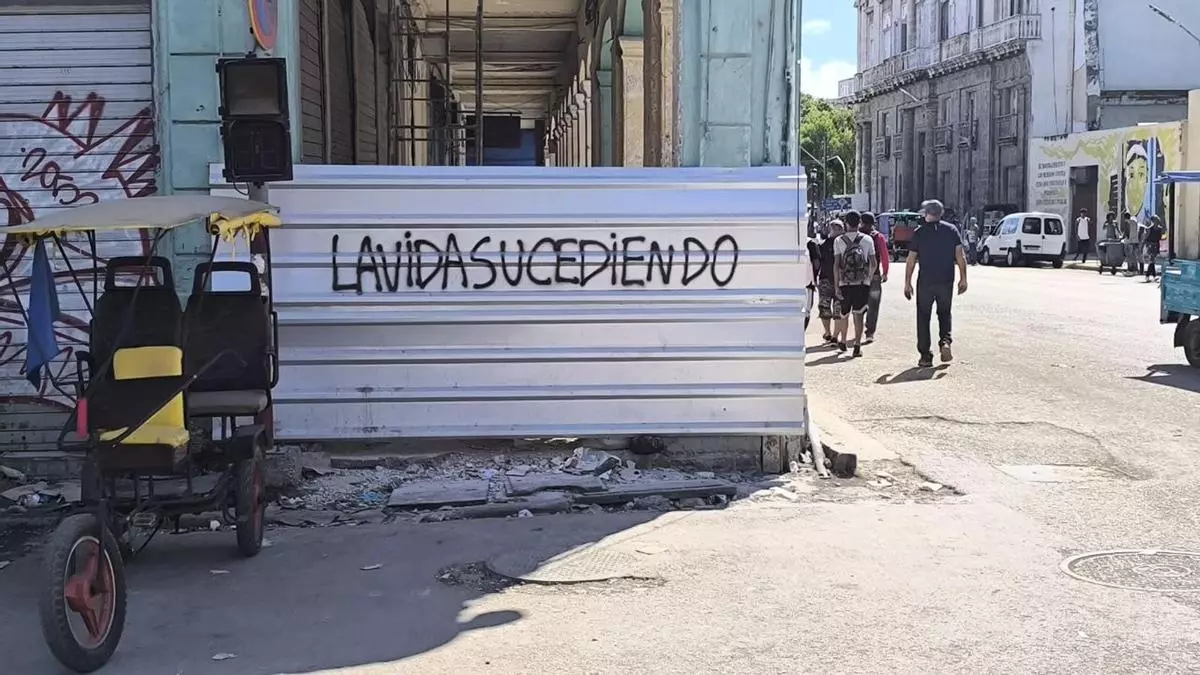
Illustration by Joven Cuba
By Dario Alejandro Escobar (Joven Cuba)
HAVANA TIMES – Life can take many turns. Some of them, frankly, are almost impossible to predict. For decades, for the vast majority of Cuban emigrants, the United States was the destination of choice. The existence of the Cuban Adjustment Act, successive waves of migration, and a well-established community in Florida reinforced the idea that reaching US territory meant that, sooner or later, you would find a place where you could prosper. And in general, that was the case, but that image is becoming increasingly difficult to reconcile with the scenes produced by Washington’s current immigration policy.
It is no secret that the Trump administration has made detention and deportation two pillars of its immigration policy. Beginning with the presidential campaign itself, Trump and his then vice-presidential candidate J.D. Vance warned that they would carry out mass deportations of migrants. In July 2026, Immigration and Customs Enforcement (ICE) made 49,571 arrests, the highest monthly figure of Trump’s second term. More than half of those detained had neither criminal convictions nor pending charges. Detentions are no longer concentrated at the border; they are also taking place during traffic stops, routine immigration appointments, and operations in communities and public spaces.
At first, many Cubans believed that this rhetoric did not include them. For a community accustomed for decades to exceptional treatment under U.S. immigration policy, this shift threatens to overturn several deeply rooted assumptions. Since the beginning of Donald Trump’s second term, having relatives in the United States, having lived in the country for years, or being involved in an immigration process no longer guarantees that a person will remain beyond the reach of detention by ICE.
In any case, perhaps the most extreme expression of this policy is occurring far from the United States—and also very far from Cuba. Washington has turned to agreements with third countries to deport migrants to nations with which they have no previous ties. African countries such as Eswatini, Liberia, and Equatorial Guinea are among the main destinations for these deportations.
In August 2026, a group of deportees sent by the United States arrived in Liberia. Cubans were among them. The migrants refused to get off the plane, arguing that Liberia was not their country and that they feared for their safety. Authorities told them they would be returned to the United States. The plane, however, ultimately ended up in Malabo, the capital of Equatorial Guinea, where they were forced to disembark. Reuters identified three Cubans among them, while El Nuevo Herald later reported that four Cubans were among the group involved in the transfer.
The case is part of a broader practice. Washington has signed agreements of this kind with several African countries, including Eswatini—formerly known as Swaziland—a small monarchy that has accepted migrants of other nationalities, including Cuban citizens. By the end of August 2026, more than 30 people had been transferred to that country under this mechanism.
The images speak for themselves. People who left Cuba seeking protection or better living conditions are being detained in the United States and then sent to an African country where they have never lived, have no family networks, and, in the vast majority of cases, do not even speak the language.
Social media has filled with testimonies from these people or their relatives asking for help or denouncing human rights violations by the current US government.
Deportations are only one part of the mechanism. Behind them is a vast structure designed to carry out this policy. Immigration facilities in poor conditions, allegations of abuse, transfers of detainees between different states without prior notification to them or their families, and legal proceedings that can drag on for months are all part of a system geared toward increasing the number of removals. For many Cuban migrants, the uncertainty that once ended upon arrival in the United States now continues even after they have crossed the country’s border.
There is also a major contradiction within the Cuban exile community itself. This policy is being carried out under an administration in which Marco Rubio, the son of Cuban immigrants and current Secretary of State, holds one of the most powerful positions. In Florida, Cuban-American members of Congress such as Mario Díaz-Balart and Carlos Gimenez continue to fully support Trump and much of his agenda, while focusing much of their public discourse on tightening sanctions and increasing pressure on the Cuban government.
Congresswoman María Elvira Salazar has very timidly questioned aspects of immigration policy and has called for protection for Cubans with I-220A forms who have no criminal records. But it is nonetheless hypocritical for part of the Cuban-American political representation to denounce every arbitrary arrest in Cuba with tremendous intensity while that same energy is almost nowhere to be seen when Cubans are detained by ICE, held in poor conditions, or sent to third countries. Something similar occurs within part of the Cuban media and from influencers in the United States. Although deportations receive coverage, a narrative centered on “criminals” frequently predominates, while the impact of these measures on people without criminal records who emigrated in search of better living conditions is pushed into the background.
Brazil offers a very different picture
A Cuban citizen who is in or arrives in Brazilian territory can apply for recognition as a refugee through Sisconare, the Brazilian government’s digital system for registering and processing these applications. The application can then be formalized with the Federal Police. Applying for refugee status and being recognized as a refugee are two different things. It is up to the National Committee for Refugees (Conare) to analyze each case. While the application is under review, the applicant can remain legally in the country and obtain documents such as a Cadastro de Pessoa Física (CPF) tax identification number and a work card, as well as access rights and services provided under Brazilian law.
Migrants can also move freely throughout the country and access public services. Brazil’s Ministry of Justice itself recognizes the right of asylum seekers and refugees to healthcare, education, social assistance, and free legal aid. Access to the Unified Health System and public education does not depend on Conare having already decided to recognize that person as a refugee.
This is extremely important. It means that a person can arrive in the country, request protection, obtain documentation, and live like any other Brazilian citizen while waiting for the government’s response. And Cubans are making broad and extensive use of this avenue.
In 2025, Brazil received 75,599 applications for recognition of refugee status. Of these, 41,919 were submitted by Cubans. They represented 55.4% of the total, and for the first time Cuba surpassed Venezuela as the leading nationality among those seeking refuge in the country. The number of Cuban applications increased by 88.1% compared with the previous year.
The 2026 data confirm that the phenomenon is continuing. This year, Cubans and Venezuelans once again ranked among the leading nationalities seeking protection in Brazil. According to the Observatory of International Migration, Cubans consolidated their position as the national group filing the largest number of asylum applications in the country. It is estimated that more than 100,000 Cubans are already in Brazil with various types of immigration status. Many are even leaving the United States and flying directly to the South American giant.
The route, however, is not without danger. In June, Brazilian police rescued 108 Cuban migrants in Roraima, on the border with Guyana, after they had crossed the northern border under precarious conditions. Five suspected human traffickers were also arrested. Following the operation, the Cubans were referred for immigration regularization procedures and assistance services.
It is important to clarify that there is no need to cross illegally into Brazil. Any migrant can arrive at a border checkpoint and request asylum from the Federal Police. They will not be deported.
In other words, when faced with an undocumented or vulnerable migrant, Brazil’s first approach is regularization. In the United States, amid the current immigration crackdown, even a person who entered legally through programs such as humanitarian parole may face detention and removal to another continent.
That said, this does not mean that obtaining Brazilian documentation is a panacea.
Integration is probably where Brazil still has a considerable debt to pay. The right to work exists on paper, but finding formal, well-paid employment can be more difficult. University degrees earned in Cuba must undergo recognition procedures that can be lengthy, expensive, and bureaucratic. Professionals trained as doctors, engineers, teachers, or journalists can spend years working in jobs completely unrelated to their qualifications.
Portuguese is another barrier. Although Spanish and Portuguese share many similarities, facing a job interview, pursuing university studies, or seeking skilled employment requires a command of the language that cannot be acquired immediately upon arrival in the country.
Brazil should develop broader Portuguese-language programs for immigrants that are directly linked to employment integration. It could also create faster and less expensive mechanisms for recognizing professional skills and degrees. In addition, it would be useful to strengthen connections between asylum seekers and companies that need workers, offer specific guidance for entrepreneurs, and better incorporate municipalities and states into integration policies.
Cuban migration has characteristics that make it possible to consider more specific policies. There are qualified professionals with experience in services, healthcare, education, tourism, and other fields. Cuban communities are growing in various Brazilian states, and this population could integrate more successfully if the government moved beyond simply guaranteeing documentation and also helped facilitate social mobility.
The case of the Federal University of Paraná, in Curitiba, is proving to be a successful model in this regard. There, several Cuban and Latin American professionals are able to obtain a Brazilian university degree through credential-recognition procedures offered by the institution. This is an example that should be replicated in every state in the country.
Some difficulties facing Brazil
Brazil has enough problems of its own to prevent any idealization. It has high inequality, informal employment, racism, xenophobia, and a bureaucracy capable of turning a simple procedure into months of waiting. Asylum also does not in itself guarantee economic stability or definitive recognition of refugee status. Nevertheless, while the United States intensifies immigration detentions and resorts to third countries to deport Cuban citizens, Brazil allows thousands of them to request protection and remain legally in its territory while their cases are evaluated. And that difference says a great deal about how the two countries understand the protection of migrants, many of whom are fleeing a context of profound crisis that makes it practically impossible to build a dignified life.
One country places those it says it “wants to save” inside a machinery increasingly geared toward mistreatment and expulsion. The other still faces serious shortcomings in terms of integration, but provides them with documents, authorizes their access to the labor market, and recognizes their human rights from the very beginning of the process. And so far, this has not depended on whether the government is on the right or the left; it is a state policy. Even under the previous government, which was on the far right, Cubans and other migrants found conditions in Brazil that allowed for reception and regularization.
For those who are already building their lives outside Cuba, or considering the possibility of emigrating, this contrast is worth taking into account.
They can choose between a destination where arrival may mean a detention center and another where it begins with documentation, access to employment, and rights recognized from the outset.
Everything seems to indicate that, at last, our north is becoming the south.
At least for a while.
First published in Spanish by Joven Cuba and translated and posted in English by Havana Times.
Read more from Cuba here on Havana Times.