- Conservationists are racing to rescue orangutans from fire-affected habitat inside an Indonesian oil palm concession.
- Some orangutans have been brought to safety, while others are believed to remain in the area.
- First Resources, which owns the concession, says it enforces a strict “zero-burning policy” across all planting activities.
- Another, larger conservation area that once supported an estimated 200 orangutans has also been affected by fire.
See All Key Ideas
JAKARTA — Conservationists are racing to rescue orangutans from a fire-ravaged peat-swamp forest inside an RSPO-certified oil palm concession in West Kalimantan, with smoke still rising and the ground remaining dangerously hot.
The 657-hectare (1,623-acre) forest, designated as a High Conservation Value (HCV) area inside PT Kayung Agro Lestari (KAL), is home to around 60 Bornean orangutans (Pongo pygmaeus), one of three orangutan species in the world and the only one found on the island of Borneo, according to conservationists.
The forest was also used in October 2015 to release four orangutans rescued by the Yayasan International Animal Rescue Indonesia (YIARI), a Borneo-based NGO working to establish and maintain sustainable orangutan populations.
Nearly 11 years after four orangutans were released there, the peat-swamp forest that provided their habitat has itself been almost completely affected by fire, according to satellite analysis by technology consultancy TheTreeMap.
This animation shows the progression of fire within and around the PT Kayung Agro Lestari concession in Ketapang (yellow lines), West Kalimantan, between 8 August and 12 September 2026. The sequence shows how fires progressively burned the HCV forests (turning from dark green to dark red) over the course of several weeks. Image courtesy of TheTreeMap/Nusantara Atlas.
The analysis indicates that one of the major fires began on Aug. 8 along a canal at the edge of the oil palm plantation in Ketapang district, before spreading westward into the HCV forest.
Conservationists are working to rescue orangutans still believed to be in the area. Some animals have already been brought to safety, while others are believed to remain in the affected forest.
The rescue effort has been complicated by the condition of the forest, where fallen tree trunks, lingering smoke and dangerously hot ground make movement difficult. Peat fires can continue burning beneath the surface even after flames are no longer visible, creating additional risks for both orangutans and rescuers.
Throughout August 2026, the YIARI team rescued seven individual orangutans affected by forest and land fires in Ketapang, West Kalimantan. Image courtesy of YIARI.
How many orangutans are left?
The exact number of orangutans that occupied the affected forest before the fires, and how many have survived, remains unclear.
PT Kayung Agro Lestari’s concession contains multiple High Conservation Value (HCV) areas totaling 3,844.52 hectares (9,497 acres), according to an HCV assessment included in an RSPO notification document dated January 2014. The assessment identifies two large conservation areas, covering 657.22 hectares (1,625 acres) and 2,330.88 hectares (5,758 acres), respectively, as well as smaller HCV areas associated with hills, rivers and other sites.
Spatial analysis by the NGO Sangga Bumi Lestari found that around 1,176.20 hectares (2,906 acres) of KAL’s HCV areas had been affected by fire.
Spatial analysis by Sangga Bumi Lestari which shows burned area inside HCV area in PT Kayung Agro Lestari palm oil concession in Ketapang, West Kalimantan, in 2026.
The 657-hectare conservation area supported an estimated 50 to 60 orangutans in 2019, according to biologist Erik Meijaard, managing director of scientific consultancy Borneo Futures, who worked with KAL to protect its orangutan populations beginning in 2011.
The larger, 2,330-hectare conservation area supported an estimated 200 orangutans before the fires, Meijaard said.
The HCV areas also supported diverse wildlife, including an estimated 360 species of mammals, birds, reptiles and amphibians.
Based on satellite imagery, much or nearly all of the 657-hectare area now appears to have been affected by fire.
“I was looking at a Sentinel image of 12 September and it looks like the 657 ha has been fully affected by fire,” Meijaard told Mongabay. “It is hard to say whether the forest can recover from this.”
That same Sentinel image indicates that at least half of the larger, 2,330-hectare HCV area has been affected by fire, Meijaard added.
First Resources, the Singapore-listed parent company of KAL, told Mongabay it enforces a zero-burning policy across its plantations and operates an integrated fire-management program that includes fire-prone maps, daily satellite monitoring, drone surveillance, ground patrols, firefighting teams and peatland water management.
First Resources said its monitoring indicated that the fires began on Aug. 8 along a canal at the edge of the KAL concession. The company said the canal, which it described as about 4 meters wide and 4 meters deep, together with firefighting efforts, held the fire at the concession’s perimeter until at least Aug. 18. It said fires originating outside the concession subsequently spread into areas under KAL’s management and became too large and fast-moving to be completely contained.
The company also attributed the broader fire conditions in West Kalimantan to prolonged dry weather associated with El Niño and community land-clearing practices that use fire.
First Resources disputed any suggestion that it had neglected the conservation areas, saying its conservation team had supported government authorities and other partners in monitoring wildlife and evacuating orangutans from the affected area.
It said prompt evacuation was necessary because fire-affected habitat can expose orangutans to respiratory distress and food shortages.
Meijaard said fires had been rare in the concession in the past, when the company paid two villages west of the concession to maintain a zero-burning arrangement for six years.
“The system worked very well, and after 2019, when the payment system was initiated, there were almost no fires,” he said.
In March 2025, First Resources announced the acquisition of PT Austindo Nusantara Jaya Tbk’s Indonesian plantation assets, including KAL.
“From what I understand, the company stopped paying the communities for zero burning, and I guess the current fires are the result of this,” Meijaard said.
An adult orangutan drinking from a peat river in the Tanjung Puting National Park area, Central Kalimantan. Image by Rendy Tisna/ Mongabay Indonesia.
Orangutans in peril
The rescue effort in KAL is part of a broader effort to protect orangutans from fires affecting their habitat across Indonesia.
Indonesian meteorologists have warned of elevated fire risks through October as climate forecasts point to a strengthening El Niño, a periodic warming of sea-surface temperatures in the central and eastern tropical Pacific Ocean that can alter rainfall patterns globally. In Indonesia, El Niño is commonly associated with hotter and drier conditions, which can increase the risk of forest and peatland fires.
The dangers facing orangutans in fire-affected habitats were highlighted by the recent death of Sampurna, an adult male orangutan found in a weakened condition near an oil palm plantation in Ketapang.
On Aug. 30, residents of Laman Satong village in Ketapang district found Sampurna near an oil palm plantation.
Komara, a YIARI veterinarian, said the animal was evacuated to the NGO’s rehabilitation center in Sungai Awan Kiri for treatment. Sampurna died several hours later after showing symptoms associated with smoke exposure.
“In conditions of severe exposure, especially when the smoke is very thick and lasts for several days, orangutans can experience respiratory distress and oxygen deficiency or hypoxia,” Komara said.
This male orangutan, named Sampurna, was found by residents in a weak condition near an oil palm plantation in Ketapang, West Kalimantan. Image courtesy of YIARI.
What about the certification?
KAL has been certified by the Roundtable on Sustainable Palm Oil (RSPO), a certification system for sustainable palm oil, since 2019, according to company information.
David Gaveau, the founder of TheTreeMap, which conducted the satellite analysis, said the certification should have protected the orangutan habitat.
“That certification should mean that this orangutan habitat is effectively protected. Yet much of the HCV forest has now burned,” he told Mongabay.
Gaveau said the case warranted an urgent, independent and transparent investigation.
“In my view, PT KAL’s RSPO certification should be suspended pending the outcome of that investigation. If violations are established, the Indonesian authorities should also impose substantial penalties,” he said.
Editor’s note: This article has been updated to include additional information from an RSPO HCV assessment, spatial analysis by Sangga Bumi Lestari concerning the extent of PT Kayung Agro Lestari’s High Conservation Value areas and the portion affected by fire, as well as a response from First Resources, the parent company of PT Kayung Agro Lestari, which was received after the article was initially published.
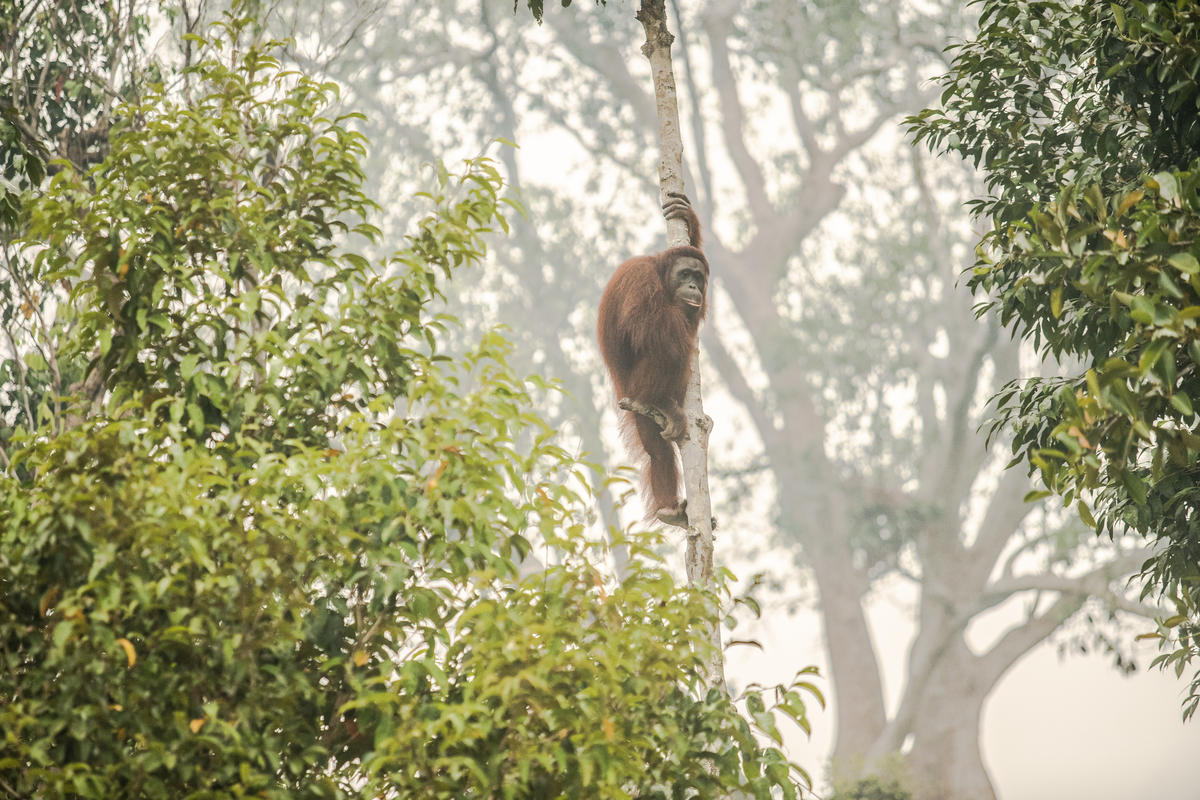
Banner image: An Orangutan climbs a tree as the area is covered by haze from forest fires at Salat island, Palangkaraya, Central Kalimantan. The smoke and flames threaten endangered species like orangutans that can only be found in Kalimantan and Sumatra. Image courtesy of Jurnasyanto Sukarno/Greenpeace
FEEDBACK: Use this form to send a message to the author of this post. If you want to post a public comment, you can do that at the bottom of the page.
Cite this article
Hans Nicholas Jong (2026). Rescuers race against time as fires ravage orangutan habitat inside Indonesian oil palm concession. Mongabay Conservation news. DOI: https://doi.org/10.66709/news-330015