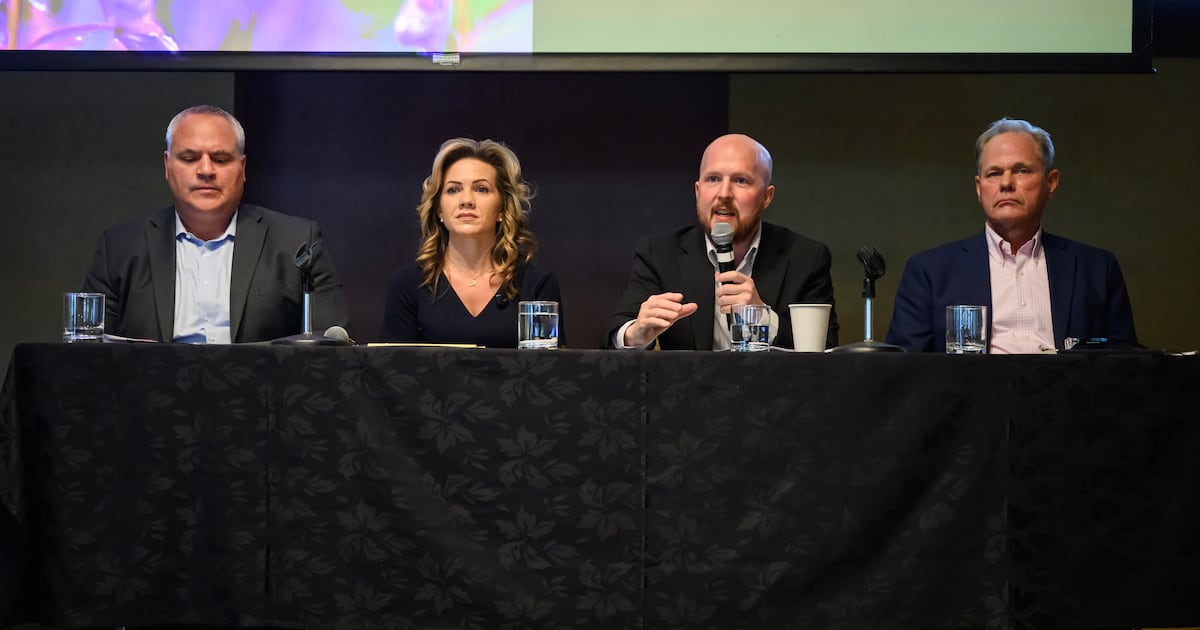
Jonathan Kreiss-Tomkins speaks during a forum for candidates for governor at the Alaska Hospital and Healthcare Association annual conference at the Alyeska Hotel in Girdwood on Wednesday, Sept. 16. Other candidates, from left, are Treg Taylor, Bernadette Wilson and Dave Bronson. (Marc Lester / ADN)
Treg Taylor, a Republican who weeks ago vowed to be the “last line of defense against Lower 48 liberals who hate our way of life,” is now asking Democrats and independents to vote for him.
Jonathan Kreiss-Tomkins, the only remaining Democrat remaining in the race, is pledging to put Republicans in his cabinet.
Dave Bronson is calling on his supporters to rank all Republicans in the race, even after Bernadette Wilson — the top GOP vote-getter in the primary — asked her supporters not to.
With the November ballot set in the governor’s race, candidates are grappling with the reality of the state’s ranked choice voting system — which rewards moderation and punishes extreme partisanship — even as the Republicans in the field are calling for the system to be abolished.
Taylor promises to ‘work across the aisle’
Taylor, a former state attorney general, developed a reputation for taking on partisan battles while serving in Gov. Mike Dunleavy’s cabinet. But in an interview this week, he said a series of television ads his campaign ran ahead of the primary were “mistakes.”
In those ads, Taylor had referred to the governor’s role as the “last line of defense against Lower 48 liberals who hate our way of life”; said he “took on the radical left as attorney general”; and promised to “stand with President Trump” and “stop the woke agenda.” The ads were the cornerstone of a campaign strategy that earned him 7.3% of the vote in the primary.
“I think we made some mistakes in the ads, just to be blunt with you. I’m proud of my record as the attorney general. But I think where we made the mistake is we should have talked about more of a unity,” Taylor said in an interview this week. “We should have talked about moving Alaska resources, those are the messages that I should have I should have included.”
“Those are some of the things that I would have done differently,” Taylor said.
Treg Taylor greets an attendee at the conclusion of a forum for candidates for governor hosted by the Last Frontier Republican Club at the Petroleum Club of Anchorage on Sept. 8. (Marc Lester / ADN)
Some of Taylor’s ads focused on the participation of transgender children in school sports. In the ads, Taylor promised he would “save girls’ sports.” The Dunleavy administration successfully pushed for transgender girls to be banned from playing on girls’ teams in Alaska public schools during Taylor’s tenure.
Taylor finished fifth in the primary but was elevated onto the top-four general election ballot after the second-place finisher, Democrat Tom Begich, dropped out of the race. Taylor was then taken off the ballot earlier this month for failing to follow Alaska’s campaign disclosure laws, only to be reinstated in a late-night decision by Republican Lt. Gov. Nancy Dahlstrom. The series of dramatic events left Taylor with what he describes as “whiplash.”
Since then, he has tried to portray himself as a moderate who can work across the aisle as he faces two other Republicans and a Democrat in the general election.
“Democrat, Independent, Republican — that’s not what defines us. Being Alaskan does. We’ve wasted too many years and too many opportunities playing party politics,” Taylor wrote in a text message to voters after Dahlstrom reversed her decision, allowing him to run for office.
In a series of candidate forums this month, Taylor has regularly mentioned that he was unanimously elected to lead the Attorney General Alliance, a group that brings together both Democratic and Republican top attorneys from most U.S. states. Taylor served as its chair in the six months preceding his resignation, a role he says proves his ability to work across party lines.
Treg Taylor gives opening remarks during a forum for candidates for governor at the Alaska Hospital and Healthcare Association annual conference at the Alyeska Hotel in Girdwood on Wednesday, Sept. 16. (Marc Lester / ADN)
While he was Alaska’s attorney general, Taylor placed himself at the center of political debates. Taylor oversaw millions of dollars in state spending on litigation against the administration of Democratic President Joe Biden; used state homeschooling funds to pay his kids’ Christian school tuition and defended the practice; blocked the dissemination of abortion medications in pharmacy chains in Alaska; and halted the Alaska Human Rights Commission’s review of complaints related to the rights of LGBTQ+ Alaskans.
But in a forum hosted by the Last Frontier Republican Club this month, Taylor said he would “get rid of partisan politics.” In his two-minute closing pitch, he mentioned the phrase “work across the aisle” three times.
[Alaska’s newly approved campaign contribution limits could be challenged, attorneys say]
Lone Democrat reaches out to Republicans
Taylor is not the only candidate trying to reach across the aisle.
Kreiss-Tomkins, the only Democrat in the race, said earlier this month that he wants his cabinet, if elected, to be made up of “one-third Democrat, one-third independent, and one-third Republican.”
“I ultimately want to have a cabinet and administration that represents all of Alaska,” Kreiss-Tomkins said.
Jonathan Kreiss-Tomkins answers a question at a forum for candidates for governor hosted by the Last Frontier Republican Club at the Petroleum Club of Anchorage on Sept. 8. (Marc Lester / ADN)
Almost two-thirds of Alaska voters are not registered with either political party. Just under a quarter of Alaska voters are registered Republicans. Less than 12% are registered Democrats.
The last time Alaskans elected a Democrat to serve as governor was nearly three decades ago.
Kreiss-Tomkins spent 10 years serving in the Alaska House, representing a Trump-voting district of Southeast Alaska that included his hometown of Sitka. Toward the end of his tenure, he co-chaired a bipartisan working group that considered solutions to the state’s ongoing fiscal crisis, though the group’s recommendations were not implemented.
As a former member of a bipartisan coalition in the House, Kreiss-Tomkins is the candidate most closely aligned with the coalitions that currently control both the House and Senate. To leave little room for doubt, he is touting endorsements from moderate Alaska Republicans.
The latest is from former state lawmaker Lesil McGuire, a Republican who ran in the gubernatorial primary, earning just 1.3% of votes.
“I want to support a candidate for governor that is open minded, a curious intellectual, committed to the challenges facing women in our state and to helping shape a future that will attract and retain young people,” McGuire said, explaining her decision to endorse Kreiss-Tomkins.
Even as Kreiss-Tomkins courts votes from across the aisle, he is drawing a sharp contrast between himself and the Republican candidates on the ballot. In a television ad that began airing this week, Kreiss-Tomkins portrays the three Republicans as successors to Dunleavy — who is termed out from seeking reelection after eight years in office.
“My opponents are running for Mike Dunleavy’s third term, using Juneau as a partisan playground,” Kreiss-Tomkins says in the ad.
Wilson questions bipartisanship
Bernadette Wilson speaks with attendees befor the start of a forum for candidates for governor at the Alaska Hospital and Healthcare Association annual conference at the Alyeska Hotel in Girdwood on Wednesday, Sept. 16. (Marc Lester / ADN)
In a forum held Wednesday, Wilson — who finished ahead of other Republicans in the primary — questioned the efficacy of the bipartisan caucuses that have formed in both the House and Senate, and dismissed the idea of working across the aisle.
“One of the strongest differences you have in this race is the mentality of how do you deliver. ‘We got to work across the aisle. We got to have bipartisan coalitions,’ ” Wilson said. “You guys have had that for more than eight years, by the way. We tried that during the Walker administration as well.”
Wilson asked the conference audience if they were better off for any of the last several administrations.
“This argument that you’re only worse off after the last eight years is a bunch of crap. We have not improved over the last 10, 20 or 30 years,” Wilson said.
Wilson and her campaign staff have not responded to multiple interview requests.
Both Taylor and Bronson, the former Anchorage mayor, are asking their supporters to rank all three Republicans in the race, even as Wilson, owner of a garbage disposal company and a former talk radio host, is calling on her supporters not to rank the other Republicans on the ballot.
“When you look at the mathematics of what’s going on, we have to have everybody rank, and that’s the message we’re giving Alaskans wherever we go. You have to rank. If you do not rank, your vote will get thrown away,” Taylor said this week.
Dave Bronson answers a question during a forum for candidates for governor at the Alaska Hospital and Healthcare Association annual conference at the Alyeska Hotel in Girdwood on Wednesday, Sept. 16. (Marc Lester / ADN)
Republicans are banking on the idea that each of them bring a unique electorate out to vote. The candidates contend that Kreiss-Tomkins has an advantage because he is not facing an ideologically aligned opponent. But if enough GOP voters turn out to vote, and enough of them rank more than one candidate, Republicans contend that they could overcome the disadvantages of a split electorate.
During the Wednesday forum, hosted by the Alaska Hospital and Healthcare Association, Taylor again called on voters to rank more than one candidate.
“We’d love to have you as our first vote. If not, rank us second,” Taylor told the audience.
Just two weeks earlier, Taylor promised he would endorse a combined Bronson-Wilson ticket if it were to emerge, but it never did.
Josh Church, Bronson’s running mate, said earlier this month that he had been willing to step aside if Wilson — who worked on Bronson’s 2021 mayoral campaign — had combined her ticket with Bronson’s.
“I was willing to consider stepping aside if it produced genuine conservative unity. After the primary, Dave formally made that offer on my behalf to the other conservative candidates on the ballot. Unfortunately, no unity agreement was reached,” Church said.
In a social media post, Bronson wrote “the healthy way to vote is to rank the people who actually align with your values. Rank all three, and keep your ballot alive through the rounds of RCV. That is how you win under the system we have.”
[Pro-repeal campaign runs ads that claim passing Ballot Measure 2 would ‘bring back’ open primaries]
Jonathan Kreiss-Tomkins, left, and Dave Bronson talk before the start of a forum for candidates for governor hosted by the Last Frontier Republican Club at the Petroleum Club of Anchorage on Sept. 8. (Marc Lester / ADN)
The Alaska Republican Party, whose leaders declared two years ago that their top priority is to eliminate Alaska’s ranked choice voting system, has yet to publicly endorse a candidate in the governor’s race or weigh in on whether GOP voters should rank multiple candidates in the race.
President Donald Trump, who has also called Alaska’s voting system “very fraudulent,” has not endorsed a candidate in Alaska’s governor’s race, though all three Republicans in the race have touted their affinity for his policy priorities.
Previous election cycles suggest that many Alaska voters are averse to ranking multiple candidates. That is in part the reason why Democratic former U.S. Rep. Mary Peltola was able to defeat two Republican opponents in a 2022 House race. In 2024, Peltola lost reelection after the Republican Party asked multiple Republican candidates to drop out of the race, paving the way for Nick Begich, running as the lone Republican left, to defeat Peltola.
It’s a strategy that the Alaska Democratic Party appeared to adopt this year when Begich, who finished second behind Kreiss-Tomkins in the primary, dropped out last month, allowing Kreiss-Tomkins to run with no ideologically aligned opponents.
Republican Shelley Hughes, a former state senator who finished eighth in the gubernatorial primary last month with 5.3% of the vote, said Wednesday that she was worried that right-leaning voters would “throw in the towel.”
“The best thing at this point to help get out the vote on the right … is some good old-fashioned competition,” said Hughes. “Competition makes voters want to show up on Election Day.”
Hughes endorsed Taylor but called on voters to rank the other two GOP candidates, as well.
“Anyone who is advising bullet-voting and not ranking is making it easier for the far-left liberal to win,” said Hughes, referring to Kreiss-Tomkins. “It’s all about math, not your political philosophy, not your position on ranked choice voting.”