09:07 | Cajamarca (Cajamarca region), Sep. 15.
On the windswept peaks of the Condebamba Valley—3,400 meters above sea level—time did not erase the memory of a sacred farewell.
At the summit known as Huaman Orco, where the Inca Empire built one of its most impressive logistical centers, archaeologists from the Wancasanga Project have just unearthed a haunting testament.
It is a ritual marking the closure of a pre-Hispanic building, which buried the memory of its first builders beneath layers of earth and stone.
The final offering and the guardian huanca
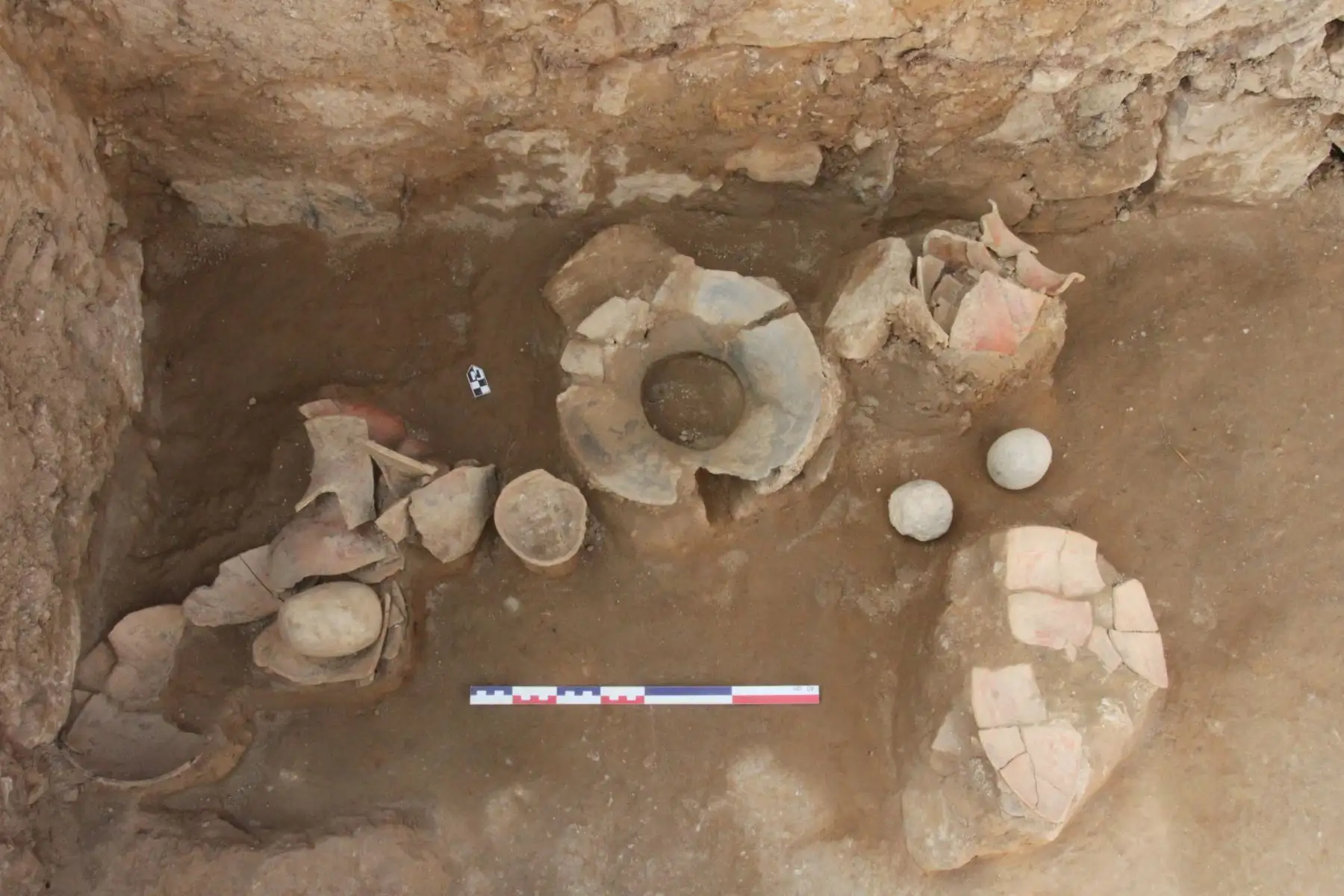
The heart of this discovery lies in Excavation Unit 03, in Plaza 1 of Sector C.
There, within the fill layer intended to ritually deactivate the space, archaeologists found 18 perfectly intact ceremonial vessels and 11 stone artifacts, including grinding stones, handstones, and hoes.
It was not simply construction debris, but a carefully arranged ritual deposit intended to render unusable the access opening connecting Enclosure 3 with the main plaza.
To crown the sacredness of the act, a huanca was placed vertically at the upper center of the seal—a guardian monolith that definitively closed off access to the enclosure.
Layers of history between mud and stone
This closure ritual buried the enclosure’s first construction phase, paving the way for subsequent renovations using ordinary masonry with cut stone blocks.
The architectural layers and recovered ceramic fragments, attributed to the Cajamarca and provincial Inca traditions, show that Wancasanga was a dynamic settlement, subject to social, political, and religious transformations.
The closure of the access did not represent an accidental abandonment, but rather the spiritual transformation of a sacred space within the site’s occupational sequence.
Echoes of a state enclave in Tahuantinsuyo
The significance of this closure ritual becomes fully apparent when contrasted with the structures uncovered in previous excavation areas led by Jerry Solano and funded by the Condebamba District Municipality.
In the same Sector C, earlier excavations had already uncovered twelve colcas (circular storage facilities) arranged in a harmonious crescent, revealing the colossal storage capacity and territorial control of the Tahuantinsuyo in Cajabamba’s highlands.
The closure in Plaza 1 thus completes the overall portrait of Wancasanga: a strategic site where imperial architecture coexisted side by side with devotion and sacred respect for the life cycle of its enclosures.
Three decades of waiting and a new research stage
This scientific revival picks up the thread established in 1989 by architect Jose Pineda Quevedo, whose initial survey of the valley’s settlement patterns established the site’s first sectorization.
More than three decades later, and under the authorization of Directorial Resolution No. 000302-2026-DCIA-DGPA-VMPCIC/, the team comprising archaeologists Oswaldo Ezeta and Diana Agapito, anthropologist Anny Vega, conservation specialist Susy Esquivel, and communications specialist Felipe Arroyo has brought Wancasanga back to the forefront of northern Peruvian archaeology.
The team has done so through surveys and excavations in Sectors C and D.
Living archaeology in Chauchabamba’s heart
The project goes beyond academic research to become a social model led by Mayor Manuel Villar and coordinated with Tania Ávalos, a representative of the Decentralized Directorate of Culture (DDC) in Cajamarca.
The community of Chauchabamba village proudly safeguards the site, directly participating in excavation activities and educational workshops organized at local schools.
Thanks to the strategic collaboration of the Yachayhuasi Museum of Cajabamba in the photographic documentation of the artifacts, Wancasanga is emerging as a heritage enhancement initiative that will strengthen research into the presence of the Tahuantinsuyo alongside neighboring sites such as Ichabamba.
At the same time, it will open new opportunities for tourism and cultural development for local residents.
(END) LPZ/MAO/MVB
Publicado: 15/9/2026