By Abdikarim H. Abdi Buh
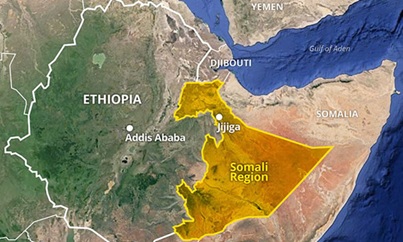
The Somali Regional State of Ethiopia has undergone a remarkable transformation in security and stability, emerging as one of the country’s most peaceful and secure regional states after decades of conflict and instability. That transformation is perhaps most visible in Jigjiga, the regional capital, where senior political leaders can move among ordinary citizens with a level of public access and security that would be difficult to imagine during the region’s years of armed conflict.
Prime Minister Abiy Ahmed, Somali Regional State President Mustafa Omer, Somalia’s President Hassan Sheikh Mohamoud and Djibouti President Ismail Omar Guelleh have all been able to participate in public events in Jigjiga without the kind of extraordinary security environment often associated with high-level political gatherings elsewhere in the region.
Jigjiga has consequently become more than the administrative capital of the Somali Regional State. It has increasingly developed into a venue for national and regional political meetings, conferences and public events. Indeed, major conferences involving Ethiopia’s regional states have increasingly been hosted in Jigjiga, reflecting the city’s growing reputation as a secure and accessible political centre.
A Region That Has Changed Its Security Story
The transformation becomes even more striking when viewed against the region’s recent history. For years, the Somali Regional State was associated with armed conflict, political instability and insecurity. Roads and commercial routes were vulnerable, communities lived with uncertainty, and the presence of armed groups profoundly affected daily life.
Today, the picture is dramatically different. One of the clearest signs of the change is the movement of commercial trucks across the region. Trucks can now travel along major routes day and night without disruption and insecurity, strengthening trade and connecting communities to markets inside Ethiopia and across the wider Horn of Africa.
For businesses, transporters and ordinary citizens, this may be one of the most important measures of whether security has actually improved. Security is not simply about the absence of fighting. It is about whether a farmer can take livestock to market, whether a trader can transport goods, whether a family can travel after dark and whether communities can conduct their daily lives without fear.
By those measures, many residents believe the Somali Regional State has made enormous progress.
Mustafa Omer: No Return to Armed Conflict
It is against this backdrop that President Mustafa Omer has sharply criticized renewed calls by elements of the Ogaden National Liberation Front (ONLF) for a possible return to armed struggle.
Mustafa said groups he described as politically failed were attempting to create expectations among the population that a new political transformation—or even renewed conflict—could emerge in the region.
He argued that Ethiopia is currently facing serious political and security challenges, with armed confrontations continuing in parts of the country, creating an environment in which some groups may attempt to revive earlier conflicts.
The President was particularly critical of organizations that, in his view, spent decades pursuing political and armed struggle without delivering the changes they promised the Somali population.
“There are groups telling people that change is coming and seeking to create conflict in the region. These are politically failed groups that have spent more than 42 years pursuing an unproductive political struggle,” Mustafa said. He also dismissed what he described as narratives circulating through the media, arguing that such messaging could not fundamentally alter the political realities of the region.
Mustafa urged residents not to be drawn into what he characterized as false expectations, saying the decades of armed and political struggle had failed to produce the promised progress. “For those 40 years, there has been nothing but decline; there has been no progress,” he said. His message was unequivocal: The Somali Regional State should not return to armed conflict.
Why the Public Remembers the Past
For many residents, the debate over ONLF is not an abstract political argument. The region’s decades-long conflict left deep memories of insecurity, displacement, economic disruption and fear. That history explains why calls for a return to armed struggle encounter resistance among the population.
The strongest argument against renewed conflict may therefore come not from government officials, but from the experience of ordinary people who remember what life was like when armed confrontation dominated the region.
For those residents, the period of ONLF’s armed struggle represents one of the darkest chapters in the modern history of the Somali Regional State. The prevailing public sentiment among many residents is increasingly straightforward: They do not want to go back.
They want roads that remain open, markets that function, trucks that move safely, businesses that operate, children who attend school and communities that can live without the constant fear of renewed violence.
ONLF Faces an Uncertain Future
Mustafa’s remarks come as ONLF itself faces political and organizational divisions. Different factions have emerged within the movement, with competing leaders advancing different strategies for the organization’s future.
The external faction led by Abdirahman Mohamed Sheikh Mahdi has remained strongly opposed to the policies of the Ethiopian government and the Somali Regional State administration. The faction recently suggested that a return to armed struggle could become possible, reigniting debate over ONLF’s future and the region’s political direction.
Another faction, led by Abdikarim Sheikh Muse Qalbi-Dhagah, is based in Jigjiga and has pursued a political path, with ONLF’s internal organization moving toward participation in the region’s political and electoral system.
The divisions illustrate a fundamental strategic choice confronting the movement: whether to pursue political change through institutions and elections or return to confrontation. For the Somali Regional State, the answer from the administration is clear. The region’s future should be determined through politics, dialogue and peaceful political competition—not through guns.
Security as the Foundation of Development
The importance of the region’s security transformation extends beyond politics. Peace has economic consequences. A secure road network allows livestock and commercial goods to move. Safe cities attract businesses. Political stability makes it easier to organize conferences and bring national and international visitors to the region. Improved security also creates opportunities for investment in infrastructure, tourism, trade and services.
Jigjiga’s emergence as a conference destination is therefore symbolic of something larger. A city once associated with the instability of a conflict-affected region can now host national political gatherings and receive senior leaders without being defined by insecurity. That is a profound transformation.
The Somali Regional State is not without challenges. Ethiopia continues to face serious political and security problems, and the region itself must continue strengthening institutions, economic opportunity and public accountability. But the security gains of recent years should not be underestimated.
The Choice Before the Somali Regional State
The debate over ONLF ultimately presents the Somali Regional State with a choice between two very different futures. One path leads backward—to armed confrontation, insecurity, disrupted trade and renewed fear.
The other leads forward—to political competition, economic development, institutional strengthening and deeper integration with Ethiopia and the wider Horn of Africa. For residents who remember the consequences of conflict, the choice may already be clear.
The Somali Regional State has experienced the cost of war. Its people now want to experience the benefits of peace. The region’s most powerful message to those advocating a return to armed struggle may therefore be found on its roads, in its markets and in its cities: life has changed, and the people do not want to surrender that progress.
The transformation of the Somali Regional State is ultimately a reminder that security is not an abstract political slogan. It is the freedom to travel, trade, work, meet, build and live without fear. And for a region that once endured decades of conflict, that freedom may be its most valuable achievement.
Abdikarim H. Abdi Buh
Email: abdikarimshak@gmail.com