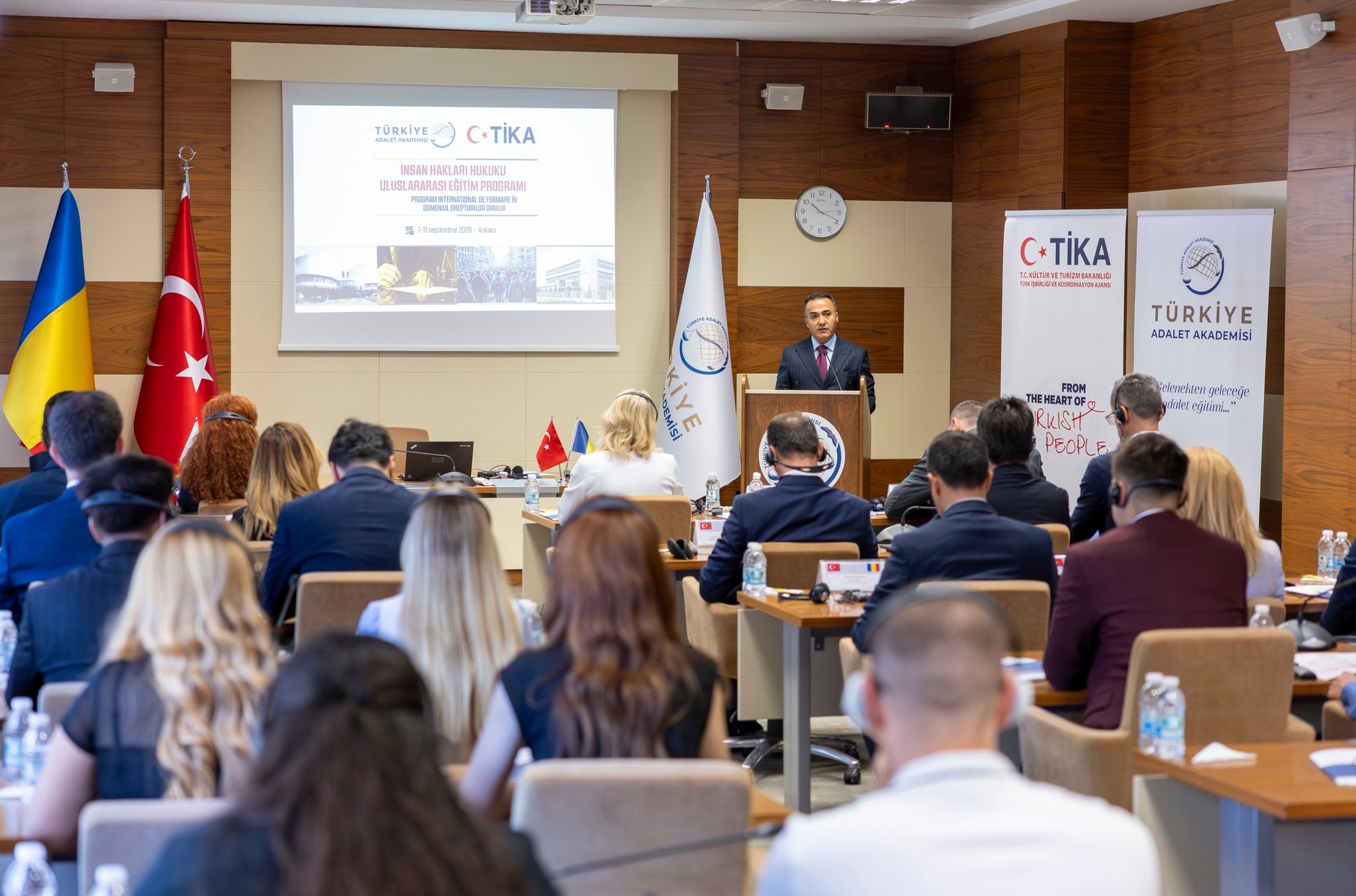
Turkey hosted Romanian judicial council members and trainee judges and prosecutors for human rights training in Ankara from September 7 to 11, while applications against Turkey made up 40 percent of the pending caseload at the European Court of Human Rights (ECtHR).
The Turkish Justice Academy (TAA) held the program with the Turkish Cooperation and Coordination Agency (TİKA).
The delegation included members of Romania’s Superior Council of Magistracy, officials from the country’s National Institute of Magistracy and Romanian judicial trainees.
Sessions covered the United Nations human rights system, the European Convention on Human Rights, the right to a fair trial, liberty and security, privacy, freedom of expression and property rights.
The delegation also visited Turkey’s Board of Judges and Prosecutors (HSK), the Supreme Court of Appeals, the Constitutional Court and a courthouse in Ankara.
Metin Yıldırım, head of the academy, said judges and prosecutors should give priority to human rights in their decisions and investigations.
The program prompted criticism from Ufuk Yeşil, a former Turkish prosecutor with a doctorate in public law, who questioned what Turkish institutions could teach their Romanian counterparts in light of Turkey’s record before the Strasbourg court.
Acaba Romanya HSYK Üyelerine ve Hakimlere Ne Anlattılar?
✅Türkiye Adalet Akademisi’nde Romanya Hakimlerler ve Savcılar Yüksek Kurulu üyeleri ile hakim-savcı adaylarına ”insan hakları eğitimi” düzenlenmiş. Konu insan hakları olunca, ister istemez akla şu soru geliyor; acaba… pic.twitter.com/2H6YH45QwM
— Ufuk YEŞİL (@DrUfukYesil33) September 13, 2026
“One cannot help but ask what they told Romania’s judicial council members and trainee judges and prosecutors,” Yeşil wrote in Turkish.
ECtHR figures dated June 30 show that 56,500 applications were pending before the court. Turkey accounted for 22,600 applications, or 40 percent of the total, while Romania accounted for 2,100, or 3.7 percent.
Turkey’s pending application count was almost 11 times that of Romania.
The court dealt with 9,865 applications concerning Turkey in 2025. It declared 6,302 inadmissible or struck them from its list.
The ECtHR delivered 74 judgments concerning the other 3,563 applications and found at least one rights violation in 66 of them.
For Romania, the court dealt with 3,314 applications. It declared 3,230 inadmissible or struck them from the list and delivered 29 judgments concerning 84 applications. It found at least one violation in 20 judgments.
The number of judgments does not match the number of applications because the court sometimes combines applications that raise the same legal issue.
Yeşil said 3,393 of the Turkish applications decided in 2025 were lodged following a failed coup on July 15, 2016 and were grouped under 28 judgments.
His count also found that the court issued findings under Article 7 of the convention concerning 1,808 applicants from Turkey during the year. Article 7 bars punishment for conduct that was not an offense under the law when it took place.
Many of the cases arose from Turkey’s prosecution of alleged members of the faith-based Gülen movement after the coup attempt. The Turkish government accuses the movement of organizing the attempt, although the movement denies any involvement.
The ECtHR has found that Turkish courts violated the convention by treating the use of the encrypted ByLock messaging application as proof of membership in a terrorist organization without an individual review of each defendant’s conduct.
Turkey also trails Romania in closing leading cases under the supervision of the Council of Europe’s Committee of Ministers. Such cases identify structural or systemic problems that can require changes to laws or judicial practice.
The committee’s 2025 report lists 454 leading cases concerning Turkey since the country joined the convention system. Of those, 311 had been closed and 143 were still under supervision, giving Turkey a closure rate of about 68.5 percent.
Romania had closed 259 of its 342 leading cases, a rate of about 75.7 percent.
The European Network of Councils for the Judiciary (ENCJ) suspended the HSK’s observer status in 2016, saying the Turkish body no longer met its requirements for independence from the executive and legislature.
The network said in 2020 that the situation had not improved and had instead deteriorated.
The academy said its work with Romania would continue through exchanges and plans for joint training materials on data protection, expression online, artificial intelligence in judicial proceedings and electronic evidence.
The World Justice Project’s 2025 Rule of Law Index ranked Romania 44th and Turkey 118th among 143 countries and jurisdictions.