- A clownfish’s defense of her eggs became one of the final recorded moments on a Singapore reef buried by land reclamation.
- Singapore has lost about 65% of its coral reef habitat and more than 45% of its original seagrass cover, largely to coastal development.
- The proposed Western Island has renewed concern about the future of the reefs and marine life around Singapore’s southern islands.
- This is a reflection by Mongabay founder Rhett Ayers Butler on what reclamation looks like below the water.
See All Key Ideas
Twenty years ago, scientist and Mongabay board member Debby Ng joined a team documenting life at Terumbu Bayan, a coral reef south of Singapore that was about to be reclaimed.
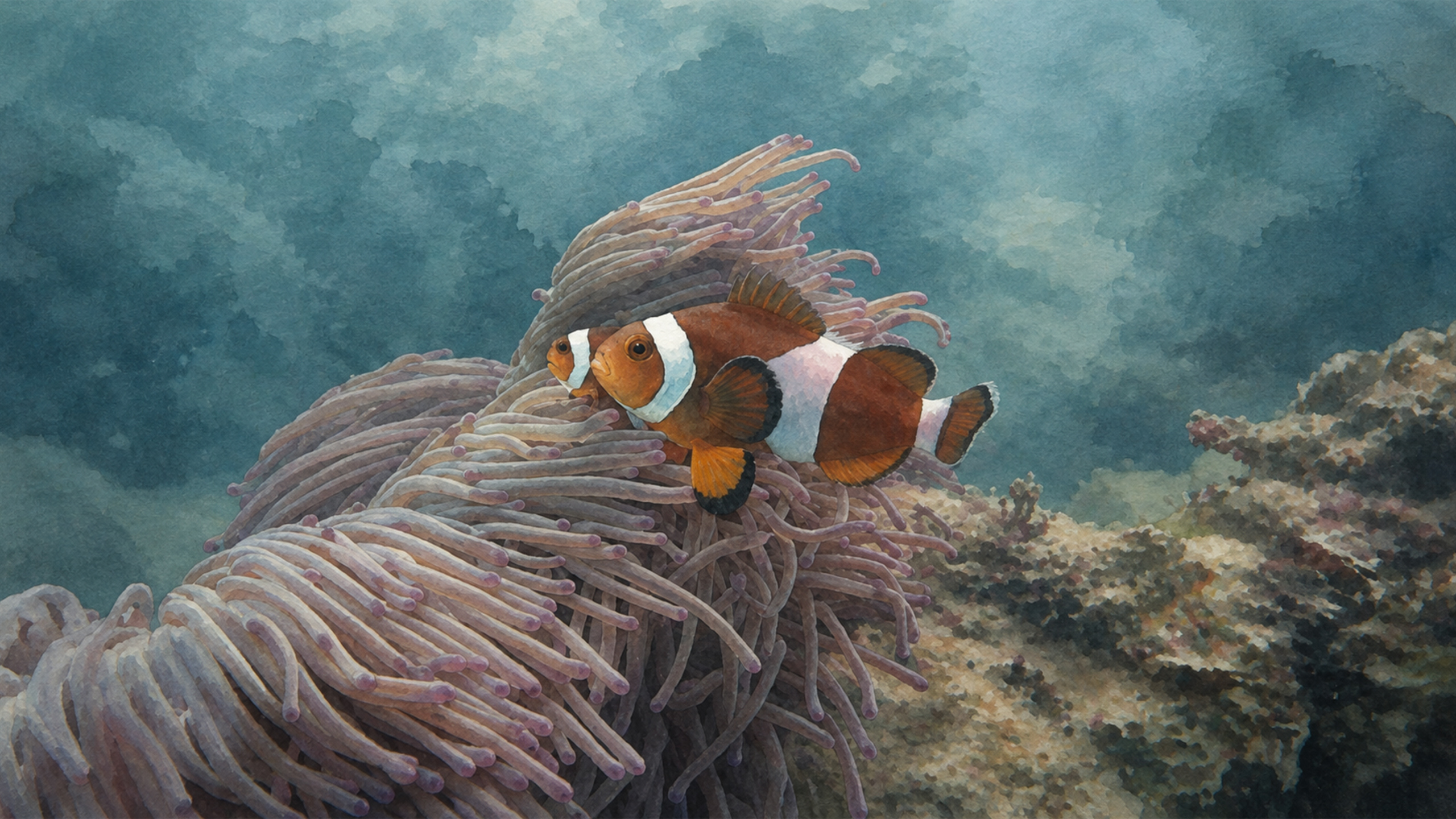
There she encountered a pair of false clownfish living in an anemone.
The mother was unusually aggressive, even for a species known to be feisty. She repeatedly charged Debby, a diver thousands of times her size, biting her several times. Then Debby saw what she was protecting: a brood of eggs. She could already see tiny eyes through the thin membranes.
Eyes of the brood of false clown anemonefish. Photographed by Debby Ng in 2006.
Soon an alarm sounded, calling Debby and the other scientists out of the water.
From the dive boat, they watched the first barges tip rock and fill directly into the channel, sending a plume of sediment through the shallows where they’d been swimming minutes earlier.
The team had salvaged some of the hard corals and a tiger-tail seahorse, but there was only so much they could move. The smaller animals, including shrimp and nudibranchs, had to be left behind along with topshells that sat in crevices and cowries with eggs attached to the reef.
Debby still remembers that clownfish.
False clown anemonefish parents. Photo by Debby Ng.
I first wrote about the dive last year in Requiem for a Clownfish. It resurfaced for me recently after The Woke Salaryman adapted the account into a comic.
In August, Prime Minister Lawrence Wong announced that several islands south of Jurong Island could be merged into a new “Western Island” to provide land for industry, defense, and power generation. The boundaries have yet to be settled. The Ministry of National Development told Channel NewsAsia (CNA), a state-owned broadcaster, that environmental and engineering studies would inform the plans, and that stakeholders would be consulted before studies and work began.
Pulau Hantu, a popular local dive site, sits among the islands under consideration. Terumbu Bayan was nearby. Its burial joined Bukom and Busing islands for a petrochemical complex. Today, Google Earth shows pipes, processing towers, roads, and industrial buildings where the reef once was.
Google Early image of the area around Terumbu Bayan in 2003.
Google Early image of the area around Terumbu Bayan in 2025.
By 2017, about 65% of Singapore’s coral reef habitat had been lost to reclamation, according to a paper published in the International Journal of Environmental Science and Development by researchers at the National University of Singapore. Over roughly the same period, Singapore’s land area had increased by more than a fifth.
Underwater visibility had fallen from about 10 meters in the 1960s to less than two by the time of the study. Suspended sediment blocked sunlight, restricting coral growth to shallower water. Sediment also settled on the corals themselves.
Monitoring of the surviving reefs showed that coral cover had stabilized after earlier declines, but the types of corals are changing, coral biologist Karenne Tun of the National Parks Board told CNA in 2023.
“Previously, we might have had more branching corals. Branching corals will attract different kinds of biodiversity,” she said.
Off Pasir Panjang Terminal, seagrass grows on the submerged Cyrene Reef. It is one of Singapore’s largest remaining continuous meadows, along with Chek Jawa on Pulau Ubin. Twelve seagrass species have been recorded in Singapore’s waters. Dugongs are still seen feeding in the meadows.
In 2024, The Straits Times reported that Singapore had lost more than 45% of its original seagrass cover to coastal development and reclamation over the previous five decades.
Map derived from Remote Sensing. 2023, 15(9), 2415; https://doi.org/10.3390/rs15092415
Chek Jawa had been scheduled for reclamation too. In early 2001, Singapore’s National Parks Board (NParks) asked the Raffles Museum of Biodiversity Research whether it wanted to make a salvage collection there. Researchers and volunteers went out before sunrise to collect specimens.
A volunteer suggested writing a magazine article as an obituary for Chek Jawa, recalled N. Sivasothi, then a research officer at the museum. The museum also began offering public walks. More than 1,000 people came over two days that October.
Guides worried about the damage so many feet could do. They kept reminding themselves that the shore was due to be buried the following month. Visitors’ responses were collected and sent to the government, alongside scientific findings and proposals. In December that year, Sivasothi attended a meeting at the ministry and learned that Chek Jawa had been granted a reprieve.
At Sultan Shoal, a reef threatened by construction for Singapore’s Tuas container port, the response was to relocate corals. In 2013–14, about 2,300 colonies were moved to other islands. A related research project raised broken coral fragments in underwater nurseries before transplanting them. The researchers attributed the high survival in the nurseries partly to regular maintenance, including scrubbing unwanted growth from the supporting mesh.
In September 2024, NParks and its partners also announced a project to restore seagrass. One problem was keeping the transplants in place: strong currents can wash them away. Researchers planned to test biodegradable mats made from coconut fiber and calcium carbonate to hold plants and sediment in place, and to study how to grow more plants from seed.
“There is no point putting it out if they’re all going to go away within the next few months,” NParks’ Samantha Lai told The Straits Times.
Around the proposed Western Island, divers are waiting to learn where they will still be able to go. Serene Pek, whose company Cuddlefish Divers has run local trips for eight years, told CNA that deteriorating water quality or restrictions on access could affect the business.
Creatures on Terumbu Bayan reef just prior to filling: 1) flatworm; 2) Cowrie with its batch of eggs; 3) Sea slug; 4) nudibranch; 5) cardinal fish 6) brood of False clown anemonefish. Photographed by Debby Ng in 2006.
At nearby Terumbu Bayan, the reclamation went ahead in 2006. In Debby’s photographs taken before the reef was buried, a cowrie sits over its eggs. A whip shrimp holds on to a sea fan. The clownfish faces the camera, close enough to bite.
Banner image: Illustration of the clownfish photo taken by Debby Ng in 2006.