Downtown Hope Center maintenance manager Chris Conners paints a baseboard in a building that will soon house the Hope Academy program on Thursday, Sept. 10. (Marc Lester / ADN)
Chris Conners applied fresh white paint to the walls of a downtown office building Thursday, sprucing it up for new tenants.
The former Port Heiden resident will soon be among them. He’s the maintenance manager at the Downtown Hope Center, an expanding homeless shelter and life skills laboratory that helped Conners turn his life around after spending 34 years behind bars.
The Hope Center is rapidly growing with the recent purchase of the Plaza 201 building on East Third Avenue thanks to grants, donations and a $1 million cash infusion from Samaritan’s Purse, a faith-based humanitarian organization. Plans are unfolding at the Hope Center for the expansion of life transformation and job training programs that help reduce homelessness and recidivism among Alaska’s formerly incarcerated population.
These evidence-based programs and others like it across the country have a proven track record, according to multiple studies, and Conners, 58, could be described as a prime example.
Conners shot and killed his mother, brother and a family friend in the village of Pilot Point during a drunken rage at age 15. Besides the homicides to which he pleaded no contest, Connors wounded four others during the shooting rampage in the summer of 1983. Family dysfunction, alcohol abuse and generational trauma fueled the killings, which were covered by the Anchorage Daily News in the 1988 Pulitzer Prize-winning series A People in Peril.
After spending the rest of his teenage years and most of his adult life in prison for his crimes, Conners entered a halfway house in Anchorage and soon joined the Downtown Hope Center’s culinary arts program, called Feed Me Hope, in 2017.
A variety of vegetables grows in a rooftop garden at Downtown Hope Center on Thursday, Sept. 10. (Marc Lester / ADN)
Offered to people who are homeless or reentering society after prison, the culinary arts program, and a similar one in baking, teaches students practical skills they can use to start a business or find a job.
Conners said he had zero interest in cooking but wanted to please his parole officer, so he completed the 16-week program, which has since grown to four months. He credits both the Downtown Hope Center and the Department of Corrections for helping him create a productive life.
“The DOC doesn’t have many success stories,” Conners said. “I’m one of them.”
Sherrie Laurie is the executive director of Downtown Hope Center. (Marc Lester / ADN)
Sherrie Laurie, the Hope Center’s executive director, has known Conners for nine years since he started the culinary program. Conners has gone on to develop skills and job experience in carpentry, auto repair and home remodeling. He’s stayed out of trouble, owns a condo and truck and supervises others at the Hope Center, she said.
“He’s the model employee,” Laurie said. “It’s why we do this.”
By “this” she means offering people a second chance through compassion, job training, nourishing food and acceptance.
This story has been made free to access as a public service.
This story was reported, and made available without a subscription, with support from the Alaska Community Foundation. If you’d like to help us continue expanding local news coverage and access to essential information, you can subscribe or make a tax-deductible donation to ADN.
‘A loving environment’
A FedEx pilot for two decades, Laurie began volunteering at what was then the Downtown Soup Kitchen after she retired. By 2016, she had taken on more responsibility and had a vision for what the place could be.
Laurie created life transformation and job skills courses where students learn about financial literacy, time management, interviewing techniques, resume writing, personal responsibility and other features of daily living that can set someone up for success. Under Laurie’s direction, the soup kitchen morphed into what is now the Downtown Hope Center.
The programs have a 90% job placement rate for those who complete the culinary arts and baking classes, Laurie said. She plans to build on that with new construction, plumbing, electrical, HVAC and other training programs, including esthetician and tattoo removal, in the new building. And she’ll also add a 30-bed dorm for men in the existing location on the corner of Third Avenue and Cordova Street for those participating in the new programs. There will also be a street-side bake shop open to the public and a used clothing boutique.
Sherrie Laurie, executive director of Downtown Hope Center, looks at portraits of people who have graduated from the center’s culinary arts and baking programs on Thursday, Sept. 10. (Marc Lester / ADN)
Brystal Mann, a baking program graduate, is helping Laurie make it happen.
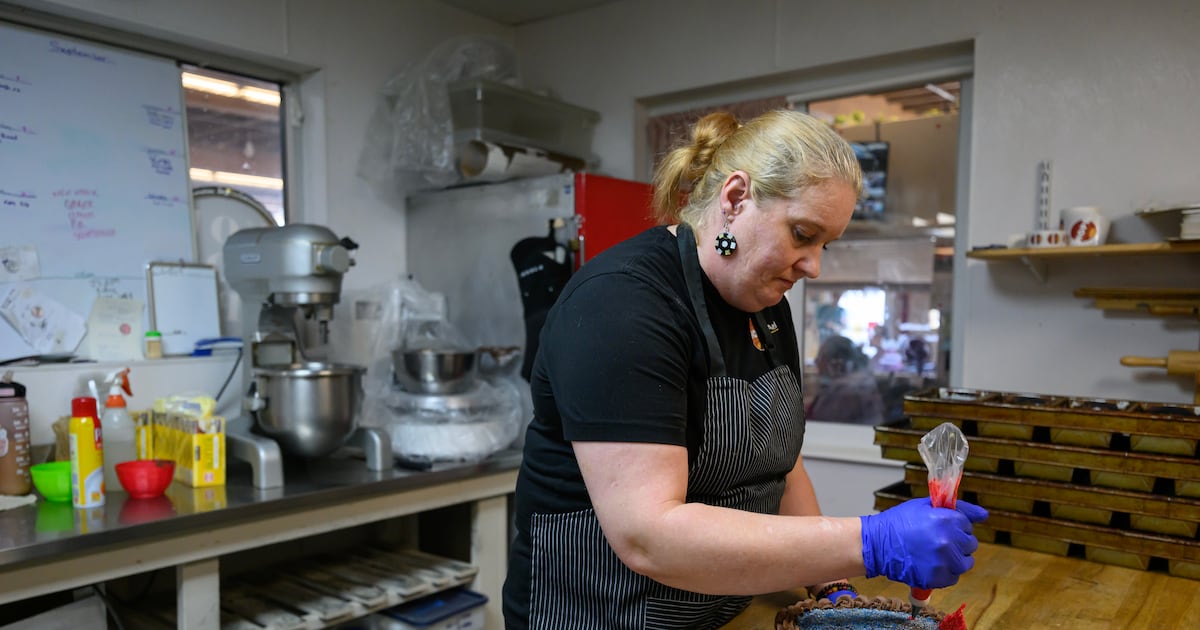
Formerly of Juneau, Mann fell into homelessness and drug addiction in Anchorage. To fuel her meth and fentanyl use, Mann turned to crime. She found herself in and out of prison but made her back way to the Hope Center for food and a warm bed. Something finally clicked when she stuck with the baking program. Cake decorating became her specialty.
Mann’s path out of addiction was one of fits and starts, a common feature of recovery. Mann relapsed and returned to prison a few times. A therapeutic, faith-based program offered at Hiland Mountain Correctional Center helped steer her life on a different course, she said. After Mann’s release, the Hope Center became the north star she needed to stay on track.
“It provided a loving environment to help me heal. Even when I was messing up, they gave me the grace to keep going,” Mann said.
Mann now works as Laurie’s executive assistant. Her responsibilities include making bank deposits, answering phone calls and emails, writing a newsletter and maintaining the center’s social media presence. She wants to take computer classes to expand her digital skills.
Brystal Mann is an administrative assistant for the executive director of Downtown Hope Center, which recently purchased an office building to expand its programs and services. (Marc Lester / ADN)
Like Conners and others who have graduated from some of the center’s programs, Mann credits the place with saving her life.
“This place is my family, my support,” Mann said. “I don’t know where I would be without it.”
‘They fed me’
Programs like the ones offered at the Downtown Hope Center are critical for lowering Alaska’s staggeringly high recidivism rates and shrinking its homeless population, said Dean Williams, a former commissioner of corrections in Alaska and former executive director of the Colorado Department of Corrections.
“Alaska still has one of the highest recidivism rates in the country, hands down, and it’s been that way for a long time,” said Williams, vice president of the board at the Hope Center and a criminal justice consultant who lives in Eagle River.
According to research by the Alaska Criminal Justice Commission, almost two-thirds of those released from prison return within three years. Some 62% return to jail or prison within the first three months of getting out. Alaska Natives are disproportionately represented in both the prison population and in recidivism rates, according to a study by the Alaska Federation of Natives, the University of Alaska and the Alaska Department of Corrections.
There’s enough research showing that investments in programs like the ones offered at the Hope Center work — there’s just not enough of them, said Williams, a former director of the center before Laurie.
He helped it grow from its soup kitchen origins into what it is today, which, along with the job training, also includes a catering business, a food truck and an apartment building called Sweet Hope for women transitioning out of homelessness.
Aeriel Reardon decorates a birthday cake in Anchorage’s Downtown Hope Center. Reardon is a graduate of the Hope Center’s baking and culinary programs. (Marc Lester / ADN)
Nametags for volunteers hang inside Downtown Hope Center. (Marc Lester / ADN)
Due to the 80-bed center’s popularity and the growing need for shelter beds in Anchorage, space became tight at the existing building at 240 E. Third Ave. But across the street, a nearly 15,000-square-foot building beckoned.
The Plaza 201 building was listed for $2.3 million. For the privately funded, donation-reliant Hope Center with an annual budget of $2.9 million, the price tag seemed possibly out of reach.
But Laurie knew someone who might help: Franklin Graham, son of the late American evangelist Billy Graham, who died in 2018.
The younger Graham is president and chief executive of Samaritan’s Purse. The nondenominal Christian organization, with a $1.3 billion annual budget, provides emergency relief and humanitarian aid in disaster and war zones around the world, and also works to address homelessness.
When Graham visited the Downtown Hope Center and learned about its work and the new building it was eyeing across the street, he stepped in with a $1 million gift.
“When I toured the Hope Center several months ago and met with Sherrie Laurie, the executive director, I was impressed with their dedication and how they are making an impact on so many lives. They have rolled up their sleeves and given themselves to help people in need and show them the love of Jesus Christ,” Graham said in an emailed statement on Friday.
The building sale closed on Aug. 17, Laurie said.
Katrina James is the kitchen manager for Downtown Hope Center. (Marc Lester / ADN)
Katrina James, 57, had her sleeves rolled up on a recent afternoon. As the kitchen manager at the Hope Center, James had spent the morning prepping sandwich fixings and 80 gallons of egg drop soup for a long line of homeless residents who lined up at a window for the free lunch.
“I try to make the soup hearty because sometimes it’s the only meal they’ll have all day,” James said.
A New Jersey native, James is a graduate of the culinary arts program and attests to its effectiveness. She fell into homelessness after losing her job and being unable to pay rent. She spent a winter camping in the woods near the South Anchorage Target. After the winter cold became unbearable, she made her way to the Hope Center.
“I was broken when I came here,” James said. ”They let me in and they fed me. I was a wreck.”
Downtown Hope Center volunteer Auriana Smith fills cups with egg drop soup to hand out at midday on Thursday, Sept. 10. (Marc Lester / ADN)
• • •