Juneau airport eyes new agreements with Alaska, Delta airlines
Published 12:30 pm Friday, September 11, 2026
By Jeffrey Kennett Juneau Empire Writer
Juneau International Airport is preparing to spend up to $100,000 on outside expertise to update the financial model that determines how operating costs are divided among airport users.
Staff asked the Airport Board on Thursday, Sept. 10 to authorize professional consulting services for the financial overhaul and negotiations with Alaska Airlines and Delta Air Lines on new Use and Lease Agreements. The goal is to have the agreements in effect by July 1, 2027.
Use and lease agreements (ULAs) govern the relationship between an airport and its airline tenants. Juneau’s audited financial statements say the contracts address airline rights, services, and privileges at JNU, including preferentially assigned gates. Carriers can also occupy ticket counters, offices, baggage areas, and other terminal spaces on exclusive, preferential, or common-use arrangements.
Payments under the agreements can change annually, according to city financial records. CBJ has ULAs with both Alaska and Delta, though its latest publicly available financial documents describe the individual contracts as having varying durations rather than providing a single expiration date for both.
The negotiations come after more than a year of debate over the model JNU uses to allocate costs and establish rates.
Early in 2025, airport officials projected a $400,453 shortfall for fiscal year 2026. Proposed solutions included raising the passenger security screening fee from $2.69 to $3.35, increasing landing charges for signatory airlines from $3.34 to as much as $3.59 per 1,000 pounds under different scenarios and adjusting fuel flowage fees.
Those proposals failed to win support from the Airport Board’s Finance Committee. The full board ultimately adopted a budget without the increases in February 2025, leaving the projected deficit to be covered through the Airport Fund Balance. Staff later described the financial model as the tool used to calculate and allocate those shortfalls among airport cost centers.
The Juneau Assembly removed two Airport Board members in February 2025 following the stalled rate-setting process, with Assembly members discussing tensions over how costs were distributed among large airlines and smaller aviation operators.
By November, JNU had brought in Matt Townsend of Frasca & Associates to present a streamlined rates-and-fees model. The proposal was designed to simplify calculations while retaining the airport’s cost-based approach. A month later, board members reviewed validation of fiscal year 2024 and 2025 figures and three scenarios for setting landing fees and terminal rents, but deferred further rate decisions for additional Finance Committee work,
The agenda from Sept. 10 does not identify which firm would receive the new consulting work. Frasca specializes in airport finance, financial modelling and airline negotiations, and Townsend has previously worked on airline agreements and long-range financial planning for airports around the country.
Another round of rate changes was proposed earlier this year. The February plan was projected to generate an additional $1.26 million annually and called for updated landing, fuel flowage, security screening, and other charges consistent with JNU’s financial model and budget.
Airport planning documents say those revenues are intended to help make JNU as financially self-sustaining as possible while keeping charges fair and reasonable. Income comes from sources including landing and fuel fees, aircraft parking, concessions and terminal leases for counters, offices, baggage areas, departure lounges and passenger boarding bridges.
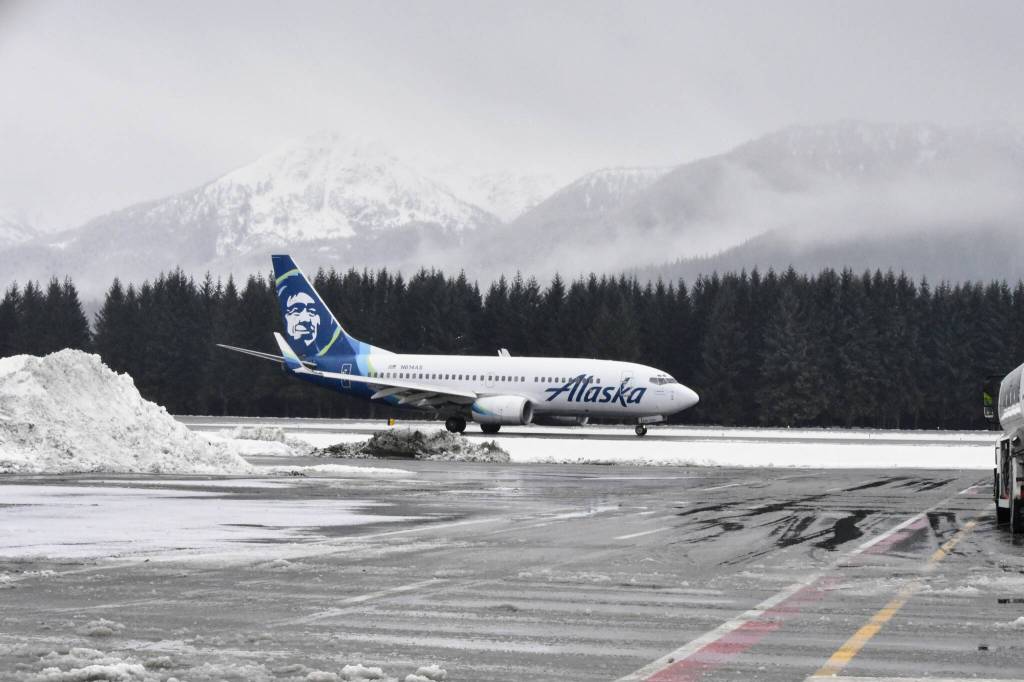
Alaska and Delta occupy the east wing of JNU’s roughly 94,200-square-foot passenger terminal and are its primary large commercial passenger carriers. The airport recorded 465,378 departing passengers in 2023 and projects that figure could reach about 732,300 by 2043.
Alaska Airlines has by far the larger presence. JNU’s draft master plan says the carrier accounted for 92.54% of passenger movements reported in its 2023 federal transportation data and offered year-round service connecting Juneau with several Alaska communities and Seattle. Delta operated 196 departures and the same number of arrivals that year, primarily between Juneau and Seattle.
The proposed consulting work would give JNU roughly nine months to update its model and negotiate the new airline agreements before the targeted July 2027 start date.