On 19 September the Mathematical Gymnasium of Belgrade — the Mathematical Grammar School, known to everyone as the MG — marks sixty years since its founding, with an event at the MTS Dvorana in Belgrade. We asked its principal, Mirjana Katić, to tell the readers of Serbian Monitor six stories about a school that is not only a forge of talent, but also a community in which the bonds between students, and between students and their teachers, often last a lifetime.
1. The Day That Had to Wait for Its Students
We remember the beginnings of some schools by decrees, historical documents, and ceremonial dates. The beginning of the Mathematical Gymnasium is remembered through something far more human — through waiting for its students.
The founders of the school, Professors Vojin and Milica Dajović. Photo: Mathematical Gymnasium
The idea of a school in Belgrade for exceptionally gifted young mathematicians had been maturing for years. It was a bold idea for its time. Professor Vojin Dajović and his associates believed that talented children needed not simply more problems to solve, but a different kind of school: a place where they could ask more, learn more deeply, and be surrounded by peers who looked at the world with the same curiosity. That idea was not everywhere met with understanding. A school that chose its own students and taught a special programme struck many at the time as far too “elitist”.
The decision to establish it was taken in May 1966. Everything, on paper at least, was ready.
And then September came — and there were not enough students.
That is why the first school year could not begin when it began in other schools. They had to wait. To go looking for children. To explain to parents what this Mathematical Gymnasium even was, and why anyone should send a child to a school that was only just at the beginning, with no tradition, no graduates behind it, and not the slightest guarantee of what would become of this unusual educational experiment.
Only on 19 September 1966 did the first fifty-five students take their places at their desks, divided into three second-year classes. Eleven of them had come from other parts of the country and lived in student dormitories. The school was a tenant on the second floor of a building in what was then Narodnog Fronta Street, number 37. It had no more than a few permanently employed teachers.
No one could have known, that morning, what had just begun.
They could not have known that the first Olympiad medal would arrive only two years later. That out of that school would come scientists, professors at the world’s greatest universities, engineers, mathematicians and researchers. That students from a small school in the centre of Belgrade would win hundreds of gold medals across the world. They knew only that they believed in one idea.
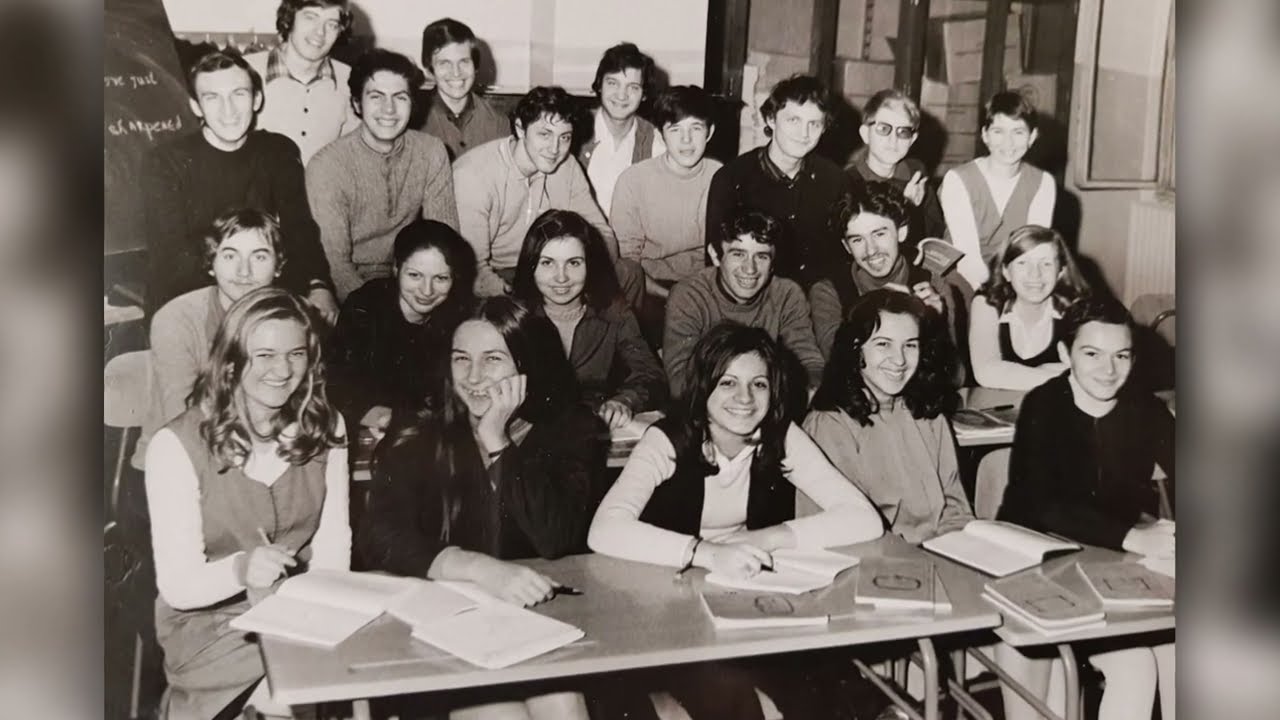
Students in the school’s early years.
That is why the Mathematical Gymnasium celebrates its School Day on 19 September.
Not on the day the document of its founding was signed, but on the day children sat down at its desks.
Because in the end, it is not paper that founds a school.
A school begins when the first student walks into it.
2. When the School Was Left Without Its Name, but Not Without Itself
Over six decades, the Mathematical Gymnasium has had many difficult moments. But probably none was as dangerous as the one in which it was supposed to — cease to be the thing it had been founded for.
At the end of the 1970s a major reform of secondary education began in Yugoslavia, the Šuvar reform, known as career-oriented education. The idea of a special gymnasium for mathematically gifted students no longer fitted into the new system.
From the 1977/78 school year, the Mathematical Gymnasium lost its status as a specialised school. Even its name disappeared. It became the Educational and Upbringing Work Organisation of the Mathematical and Technical Vocation, “Veljko Vlahović”. For a period the first two years, the so-called common core, were given up as well.
On paper, the old Mathematical Gymnasium had all but ceased to exist. But in the building at Narodnog Fronta 37 something interesting happened. The school did not agree to forget who it was.
The teachers remained. The cooperation with faculties and research institutes remained. The need to set the most talented children a harder problem than the one written into the compulsory syllabus remained. And, perhaps most important of all, there remained the children who knew that it was precisely in that building that one could find something hard to find anywhere else.
Milan Raspopović, principal of the MG from 1970 to 2001.
A large share of the credit for the fact that this thread was never broken belongs to the principal Milan Raspopović and to the teachers who preserved the essence of the school through those years, sometimes at the very edge of what the system permitted.
In 1983 they managed to bring back the second year. And in 1986 they made a move that sounds almost unbelievable today: they enrolled a first year once again, with an increased number of mathematics lessons, and organised an entrance examination, although entrance examinations were strictly forbidden at the time. The official history of the MG still calls that entrance examination, to this day, quite simply — “completely illegal”.
It is one of the finest small rebellions in the history of the school.
Not rebellion for the sake of rebellion, but a defence of the conviction that not all children have to learn in the same way, and that talent should not be pressed into a mould merely because that is administratively simpler.
Before long, its former students and professors, the universities, the Society of Mathematicians and the research institutes joined the fight for the school’s renewal. After eleven years, in the autumn of 1988, the first generation of the renewed Mathematical Gymnasium was enrolled under a special experimental programme.
The name came back too.
But the most important thing, in fact, is that the spirit of the school had never even left.
3. Nataša — the Teacher Her Students Came Back To
When Nataša Čaluković graduated from the Mathematical Gymnasium in 1974, her teachers were convinced that a career in science lay ahead of her.
Nataša Čaluković taught physics at the MG for almost forty-two years.
She was an exceptional physics student, and everything suggested she would stay on at the University and devote herself to research.
She chose, however, something else. She went back to her school.
Just four years after her final examinations, in 1978, Nataša Čaluković walked into the Mathematical Gymnasium again — this time as a physics teacher. And she practically never left it again. She worked at the MG without interruption for nearly forty-two years, until her retirement in 2020.
Generations of students remembered her for something far harder to describe than a tally of lessons and prizes.
Nataša did not merely teach children to solve a problem. She taught them to see a problem.
Why is something exactly the way it is? What would happen if we altered the condition? At what point does a solution stop making sense? What may we disregard, and what may we on no account disregard?
Her former students Branislav Cvetković and Zoran Hadžibabić, later scientists at the Institute of Physics in Belgrade and at the University of Cambridge, wrote a whole piece about her in the international journal Europhysics News. The title was simple and exact: “Nataša Čaluković — An Inspiring Physics Teacher.” In it they tried to explain what the generations she taught knew perfectly well — that Nataša’s real gift was to lead her students to think.
She wrote dozens of textbooks and problem books. Her students won medals at the greatest competitions in the world and became scientists all over it. She received many honours, among them the City of Belgrade Award for Education.
But perhaps the finest measure of her success was not the honours.
When the school held a ceremony in her honour, students from many different generations came, and filled the Ceremonial Hall to the last seat.
And for many years afterwards they kept coming back to her: to tell her where they were, to boast a little about some success, to look for advice — or simply to talk to their teacher.
Nataša Čaluković passed away in 2023.
But at the Mathematical Gymnasium a teacher never quite leaves.
They remain in the way their students ask questions.
And Nataša left behind thousands of good questions.
4. Mihajlo — the Light That Remained
The Mathematical Gymnasium has a long list of great students, but there are names that are not remembered for their medals alone. Mihajlo Sporić is one of them.
Mihajlo Sporić, MG class of 2016. Remembered above all as a good person.
Mihajlo graduated from the Mathematical Gymnasium in 2016. That same year he won a gold medal at the International Physics Olympiad and the Saint Sava Award. After the MG he went to Trinity College at the University of Cambridge, where he read physics and was one of the finest students of his generation. It sounds like the opening of a great scientist’s biography. But everyone who knew Mihajlo says that such a biography would be incomplete. Because Mihajlo was not remembered only for how clever he was. He was remembered for his kindness, his good cheer, his modesty, and the way he treated other people.
When he died in 2019, after a long illness, as a third-year student, both Belgrade and Cambridge said goodbye to him. Trinity College spoke of him as an exceptionally gifted student whose intellectual brilliance never crowded out the warmth of his character and his readiness to stand by his friends. The Mathematical Gymnasium did not want the memory of Mihajlo to remain merely a keepsake.
Today his name is borne by an award given to exceptional young students. So every year a new generation hears the story of a young man who was a first-rate physicist, but whom the school remembers above all as a good person.
And then the remembering was taken up by the students of today. Members of the school television station MG TV worked for more than a year on the documentary “Remembering Mihajlo Sporić”. The premiere was held on 19 June 2025 in the school’s Ceremonial Hall, before Mihajlo’s parents, his friends, his teachers and the students. The premiere was also a charitable occasion, and the money raised was donated to NURDOR, to help children suffering from cancer. The film then began a life of its own. It won first prize at the international festival “FilićFilmić”, and in 2026 the special “Ljubiša Samardžić Smoki” recognition at CityFest in Niš. And in that there is something deeply characteristic of the MG. One former student inspired a generation of students who never even met him. From physics to film. From memory to humanity. From one short life to something that goes on lasting.
Mihajlo’s story, therefore, is not a story about what was lost.
It is a story about the light that remained.
5. Circles
In every school there comes a moment when a student closes the classroom door for the last time and goes their own way. One chapter ends, some other children arrive, some other teachers, some new registers.
At the Mathematical Gymnasium, though, these departures are often not the end of the story.
Sometimes they look more like a circle.
When Srđan Ognjanović was a student at the Mathematical Gymnasium, he was taught mathematics by Milica Ilić-Dajović, one of those who made the school in its early years. Vojin Dajović, one of its founders, was later his professor at the faculty.
The years passed, and Srđan came back to the MG.
This time he did not sit down at a desk. He stood in front of them.
Among the students he taught were Vladimir Dragović and Mirjana Katić. They were only pupils of the Mathematical Gymnasium then, with their homework, their competitions, their plans, and the uncertainty that belongs to being young.
Life afterwards drew up its own timetable.
The two former principals, Vladimir Dragović and Srđan Ognjanović, with the current principal, Mirjana Katić.
Vladimir Dragović became a mathematician, a scientist and a professor, and then principal of the Mathematical Gymnasium. Srđan Ognjanović, after long years of teaching, led the school as well. Today it is headed by Mirjana Katić — a former MG student, and Srđan’s pupil.
It might make a fine coincidence, if it were the only one.
But it is not. Throughout the history of the Mathematical Gymnasium the same circle has repeated itself many times over. Students went off to faculties, to institutes, to universities in Belgrade or far from Serbia, and then some of them appeared again at the same address. As teachers. As mentors. As lecturers. As associates. People who prepare some new generation for the olympiad, who give an extra lesson, or who come to pass on to the younger ones what they have learned in the meantime.
Others never came back to the teacher’s desk, but neither did they stop being part of the school. They help it from out in the world, they put its students in touch with one another, they support projects, provide equipment, open new doors.
Out of that same need came ALMAGI — the Alumni of the Mathematical Gymnasium. Not merely as an association of former students, but as a way of making sure that what began at school does not end with the graduation ceremony.
And so at the MG one circle joins on to another. Someone who was a student yesterday stands today in front of students. Someone who once needed help is now helping another. Someone who carried knowledge, friendships and opportunities away from the school will one day give part of it back to some new generation.
And perhaps that is exactly why there is a phrase one often hears at the Mathematical Gymnasium — the MG family. Not because everyone thinks alike, nor because everyone stays close. On the contrary, its people go off to different parts of the world and build wholly different lives. But somewhere that invisible connection with the place they set out from remains.
The circle does not close so that the story can end. It closes so that the next one can begin.
6. When Cambridge Speaks Serbian
Sometimes it is only much later that one sees where a decision was leading.
When the Mathematical Gymnasium admitted seventh-grade students for the first time in 2004, it was something new even for a school already accustomed to being different. The idea was simple: talent does not begin at fifteen, and there is no need to wait for secondary school before it is cultivated seriously.
Into one of those first two classes sat some twenty thirteen-year-olds.
Six years later, when the time came for them to leave the MG, something happened that was hard to foresee even for a school used to unusual generations. Luka Milićević, Nikola Mrkšić, Aleksandar Vasiljković, Mihajlo Cekić, Dušan Perović, Ognjen Ivković and Dušan Milijančević passed the entrance examination for Trinity College at the University of Cambridge and were awarded full scholarships. Dušan Milijančević in the end chose another path and went to MIT. The others carried on to Cambridge.
All at once a large part of a single school class from Kraljice Natalije Street was going on with its life in Cambridge.
And perhaps that is exactly why an unusual guest arrived at the Mathematical Gymnasium that year, in 2010. Michael O’Sullivan, the director of the Cambridge Commonwealth Trust, came to Belgrade and met the students who were preparing to continue their schooling at Cambridge. He was received by the principal of the school, Srđan Ognjanović, and by Professor Zoran Kadelburg.
It was very nearly the reverse of the picture we are used to. Usually it is the students who travel to see the great universities. This time someone from Cambridge came to see the school those students were coming from. That same year a group of the school-leavers who were going off to Cambridge and MIT also signed an agreement with the Mathematical Institute of the Serbian Academy of Sciences and Arts: the idea was that, although they were leaving for the wider world, they should stay connected with science at home, take part in the work of seminars while they were in Serbia, and one day join their knowledge up again with the setting they had started out from.
The story did not end there.
In the years that followed, new students of the Mathematical Gymnasium kept arriving at Cambridge. Others went to Oxford, to MIT and to other great universities of the world. What in that first generation of seventh-graders had looked like an almost unbelievable coincidence became in time a recognisable path for many generations of the school. The very next year another group of MG school-leavers was admitted to Cambridge and Oxford.
But the path did not always lead in one direction only.
Best student of his year in 2010, Luka Milićević is today a scientist at the Mathematical Institute of SANU.
Luka Milićević, the best student of his year in 2010, completed his studies and his doctorate at Cambridge. Then he came back to Belgrade. Today he is a scientist at the Mathematical Institute of SANU, where he runs the Student Seminar, and he has gone on passing his knowledge and experience to students of the Mathematical Gymnasium as well. While he was still a Cambridge student, as early as 2012, he was coming to the MG to give lectures to the younger ones.
It is as though a thread begun in the seventh grade had never been broken at all. It only went on lengthening — from Belgrade to Cambridge, from school mathematics to science, and then on again to some new generation at the MG.
And perhaps that is why a headline about Cambridge “speaking Serbian” is more than a turn of phrase.
Because the point is not merely that a great many students from one small Belgrade school turned up at one distant university.
Something else is stranger than that. That after them, others came.
And that some of those who went far away one day stood in front of MG students again — to help them reach the place they themselves had once set out for.
Afterword: The School That Does Not Wait for the Future
When the Mathematical Gymnasium introduced a programming stream in 1969, computers were for most people something distant and almost exotic. Only two years later the school founded its own Computing Centre and acquired a LITTON 32 computer, which the students themselves worked on.
That is perhaps the best explanation of today’s Mathematical Gymnasium: it never acquired the habit of waiting for the future to become ordinary.
Today, in the same school where programming was being taught more than half a century ago, the talk is of Large Language Models and Intelligent Agents. The students have an Artificial Intelligence Section and an Applied Physics Section, they take part in international and Erasmus+ projects, they build scientific projects of their own, but they also record programmes, podcasts and documentary films within MG TV.
In time the MG extended to students in the seventh and eighth grades as well. The first seventh-grade classes were opened in 2004, because the school had recognised once again the same problem it had recognised in 1966: talent appears early, and we should not wait for a child to grow up before taking it seriously.
In 2019 the Mathematical Gymnasium was granted the status of an institution of special national importance. But what makes it special could never be contained in a single decision or title.
That is seen best in the people who come back.
Some former students, after the finest universities in the world, walk into the same classrooms once again — this time as teachers and associates. Others give lectures, train the Olympiad team, help the school through ALMAGI, or support new generations on their way to competitions.
And the results keep arriving. In 2026, the year the school celebrates six decades, all six members of Serbia’s team at the International Mathematical Olympiad were MG students — and all six came back from Shanghai with medals.
The anniversary website today gives a figure of 1,827 medals won over six decades at international, European and Balkan olympiads and other major competitions.
An impressive number.
But the essence of the school does not lie in counting medals.
Mirjana Katić has been principal of the Mathematical Gymnasium since 2019.
The MG came into being because a few people believed that a talented child should be given a space where he or she does not have to apologise for wanting to know more.
Sixty years on, the technology is different, the world is different, and tomorrow children may perhaps be studying fields whose names we do not even know yet.
The task of the school remains the same: to recognise them in time — and not to step aside from their path.