About a year ago, official statements suggested that reconstruction in Syria was only a matter of time — that obstacles would be removed one after another, and that companies, institutions, and states eager to take part were lining up behind the door, which, once it opened, would bring offers and money pouring into the country from every direction.
Months went by, and nothing new happened on this front. The obstacles were removed, or so we were told, but the standstill continued, and we became unsure that anyone had really been waiting behind that door.
Sanctions were said to be the main obstacle to reconstruction, and the Syrian Democratic Forces (SDF) file was also cited as one reason for the delay, given the security instability it caused. What now, with both files more or less closed?
A Highly Complicated Cycle
Economic researcher Younes al-Karim tells Ultra Syria that the Syrian government raised expectations too high when it first put reconstruction on the table — to the point that three separate files became conflated. The first is reconstruction in its direct sense: securing the minimum level of needs, services, and basic infrastructure required to stabilize the population and restart the economy. The second is the sweeping vision through which the government wants to shift Syria and its economy toward an entirely new economic model. The third is the blending of political and economic files, so that each now affects and obstructs the other, pulling the government into a highly complicated cycle.
Al-Karim adds that the SDF file was not, on its own, the main obstacle to reconstruction, and sanctions were not the sole cause either. This has become clearer with the changes to the sanctions regime and international restrictions, and with the lifting of some measures once seen as among the biggest obstacles.
The problem, according to al-Karim, is that raising expectations so high made these steps look as though they should have led directly to a flow of money and the start of reconstruction. When that did not happen, measures that were meant to be preliminary steps came instead to look like signs of failure.
He continues: there are points that appear small but are in fact highly consequential, and they were skipped over. Chief among them is building the institutions of the state. Reconstruction does not begin with money alone — it begins with the existence of a state capable of managing that money, setting the rules that govern its use, determining priorities, and ensuring transparency and accountability.
According to al-Karim, the state’s role here is essential — not as the party that carries out everything itself, but as the party that leads the reconstruction process and establishes the legal and institutional environment that allows the private sector and international institutions to take part. He distinguishes between three different perspectives on reconstruction: there is the optimistic government view, which expects money to flow into Syria. There is the investor’s view, who is not simply looking for an investment opportunity but is waiting for the government to take clear steps toward establishing an economic and legal environment that protects his money and defines his rights and obligations. And there is the view of Syrians themselves, who are waiting above all for the rebuilding of state institutions and for a degree of political and economic stability, along with a modernized state structure, powers, and approach to managing the economy.
Al-Karim explains to Ultra Syria that without an intersection between these three perspectives, it is not yet possible to speak of reconstruction in the real sense of the word — only of investment projects. And there is a fundamental difference between the two. Investment can happen anywhere in the world, even in countries with high levels of risk. The existence of an investment project does not mean the economic environment has become suitable for reconstruction, nor does it mean the state has actually begun rebuilding its economy.
Reconstruction is one thing, and investment is another. Investment — still in al-Karim’s words — looks for returns and profit, while reconstruction first requires rebuilding the state, the economy, infrastructure, services, and institutions.
Al-Karim then moves to another problem, related to domestic economic policy. When official statements declare that Syria does not want foreign loans, these messages do not stay within Syria’s borders — they reach international institutions, investors, and financing bodies, and may lead some of these institutions to hold back from making offers or entering long-term financing programs.
At the same time, the shift in domestic policy toward direct investment agreements, bypassing institutions and clear, transparent rules, sends another message abroad: that the Syrian government still prefers direct relationships over building a clear institutional system.
Here, in al-Karim’s view, lies the real problem. Syria does not just need an investor who brings in money — it needs an environment that allows an investor to bring in his money knowing in advance how it will be managed, what his rights are, what laws protect him, how he can exit his investment, and who will settle disputes if they arise. None of this is built or undone by sanctions. It is built within the state itself.
That is why lifting sanctions, settling security and political files, and opening the door to foreign financing are all important conditions — but they are not enough on their own to set reconstruction in motion.
Al-Karim says the problem today is not just the amount of money that could flow into Syria, but the Syrian state’s capacity to create an environment in which that money can operate safely, transparently, and efficiently. He adds that the West, for its part, still views Syria as a state that remains fragile politically, economically, and institutionally — which gives international parties greater leverage in negotiations, allowing economic files to become entangled with political ones.
Breaking out of this cycle, he says, will not come simply from demanding sanctions relief or waiting for money, but from rebuilding the state itself, defining the kind of economy Syria wants, and building institutions capable of managing the reconstruction phase.
The economic researcher closes by saying the question is no longer “When will reconstruction money come to Syria?” but rather the more important question: “Has Syria become ready to receive this money and turn it into actual reconstruction, or are we still looking at scattered investment projects inside a state that has not yet settled the features of its economy and institutions?”
For his part, journalist Absi Smeisem tells Ultra Syria that he believes the main reason for the delay lies in the fact that the Gulf Arab states — which were expected to be the main contributors to reconstruction costs — have been preoccupied with the Israeli-American war against Iran, with national security priorities taking precedence over this file. He adds that the Syrian government itself has not taken any serious steps, since it is unreasonable to rely entirely on outside support to carry out reconstruction projects.
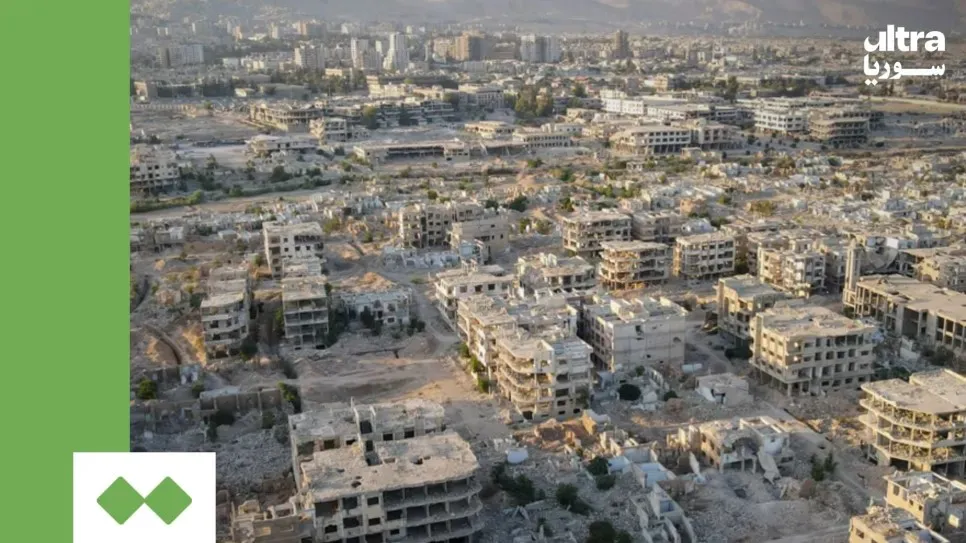
Smeisem adds that European countries, the United States, and other states that might contribute to reconstruction do not appear to have secured privileges in Syria that would make them engage with this file more seriously. At the government level, there is a clear shortfall — even in clearing the rubble from destroyed cities — and the government may be waiting for organizations to launch small projects tied to basic needs, or for residents themselves to rebuild or repair as many damaged homes as they can.
Reconstruction: A Conversation That Has Gone Quiet
A few months ago, reconstruction was still a distant prospect, yet talk of it dominated public discussion in Syria. Today, that same conversation appears to be fading. What explains this?
Economic researcher Younes al-Karim answers that the first reason for the decline in talk of reconstruction is the economic and institutional fragility that has become more visible to investors and international research centers that study Syria and advise their own companies on investing there.
Based on figures released by the Ministry of Finance in its published financial performance report, these observers found a problem with the level of transparency — many figures appear inaccurate or unrealistic, and some contradict statements made by officials themselves.
According to al-Karim, an investor does not read this simply as an error in a number or a report, but as an indicator of the nature of the environment they would be entering.
He continues: on top of that, the continued depreciation of the Syrian pound and the persistence of certain fiscal and monetary policies all feed directly into feasibility studies and risk assessments. In the end, an investor does not look only at potential profits but also calculates the cost of risk — and for many investors, that cost in Syria has become far higher than the expected return.
A bigger problem emerges here, in al-Karim’s view: in many of its decisions, the government does not appear to weigh opportunity cost. When the government makes a given economic decision, it should also ask: what did we lose by making this choice, and what alternative might have produced a better outcome?
An investor looks at this question very differently. When putting money into Syria, an investor studies not just the current situation but also what might happen five or ten years down the line.
If an investor puts money in today under one government, and a different government later comes in and deems the contract or project improper, the investor could face disputes, compensation claims, and international courts — and ultimately could be held accountable by their own company’s shareholders for the resulting losses.
That is why an investor looks not only for guarantees from the current government but for institutions and laws capable of protecting their investment even if the government and its policies change.
Al-Karim concludes: this is where the importance of reforms comes in — reforms that may appear, on the surface, unrelated to reconstruction but are in fact a fundamental part of it. The absence of even serious attempts to reform corporate law, rebuild the banking system, modernize the property registry, regulate ownership and investment, and build economic institutions capable of operating independently and transparently — all of this creates the impression that reconstruction is not truly among the government’s actual priorities, or at least not to the degree that the political discourse suggests.
Al-Karim raises another point: if the government wanted to rally social forces behind the reconstruction process, it needed to launch a transitional justice process as one of the basic conditions for social stability. An investor is not looking only for temporary security stability — they want a stable society, clear rules, property rights that can be defended, and an environment free from the fear that old conflicts will resurface in new forms. In his view, transitional justice is not a political file separate from the economy — it is part of building the environment that both investment and reconstruction require.
He adds: international institutions are interested in Syria and in investing there, and are therefore prepared to offer support, financing, and expertise to help restructure the economy and help the state get through the initial, necessary steps. But this assistance is not open-ended. If Syria fails to complete the essential steps related to institutional, financial, and legal reform, international institutions and major companies will recalculate — and may shift from trying to support Syria’s economic transition toward pursuing their interests through other paths instead.
Al-Karim concludes that the decline in talk of reconstruction does not necessarily mean the world has lost interest in Syria. It may mean the opposite: that the world is now waiting for Syria to first prove it is capable of building the environment that makes reconstruction possible, rather than waiting for money to be the thing that creates that environment.
Media Generosity Versus Economic Stinginess
Observers point to a contradiction in the positions of states that declare their support and friendship toward the transitional authority in Syria: diplomatic and media generosity in expressing support, paired with stinginess in economic support and hesitancy to engage in the reconstruction process. What explains this, if the observation holds true?
Journalist Absi Smeisem believes that the generosity in diplomatic and media support, contrasted with stinginess in economic support, stems from the fact that the criteria for economic support differ from political and media positions. Syria’s economic direction remains unclear, and the government has not taken any serious steps to encourage and attract foreign investment. Laws remain unsuitable and unstable pending new legislation from the People’s Assembly, and there are still no standards for transparency in place.
Smeisem tells Ultra Syria that state economic institutions are not subject to any recognized governance standards or financial audits, and that the security situation remains discouraging for investment. For example, since the start of the liberation, the government has promoted the idea of turning Syria into a transit hub and corridor for energy supply chains, yet transit roads remain unfit for ordinary vehicle use to this day and claim dozens of lives every month, and not a single railway line among those promised has been completed.
This article was translated and edited by The Syrian Observer. The Syrian Observer has not verified the content of this story. Responsibility for the information and views set out in this article lies entirely with the author.