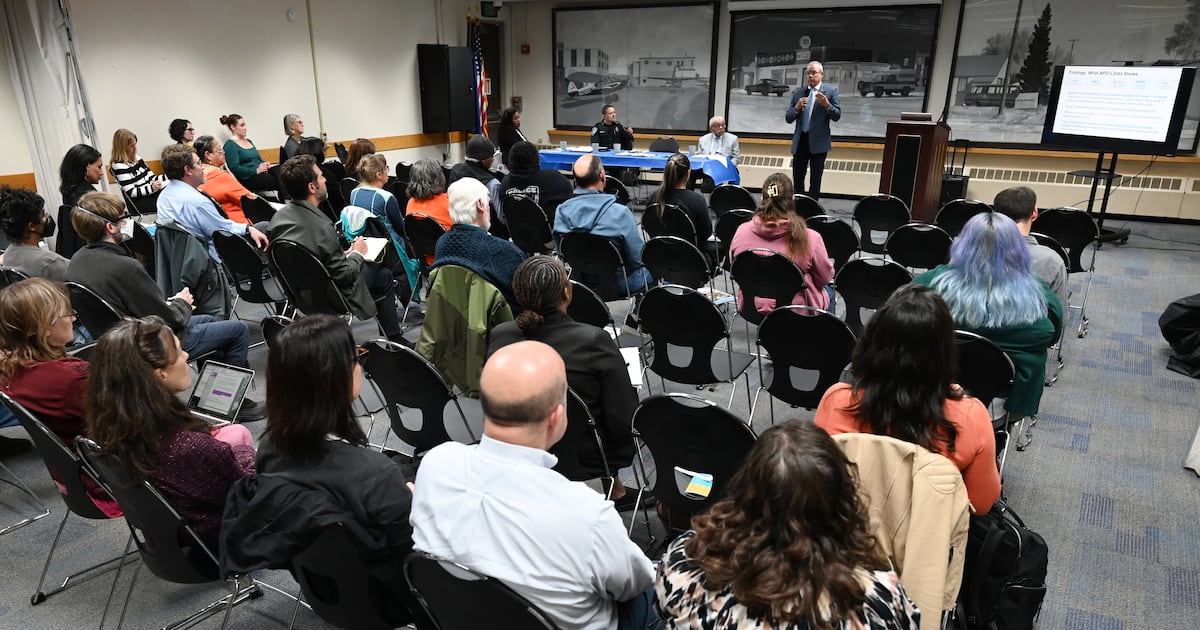
People gathered at the Fairview Community Recreation Center listen to retired LAPD Chief Michel Moore, a senior adviser at 21CP Solutions, speak about the consultant’s APD audit on Tuesday, Sept. 8. (Bill Roth / ADN)
Some community members say a recently released audit of the Anchorage Police Department’s use of force highlights the need for civilian oversight of the department.
Anchorage’s municipal attorney last week released a sweeping audit of the department’s practices and policies that found use-of-force incidents reported at higher rates than at some of the Northwest’s largest departments. The audit also found that a relatively small group of Anchorage officers were involved in a disproportionate share of the encounters.
The audit followed a series of officer-involved shootings in 2024 that left four people dead, including 16-year-old Easter Leafa, a case that galvanized public attention on the department’s use of force.
The audit, among other findings, showed that Anchorage’s Alaska Native and Indigenous population was involved in a disproportionate number of use-of-force incidents reported by police.
In public meetings this week, representatives from 21CP Solutions — the national public safety consulting firm that completed the 121-page final report — said they didn’t find any alarming shortcomings. Much of the firm’s leadership is made up of former police department or federal law enforcement agency leaders, according to its website.
The consultant made presentations at a Tuesday evening community meeting at the Fairview Community Recreation Center and a Wednesday morning meeting of the Anchorage Assembly’s Health & Public Safety Committee.
At Tuesday’s event, officials didn’t take live public comments from the approximately 30 attendees.
The municipality limited public feedback to written questions due to time limitations and “anticipated substantial public interest,” said Emily Goodykoontz, a spokesperson for Mayor Suzanne LaFrance.
“Many residents had similar questions, and collecting written questions allowed us to combine related inquiries and address as many topics as possible during the event,” she said.
Several community members did testify during Wednesday morning’s meeting, which also featured comments from the consultant.
“You don’t have a perfect department, but you don’t have one that’s out of control,” Michel Moore, a 21CP Solutions senior adviser and former chief of the Los Angeles Police Department, told Assembly members during Wednesday’s meeting.
Retired commissioner Charles H. Ramsey, right — who served in police departments in Chicago, Washington, D.C., and Philadelphia, and is a partner at 21 CP Solutions — speaks during a community meeting on the APD audit at the Fairview Community Recreation Center on Tuesday, Sept. 8. Retired LAPD Chief Michel Moore is at left. (Bill Roth / ADN)
Still, the audit resulted in dozens of recommended changes, most of which Anchorage police say have been adopted or are in the process of being implemented.
As the public has started to digest the findings, some have said the audit proves that better oversight of the department is needed to adequately address concerns about officers’ use of force.
“We need more community input and direct involvement in APD,” Mercedes Arciniega said at Wednesday’s public safety committee meeting.
Arciniega works with Stand Up Alaska, a nonprofit focused on social justice issues, and also served on a task force that last year recommended the municipality re-establish a public safety commission that has, for example, subpoena power and other independent oversight authority.
The Assembly killed a proposed ordinance in July that would have created a public safety advisory commission that lacked those powers amid widespread criticism of the measure.
Stand Up Alaska said the report’s finding that a small group of officers were involved in a disproportionate number of incidents was concerning.
“It’s time for real consequences, not another policy memo,” the organization’s executive director, Erin Jackson-Hill, said in a statement.
During the public meetings this week, Case and 21CP Solutions representatives defended the department’s practices and explained some of the findings, such as a much higher use-of-force per-capita rate compared to other departments noted in the report.
APD Chief Sean Case listens to retired LAPD Chief Michel Moore, a senior adviser at 21CP Solutions, speak during a community meeting on the APD audit at the Fairview Community Recreation Center on Tuesday, Sept. 8. (Bill Roth / ADN)
For example, the small group of officers who account for about 20% of incidents are assigned to dangerous roles that see them use force more often, usually lower-level methods that don’t result in injury, the chief and consultant said. Anchorage police also count actions as force that many other departments wouldn’t, they said.
The LaFrance administration hired 21CP Solutions in July 2025 to audit APD’s use-of-force incidents, policies and training protocols.
Goodykoontz said that 21CP Solutions hasn’t submitted its final bill yet but that the municipality anticipated the cost of the audit to total about $120,000. The firm was among seven that submitted proposals, she said.
The consulting firm reviewed more than 5,700 of use-of-force incidents between January 2021 and June 2025, as well as 11 of 13 officer-involved shootings in 2024, including Leafa’s in August of that year.
At Wednesday’s meeting, Moore said three officer-involved shootings — one each in 2024, 2025 and this year — had involved a violation of department policy. The audit didn’t address criminal investigations of the shootings.
[Previous coverage: Outside review of Easter Leafa killing by Anchorage police calls for changes in operations]
The state Office of Special Prosecutions found all of the shootings from prior years justified. The department also conducted internal reviews of the shootings.
After Wednesday’s meeting, Case declined to share additional details about the internal investigations, citing APD policies and state employee confidentiality laws. But, he said, internal investigators had never previously found that an officer violated department policy in a shooting, which Case attributed to more thorough investigations and more detailed policy and practice requirements.
Moore, at Wednesday’s meeting, recommended that police disclose the findings of such investigations to help improve public trust.
The municipality, Case said, was working on a solution to share basic details about internal investigation outcomes in documents like an annual report while also complying with state law.
The audit’s other recommendations included requiring officers to try to de-escalate situations or use other non-lethal methods before resorting to deadly force and better cultural competency and communication training.
“These recommendations, in and of themselves, are something that’s necessary that we’ll move forward with,” Case said Tuesday evening at the Fairview Community Recreation Center.
The department began updating its policy manual during the audit, he said.
While the fast pace of change has frustrated some within the department, he said policy and training changes, and other APD initiatives, will result “in positive changes in the next couple of years.”
Still, Alaska nonprofit Native Movement, which has pushed for the creation of a civilian-led public safety oversight commission in Anchorage, said outside supervision of the department is needed to ensure the changes — such as improvements to use-of-force monitoring and early-warning systems to identify trends or concerns about individual officers — are effective. The organization also advocates on behalf of Indigenous communities and issues.
Its deputy director, Amanda Bremner, said Wednesday that the disproportionate rates of Indigenous people’s involvement in police use-of-force incidents, and the concentration of encounters among a small group of officers, should be a key focus for officials moving forward.
“This is exactly why Native Movement continues to support the development of an independent community review commission, a board with real authority, not just another advisory body, and not a process where the department checks its own boxes,” the organization said in a statement. “These are the systemic patterns that require ongoing, independent accountability checks.”