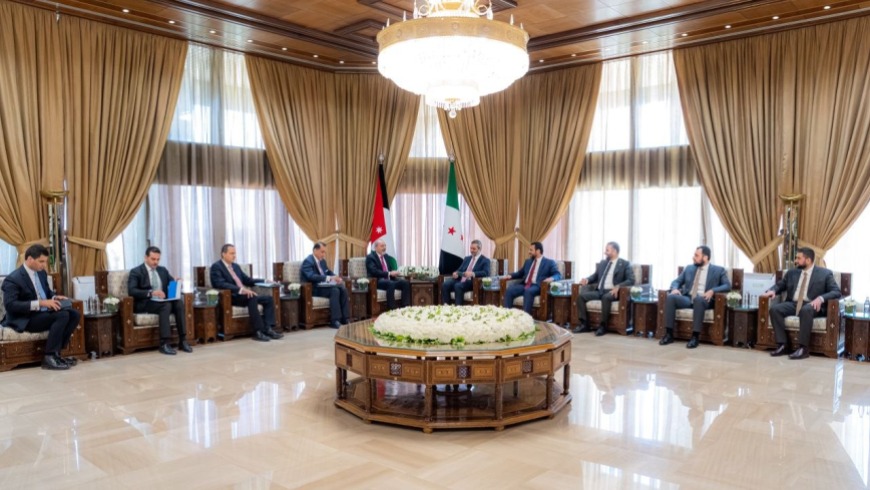
Syrian Foreign Minister Asaad Hassan Al-Shibani met on Wednesday, September 9, 2026, with Jordanian Deputy Prime Minister and Minister of Foreign Affairs Ayman Safadi in Damascus. Safadi’s visit — his second to the Syrian capital this year — focused on regional developments, preparations for the third session of the Syrian-Jordanian Higher Coordination Council scheduled for October in Damascus, and the status of the trilateral diplomatic framework addressing the situation in Suweida province.
The meeting followed Shibani’s diplomatic tour to Ankara earlier in the week, where he held talks with Turkish Foreign Minister Hakan Fidan and US Special Presidential Envoy Thomas Barrack. After late-night discussions, Barrack emphasized Washington’s role in easing regional tensions and reaffirmed US support for integrating Suweida into Syrian state institutions.
The flurry of high-level diplomacy coincides with the one-year anniversary of the “Roadmap for Resolving the Crisis in Suweida and Stabilizing Southern Syria,” adopted on September 16, 2025, by Syria, Jordan, and the United States. A review of the roadmap’s implementation over the past year reveals a blend of institutional progress and persistent security, humanitarian, and political challenges.
Over the past twelve months, bilateral arrangements between Damascus and local Suweida actors have brought most municipal administrations back under the oversight of state ministries, restoring links to national planning and budget allocations. Preparations are also underway to reconstitute a civil police force under the Ministry of Interior, drawing personnel from previous local applicants. A national fact-finding committee has issued its findings on past abuses, assigning responsibility to state security personnel, local armed factions, and tribal militias. Military criminal courts have since initiated trials, while facilitation by the International Committee of the Red Cross led to the release of 86 detainees earlier this year.
Yet significant hurdles remain. Hundreds of missing persons are still unaccounted for, and thousands of displaced residents from Suweida’s northern and western rural areas have been unable to return home due to infrastructure delays and resistance from local armed groups. The province has also witnessed sharp internal polarization over its political future. Efforts by factional leaders — including Sheikh Hikmat al-Hijri — to promote autonomous governance or full separation have faced pushback from civic figures. Tensions escalated recently when members of the “National Guard” faction forcibly expelled social figure Aatef Hneidi after he publicly rejected separatism and foreign alignment.
Diplomatic sources have additionally clarified that, despite claims by certain local groups, Suweida has not been part of the agenda in Syrian-Israeli security discussions brokered by the United States, aside from preliminary conceptual references to humanitarian access.
As the trilateral roadmap enters its second year, Syrian officials and international mediators maintain that it remains the principal mechanism for restoring stability in southern Syria. Its success, they argue, will depend on completing detainee releases, securing weapons management, and enabling the safe return of displaced residents.
This article was translated and edited by The Syrian Observer. The Syrian Observer has not verified the content of this story. Responsibility for the information and views set out in this article lies entirely with the author.