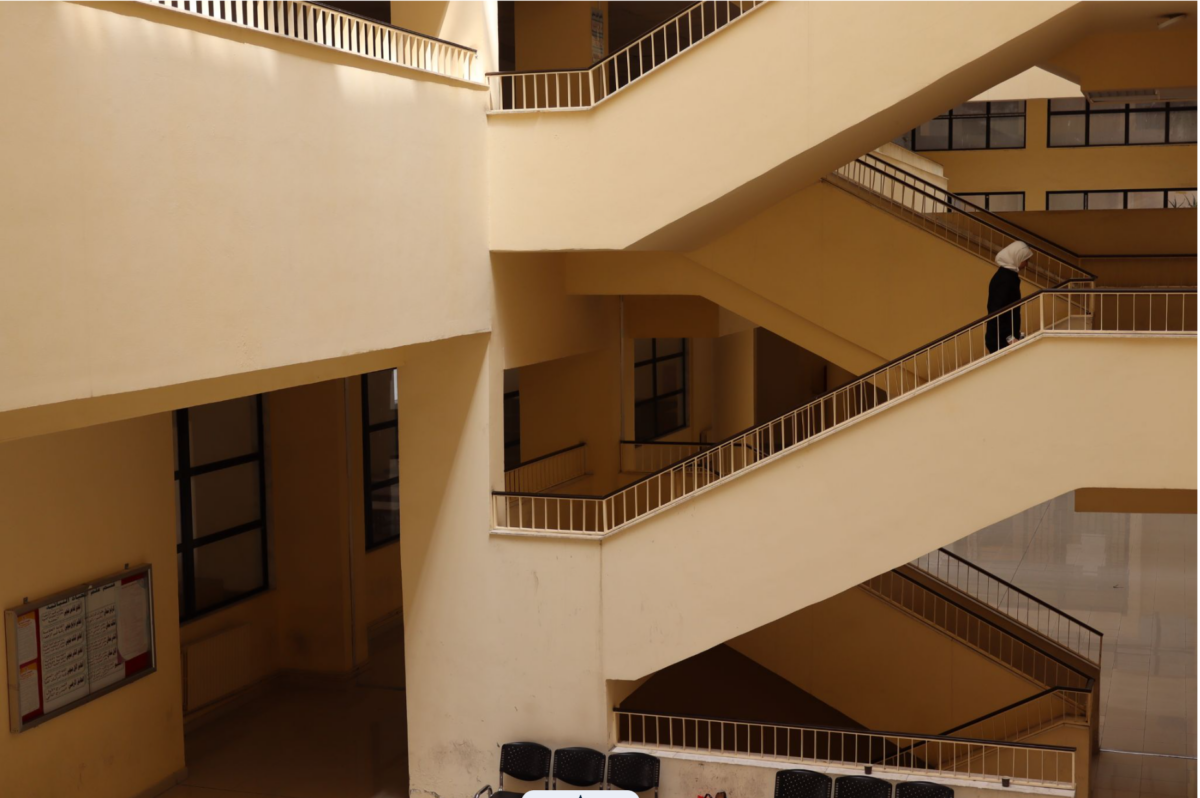
DAMASCUS — On a hot August day, ululations echoed through the cool hallways of Damascus University’s Political Science Faculty. It was graduation day. Students in black robes gathered with friends and family marking the occasion. Their joy stood in stark contrast to the university’s somber mood during the war, when students were detained and disappeared.
Historically, the Political Sciences Faculty was called the Institute for Party Training, in reference to the Baath Arab Socialist Party, headed by Hafez al-Assad. At the time, students had to swear allegiance to the party to be admitted, and it was a pipeline for teachers of “National Education,” a course on Baathist ideology taught in middle school and high school. Then in 2003, under Hafez’s son Bashar, who carried out limited reforms, the faculty was renamed the Political Science Faculty and became part of Damascus University, loosening its affiliation with the party.
After the fall of Bashar al-Assad in 2024, the Political Science Faculty was at risk of dissolution. However, in 2025, a new leadership was appointed to transform it into an institution capable of building Syria’s next generation of leaders free of Baathist ideology.
Today, tensions are rife between professors appointed under Assad and a new generation versed in the principles of the revolution. As a new government establishes itself, how does education undergo de-Baathification and guarantee academic freedom?
Revolution and war
When the Syrian revolution broke out in 2011, the Political Science Faculty was particularly attuned to the upheaval in the country. The university became a political battleground that reflected the fault lines of the Syrian conflict.
“Students were sharply divided into two groups: absolute loyalists—blind loyalty to the party—and the second group who were initially quiet,” Assistant Dean Dr. Alaa Sardar told Syria Direct. She was a student in the faculty at the time, before moving to Russia in 2015 to undertake a PhD.
“One day, a student from the Assad family came to the university with a gun and opened fire in the cafeteria to intimidate the pro-opposition camp.”
“After peaceful protests in Daraa were violently repressed by the regime in March 2011, a kind of heated tension emerged between the two groups,” she added. “One day, a student from the Assad family came to the university with a gun and opened fire in the cafeteria to intimidate the pro-opposition camp.”
After the incident, some students began secretly distributing flyers in the university calling for political reforms. “They were calling for the reform of the regime, they weren’t even calling for the fall of the regime,” Sardar added.
Then, in 2012, as the conflict turned increasingly violent, protests began at the university. “The students started speaking aloud about Bashar al-Assad, whereas previously they had whispered out of fear and apprehension,” Sardar recalled. “Students started to call, in a clear and explicit way, for the fall of the regime.”
After an Alawite professor was reportedly kidnapped or killed, Sardar said the department relocated from the suburb of al-Tal to downtown Damascus in 2013. “Then, the Students’ Union—the Baath Party’s branch in the university—started working as an intelligence agency, writing security reports on other students,” she added.
“Many students were subsequently expelled or arrested due to their support for the revolution, and some of them died in detention.”
Dean Dr. Najib Ghadbian (right) and Assistant Dean Dr. Alaa Sardar (left) stand in their office, 25/8/2026 (Natacha Danon/Syria Direct)
De-Baathification
“Under the previous regime, freedom of speech was essentially nonexistent, and this had profound implications for universities and for academic life more broadly,” said Massa Mufti-Hamwi, an education specialist focused on Syria. “All departments and faculties were deprived of academic autonomy and academic freedom, as well as freedom of thought.”
However, last year, Minister of Higher Education Marwan al-Halabi held an international conference seeking to make a clean break from the past. “He explicitly highlighted academic freedom and academic autonomy as principles on which Syrian universities should be founded going forward.”
New deans were appointed to most of Damascus University’s faculties. In September 2025, Dr. Najib Ghadbian was appointed dean of the Political Science Faculty. He left his position as an associate professor in the United States to return to Syria and accept the role.
“It soon became very clear that changes must include the teaching staff, the curricula, the general atmosphere and culture, with the primary mission of redefining the role of the faculty in its relation to society and the state,” Ghadbian said.
After the fall of the Assad regime, the university considered dissolving the Political Science Faculty. “Professors connected to the Baath Party and the security apparatus voluntarily left after the liberation, but in the end it was decided that the faculty should continue,” Ghadbian said.
However, many of the professors from the Baath era still remain, constituting the faculty’s “biggest challenge,” Ghadbian said. Under the Assad regime, “preferential acceptance and hiring were given to students and professors from the former ruling [Alawite] minority,” he explained. According to Ghadbian, investigations are currently underway against professors who were in leadership positions when students were dismissed or detained.
Under the Assad regime, “preferential acceptance and hiring were given to students and professors from the former ruling [Alawite] minority,” Ghadbian explained.
Today, students dismissed during the revolution are able to resume their studies. Students from universities in formerly opposition-controlled northwestern Syria have also been given the opportunity to enroll.
“Sometimes students from those universities are coming with a spirit of ‘we are the people of the revolution, we suffered, we sacrificed,’ and sometimes there is tension between them and the professors,” he explained. “We have tried to strike a balance so that there is continuity in the educational process within these available resources, while also undertaking a process of correction.” Under Syrian law, professors at state universities are public employees and cannot be arbitrarily dismissed.
Read more: A struggle over education continues in northeastern Syria
Tensions also exist between the students themselves. “Our primary challenge as students in this post-conflict phase is dealing with each other as Syrians; we are a reflection of a society that has suffered deep structural fragmentation,” Baassam Naaman, 40, told Syria Direct. He studied at Damascus University prior to the war and resumed his studies in 2024. He is currently writing his dissertation.
“We need to interact as fellow citizens, reinforce the concept of citizenship and condemn crimes regardless of who committed them, because a crime remains a crime.”
In addition, the curriculum—much of which was imbued with Baathist ideology—needs to be brought up to international standards. “We did a comparative study of some other universities inside and outside the region,” Ghadbian said. “I imagine that the new curricula will become very close to many of the faculties of political science [abroad].”
One way of doing this is to partner with foreign universities. The department currently has an agreement with the Geneva Graduate Institute to deliver an executive education program on governance, resilience and recovery. The six-month program is designed for current employees of government institutions, international organizations and non-governmental organizations.
Other university partnerships are currently being discussed, Ghadbian said. “We also want to try to communicate with some of our [Syrian] colleagues who obtained PhDs abroad for them to return for a sabbatical and teach a course.”
Ultimately, Ghadbian said the Political Science Faculty can play an essential role as “a space for freedom and open discussion in the new Syria.”
Yet the boundaries of academic freedom remain unclear. One faculty member told Syria Direct that he had been discouraged by his colleagues from discussing events after December 2024. In 2025, Syria was rocked by sectarian massacres against Alawite and Druze communities largely committed by state security forces. “I was told to avoid the headache of raising these sorts of topics,” the faculty member said. “But if not now, when?”
“I was told to avoid the headache of raising these sorts of topics,” the faculty member said. “But if not now, then when?”
“Until now, we censor ourselves before speaking or writing because we are not yet accustomed to this new reality, nor do we fully know the new boundaries,” added Naaman. “Consequently, we try to frame our work around less contentious, broadly accepted topics.”
“The official discourse is certainly promising and indicates a commitment to academic freedom, academic autonomy and freedom of thought,” said Mufti-Hamwi. “However, it is too early to know the extent to which these principles will genuinely reshape universities and faculties, including political science.”