A persistent claim has circulated in Syrian discussions of the country’s Sovereign Fund: that Ibrahim Succarieh, better known as “Abu Mariam al-Australi,” was appointed director-general by presidential decree. Yet no such decree has appeared in the public record.
There is no ambiguity about the legal foundation of the fund itself. Presidential Decree No. 113 of 2025, dated 24 June and announced by SANA on 9 July, established the Sovereign Fund as an economic institution with legal personality and financial and administrative independence. Headquartered in Damascus and affiliated with the Presidency of the Republic, its mandate includes direct development projects, the investment of human and material resources, and the transformation of underused state assets into productive instruments. The decree also requires quarterly and annual reporting to the presidency and independent financial audits.
The decree is equally explicit on leadership. Article 5 assigns management to a board of directors and a director-general. Article 8 states that the director-general “shall be appointed by decree,” while Article 12 makes the officeholder accountable to both the board and the president.
This is where the uncertainty begins.
Published reporting indicates that Succarieh has exercised, or is widely understood to exercise, the role of director. AFP reported in July 2026 that the identity of the fund’s manager had still not been officially announced, even as several individuals said they had met “Abu Mariam al-Australi” in that capacity. The same report described the fund as central to Syria’s effort to attract foreign capital and manage state assets.
At the same time, the fund now has a publicly identified chairman. In July 2026, SANA referred to Tourism Minister Mazen al-Salhani as chairman of the Syrian Sovereign Fund, a title repeated in subsequent reports on major investment agreements. The distinction matters: the decree treats the chairman and the director-general as separate offices.
What remains absent from the public record reviewed for this article is a decree naming Ibrahim Succarieh as director-general.
This is more than a technicality. The fund was created to manage state assets and investments of potentially enormous value. AFP quoted economist Ahmad al-Riz as saying the Finance Ministry estimated the fund’s assets at around $50 billion, compared with an estimated Syrian GDP of roughly $33.7 billion in the current year’s budget.
If someone is exercising the powers of director-general of an institution of that scale, the public has a legitimate interest in knowing the legal basis for that authority, the limits of the officeholder’s powers, the mechanism of appointment and the lines of accountability.
Who Is Abu Mariam al-Australi?
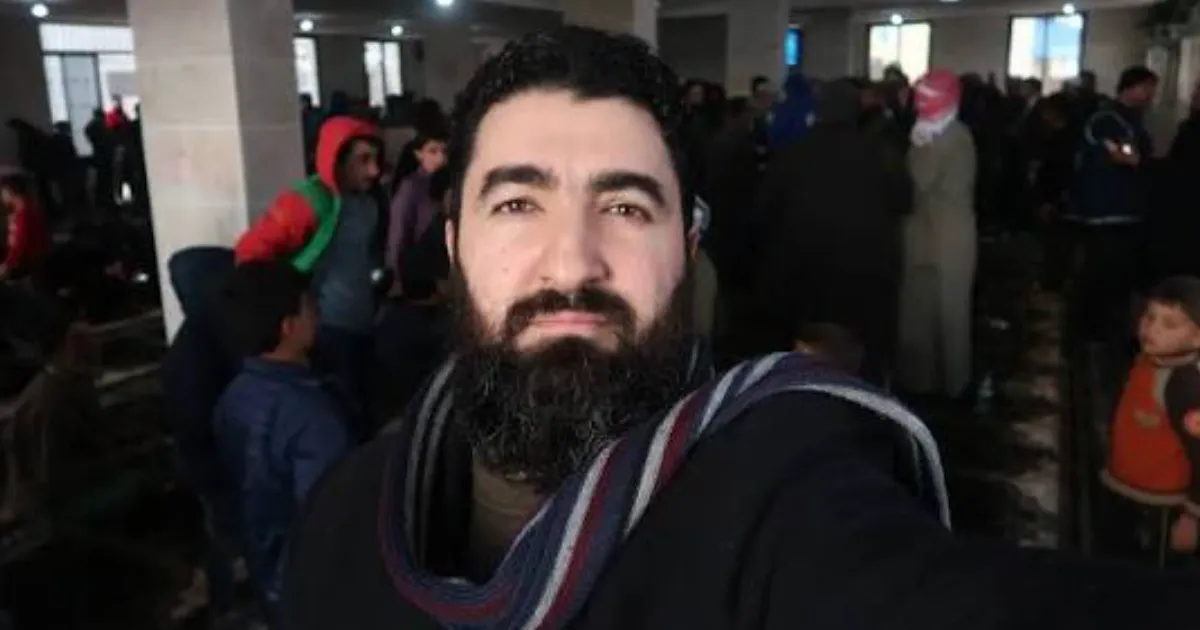
Abu Mariam al-Australi is Abraham, or Ibrahim, Succarieh, an Australian citizen of Lebanese origin who left Australia for Syria in 2013.
His background carries particular significance because his legal status abroad differs from that of many Syrian figures whose sanctions were tied principally to developments inside Syria.
On 8 June 2018, the Australian government listed Abraham Succarieh for targeted financial sanctions under its counter-terrorism regime. Australia’s Department of Foreign Affairs and Trade said he was believed to be in Syria and “alleged to be a member of Jabhat al-Nusra.” The designation makes it an offence, without ministerial authorisation, to use or deal with assets owned or controlled by him, or to make assets available to him directly or indirectly.
More importantly, the designation remains in force. Australia’s Consolidated List was updated on 1 September 2026, and a DFAT notice published in August still lists Abraham Succarieh among those subject to restrictions.
His case therefore has an independent Australian legal dimension. The sanctions derive from Australian law and Australia’s counter-terrorism financial sanctions system. Changes in Syria’s government, or shifts in the policies of Washington or other capitals, do not automatically alter his status under Australian law.
A Family Inside Australia’s Counter-Terrorism Files
The sensitivity surrounding Succarieh is heightened by the history of several members of his family.
His brother Ahmed Succarieh was identified by Australian authorities and court records as the first Australian suicide bomber to die in Syria. Reporting said Ahmed, known as Abu Asma al-Australi, drove an explosives-laden truck toward a Syrian military checkpoint in September 2013 and detonated it. Early accounts noted difficulties in independently confirming his identity, although later Australian Federal Police material referred to Ahmed Succarieh as the bomber.
Another brother, Omar Succarieh, also came before the Australian courts. In 2016, he was sentenced to four and a half years in prison after pleading guilty to four foreign-incursion offences. The court heard that between January and July 2014 he provided approximately US$43,700 to his brother Abraham and three other Australians to assist their participation in armed hostilities in Syria. He also assisted another man with arrangements to travel to the conflict zone.
The legal distinction is important. Omar Succarieh had originally faced terrorism-related charges, including making funds available to a terrorist organisation, but those charges were dropped before trial. His convictions were for foreign-incursion offences. It would therefore be inaccurate to describe him as having been convicted of financing terrorism.
These facts reinforce the point that Ibrahim Succarieh’s legal circumstances cannot be understood solely through Syria’s political transition. Australia retains its own legal framework, its own sanctions regime and its own jurisdiction over the measures imposed on him.
A Compliance Question With Political Consequences
This raises a practical issue for the Sovereign Fund.
If Ibrahim Succarieh is exercising managerial authority within an institution handling Syrian state assets while remaining subject to Australian targeted financial sanctions, the matter has implications beyond controversy over his past. It raises questions of financial compliance.
Australian law prohibits unauthorised dealings with the assets of a listed person and the direct or indirect provision of assets to that person. The designation of an individual does not automatically mean that every institution with which that person is associated becomes sanctioned. Yet banks, investors, lawyers, auditors and other counterparties may need to establish the precise nature of the individual’s authority, whether he controls relevant assets or transactions, and whether any proposed dealings could engage sanctions restrictions.
Those are material questions for a country seeking to restore normal relations with international financial institutions and attract large-scale foreign investment.
International finance operates through extensive due-diligence systems, including sanctions screening, know-your-customer procedures and rules designed to combat money laundering and terrorist financing. Uncertainty over who exercises effective authority within a major state investment institution complicates that process, particularly when the individual concerned remains on an active counter-terrorism sanctions list.
The risk should not be exaggerated. Succarieh’s designation does not, by itself, establish that the Syrian Sovereign Fund is sanctioned or that transactions with the fund are unlawful. The relevant issue is one of legal exposure, control and due diligence, all of which depend on the facts of a particular transaction.
The Fund That Promised Transparency
The larger difficulty is that uncertainty over the director is only one part of a broader transparency problem.
Decree No. 113 commits the fund to a “strict and transparent governance system.” It requires quarterly and annual reports to the presidency, independent financial auditing and continuing oversight. It also specifies the structure of the board and establishes the director-general’s accountability.
More than a year after the fund was created, however, basic questions remain unanswered in publicly available information. What is the complete composition of the board? Which state assets have been transferred to the fund, and at what valuations? What companies and holdings sit within its portfolio? What conflict-of-interest rules govern its officials? Which of the required quarterly and annual reports have been made public?
These concerns are no longer confined to critics outside the system. AFP quoted Syrian economists describing the Sovereign Fund as a “black box.” Ahmad al-Riz of The Syria Report asked how state assets offered for foreign investment were being selected and noted that the identity of the fund’s manager had not been officially announced.
The question has acquired greater weight as the fund’s activities have expanded. In recent months it has appeared in major transactions involving agriculture, healthcare and real estate. On 31 August 2026, the fund signed a $7 billion agreement with UAE developer Arada for a four-million-square-metre development known as “New Damascus.” SANA identified Mazen al-Salhani as chairman of the fund and Mohammed al-Khayyat as head of its real-estate development arm.
This is plainly no marginal institution. It is emerging as one of the principal vehicles through which the new Syrian authorities intend to manage state assets and channel foreign capital into the country.
De Facto Influence Without a Published Appointment
There is also a wider context to Succarieh’s economic role.
A Reuters investigation published in July 2025 identified Abraham Succarieh, alongside Hazem al-Sharaa, the president’s brother, as a central figure in a secretive economic committee involved in restructuring assets belonging to businessmen associated with the Assad era. Reuters reported that the process had brought more than $1.6 billion in assets under the new authorities’ control and that the committee itself had not been formally acknowledged.
AFP’s reporting a year later added another piece to the picture: individuals dealing with the Sovereign Fund said they had met Succarieh as its director, even though his appointment had not been publicly announced.
Taken together, these reports provide substantial evidence of influence and an operational role. They do not substitute for the presidential decree that Article 8 of the fund’s founding legislation requires for appointment as director-general.
That distinction lies at the heart of the matter.
Transparency cannot depend on the public discovering who runs a state institution through photographs, deleted social-media posts, anonymous accounts or reports from businessmen who have met its officials. If Succarieh has formally been appointed director-general, the decree should be identifiable in the public record.
If he has not been formally appointed, another question follows: what is the legal and administrative basis on which he exercises the functions attributed to him?
The Issue Goes Beyond One Man
The Syrian authorities may argue that a transition emerging from years of war inevitably involves temporary and unconventional arrangements, that institutions are still being assembled, and that trusted officials who worked with the new leadership in north-western Syria have moved with it into the structures of the state.
Such arguments become harder to sustain as the institutions concerned acquire greater authority and control over larger pools of public wealth.
The Sovereign Fund is a state institution, not a private company. Its assets are public assets. The identity of those who exercise authority over them, the legal basis of their appointment, the scope of their powers and any international legal restrictions affecting them are matters of legitimate public concern.
They belong to the minimum requirements of stewardship over public money.
The controversy therefore reaches beyond Ibrahim Succarieh himself. It offers an early test of what “governance” will mean in the new Syria. Will institutions of enormous economic importance operate through publicly identified officials, published decisions and rules that can be scrutinised? Or will formal structures coexist with centres of effective authority whose existence the public must reconstruct from scattered clues?
If “Abu Mariam al-Australi” is indeed the director-general of the Syrian Sovereign Fund, the simplest first step is also the most obvious: publish the decree appointing him and explain how the government intends to manage the implications of his continued presence on Australia’s counter-terrorism sanctions list.
Leaving the effective management of a major public investment institution in a grey zone between formal office and de facto authority does little to reassure potential partners or answer questions about accountability.
For a fund created under a decree that explicitly promised strict and transparent governance, clarity over who actually runs it is an elementary test.