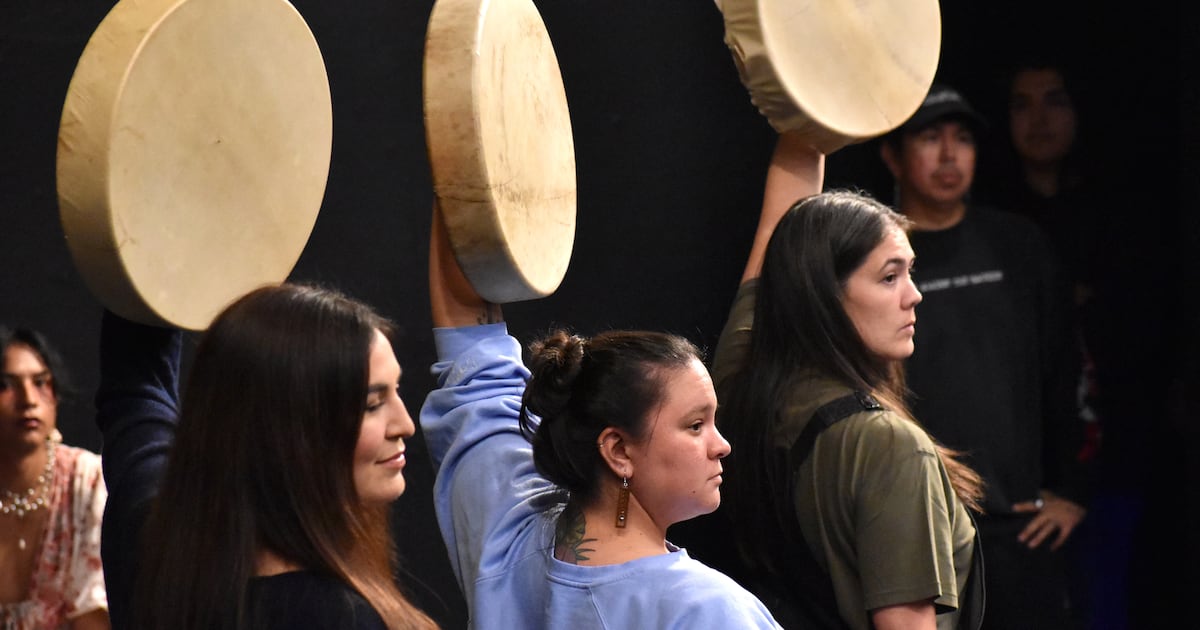
Kira Apaachuaq Eckenweiler, left, Carlyn Costales, center, and Madeline Soboleff Levy, right, hold drums above their heads as they rehearse for the opera “Kutulagaaw: The Tlingit-Russian Battles” at Perseverance Theatre in Juneau on Aug. 27. (Mari Kanagy / ADN)
JUNEAU — About a decade ago, Rosita Kaaháni Worl had an idea: to tell the story of the 19th-century battles between the Tlingit nation and Russian settlers through opera, bringing together history, music and the Tlingit language.
That idea will come to life Friday, Sept. 11, when “Kutulagaaw: The Tlingit-Russian Battles” opens in Juneau for a two-week run.
The production, put on by Sealaska Heritage Institute and Perseverance Theatre, is believed to be the first Tlingit opera in recorded history.
The opera tells the story of a pair of wars fought on Kiks.ádi land in 1802 and 1804 in Sitka — which later became the colonial capital of Russian America — between Tlingit clans and the Russian-American Co. sent to expand the empire’s foothold in North America. The final battle in 1804, which ended when the Tlingit retreated from a fort near Sitka after multiple days of heavy fighting, was the last major armed conflict between the Russians and Alaska Natives.
The opera, performed entirely in Tlingit by an all-Indigenous cast, draws on accounts of the conflict passed down through the generations, as well as written historical records.
“This is both a performance, but also a statement and a sort of line in the sand. We’re still here. We’re going to be here. We’re going to continue pushing our art and pushing what we can do with it while we listen to our ancestors and bring those traditions forward,” said Vera Starbard, the opera’s librettist, or writer.
The show will be performed at Thunder Mountain Middle School in Juneau. All tickets, except for opening night, are pay-as-you can.
The history
Worl, president of Sealaska Heritage Institute, described the genesis of the opera during an Aug. 27 panel at the Sealaska Heritage Institute Clan House.
The idea came to her while listening to a collection of Tlingit recordings about the battles passed down through generations of families at Sitka National Historical Park.
Those accounts, recorded decades ago, along with historical research, became the foundation for the opera.
Worl described the early relationship between the Tlingit and Russians as mutually beneficial, with the groups trading and exchanging goods. But that relationship soured as Russian settlers began appropriating Tlingit land and resources and violating Tlingit laws, she said.
As tensions rose, Tlingit clans organized to attack the Russian’s fort. Worl said leaders of about 50 autonomous Tlingit clans met, with Haidas also joining them. The Tlingit won the first battle in 1802 and burned the Russian fort, but retreated during the 1804 conflict when the Russians returned to retake the area for their empire.
Rosita Kaaháni Worl, president of Sealaska Heritage Institute, speaks about the institute’s Tlingit opera during a panel at SHI in Juneau on Aug. 27. (Mari Kanagy / ADN)
Telling the story as an opera harks back to the Tlingit tradition of using musical performances to tell stories, which were often performed in natural amphitheaters found in the Southeast Alaska landscape. Some of those traditions are seen today in Celebration, the biennial event honoring Indigenous cultures of Southeast Alaska.
“We had singers and performers, along with all of our cultural objects, masks, drums — all of the kinds of things that you see at Celebration. So you could see kind of the remnants of those traditional operas that we had,” Worl said.
But for generations, Russian and U.S. governments suppressed Alaska Native people and traditions. Children were forced to attend boarding schools and prohibited from speaking Indigenous languages, while laws criminalized traditional dances and ceremonies.
“We were not allowed to do our performing arts for generations,” Starbard said. “So many of these things were literally illegal for us to do.”
The composition
After its inception, the opera began with words.
Starbard, the current Alaska State Writer Laureate, spent months studying the sources, familiarizing herself with the stories and crosschecking the accounts before beginning to write the script.
First, Starbard would write a scene in English, before it was then translated into Tlingit by X’unei Lance Twitchell, the opera’s translator and language consultant. Once the script was finalized, Shaakindustóow Edward Littlefield and Rory Stitt composed and arranged the music for an orchestra.
The yearslong process was repeated scene by scene.
Twitchell would reverse-translate his work back into English to compare the meaning with Starbard and make adjustments. The reverse, word-for-word translation was also helpful for the actors to guide their scene, some of whom had never spoken Tlingit before the play.
Creators of “Kutulagaaw: The Tlingit-Russian Battles” hold a panel about the Tlingit opera on Aug. 27 at Sealaska Heritage Institute in Juneau. Pictured, from left, are Vera Starbard, librettist; Madeline Sayet, director; Shaakindustóow Edward Littlefield, composer and musical director; X’unei Lance Twitchell, translator and language consultant; and Frank Henry Kaash Katasse, actor. (Mari Kanagy / ADN)
Twitchell has studied the dramatic losses of the Tlingit language in the past 20 years, as the last generation who grew up with Tlingit as a first language ages. Tlingit is classified as a critically endangered language by UNESCO, and Twitchell estimates there are only a handful people who can “really speak the language” still alive today.
For Twitchell, translating the opera means considering the metaphors, sayings and memories embedded in the Tlingit language — and some of his own experience learning it from elders who have since passed away.
“So their words, their voices don’t echo out and get lost, every day we’re always going to be speaking Tlingit,” he said. “We’re going to sing songs in Tlingit, and even though some of the houses begin to fall down in the clan houses of our ancestors, our language is echoing back, and it’s such a wonderful thing to be a part of that.”
The stage
At an evening rehearsal in late August, the cast was preparing to bring the story to the stage.
Madeline Soboleff Levy, who plays Tix’, described herself as a Tlingit language learner. Learning the language has been a family endeavor: three of her children attended the Tlingit-language immersion preschool Haa Yoo X̲’atángi Kúdi.
Sometimes, while rehearsing her lines, she looked to her kids for guidance.
“There were times where I could be singing something, and I could say, ‘Is it, ‘hh’ or is it ‘ck’ ‘? And my kids will look at, and they’re like, ‘ck,’ ‘ck.’ So they can help correct my pronunciation,” Soboleff Levy said.
In the story, her character serves as a translator between Tlingit and Russian rather than as a clan leader directing battle strategy. But Soboleff Levy said the character takes on an important role as the conflict unfolds.
Kira Apaachuaq Eckenweiler, left, Carlyn Costales, center left, and Madeline Soboleff Levy, center right, receive notes from Shaakindustóow Edward Littlefield, right, composer and musical director for the Tlingit opera, at a rehearsal at Perseverance Theatre in Juneau on Aug. 27. (Mari Kanagy / ADN)
“In the midst of this chaos, this person who normally wouldn’t have a leadership role is stepping in, and then after the battle, helping helping facilitate a conversation about the cost of this — that the cost of this war is too much,” Soboleff Levy said.
For audience members who do not speak Tlingit, the production will include an English-language program explaining the opera scene by scene. A storyteller will also explain the plot before the performance begins.
But Madeline Sayet, the director, said at the panel that audiences do not need to understand every word or detail of the plot to connect with the work.
“Whatever emotionally is resonating with you is actually what’s most important,” Sayet said. “You hear the sounds, hear the poetry, watch the performers, and let it wash over you, and receive whatever it is that you receive, and know that that’s enough.”
• • •
“Kutulagaaw: The Tlingit-Russian Battles” will feature performances on Fridays, Saturdays and Sundays from Sept. 11-20 at the Thunder Mountain Middle School auditorium in Juneau. Additional information about the production and tickets is available at ptalaska.org/kutulagaaw.