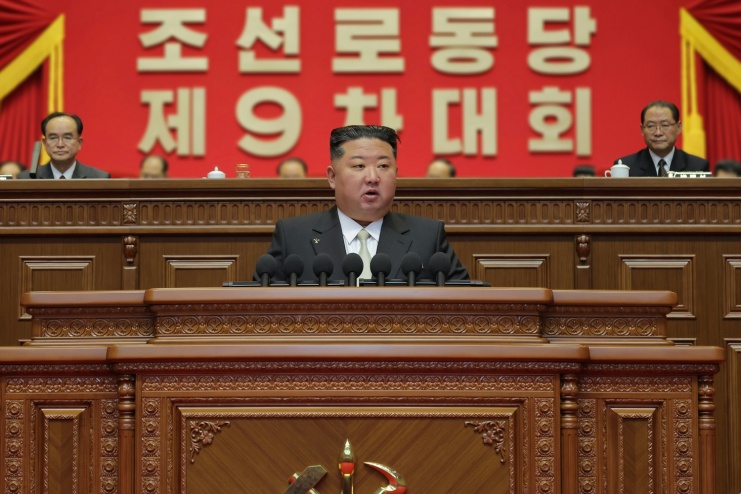
Kim Jong Un addresses delegates at the Ninth Workers’ Party of Korea Congress on Feb. 19, 2026. The congress produced sweeping resolutions on ideology, personnel, and economic policy. Photo: Rodong Sinmun/News1
North Korea revealed the full text of its revised party charter from the Ninth Party Congress held in March 2026, institutionalizing Kim Jong Un’s sole leadership system and consolidating his long-term rule on normative and institutional grounds, according to analysis released Sept. 3.
The National Security Strategy Research Institute held a press briefing in Seoul on Wednesday, releasing the complete text of the revised charter and providing analysis of North Korea’s current political situation. Kim In Tae, a senior research fellow at the institute, said the revised charter represents a decisive consolidation of Kim Jong Un’s leadership authority over the Workers’ Party of Korea.
Rewriting the party’s ideological foundations
The institute highlighted two critical areas of revision: the removal of predecessor symbolism from the charter’s preamble and the detailed expansion of the Secretary General’s powers in Article 24.
The preamble had previously included passages praising the achievements of Kim Il Sung and Kim Jong Il. The revised version deletes these praises entirely, retaining only the designation “Kim Il Sung and Kim Jong Il Thought” as the guiding ideology. The charter adds what North Korean authorities call the “Five Principles of Party Construction” from the Kim Jong Un era, now rebranded as the “Permanent Party Construction Line.”
Kim In Tae said the earlier Eighth Party Congress in 2021 had already addressed predecessor symbolism in its charter. “This revision removes the two remaining paragraphs in the preamble,” he explained. “The Workers’ Party charter now truly and fully reflects the Kim Jong Un era.”
The shift marks a significant institutional departure. While Kim Il Sung and Kim Jong Il built their rule partly through reverence for revolutionary legacy, the revised charter signals that North Korean legitimacy now rests on Kim Jong Un’s personal authority and institutional framework rather than historical inheritance.
The revised charter’s Article 24 for the first time spells out the Secretary General’s specific duties and authorities in concrete detail. The previous version contained only a blanket statement that the party leader holds the title of Secretary General. The revised text explicitly specifies the Secretary General’s power to convene Politburo meetings and Standing Committee sessions, directly appoint senior cadres, admit and expel party members and candidate members, dissolve party departments and organizations, and make other strategic decisions.
Kim In Tae noted this level of specificity in the charter is unprecedented. “Detailing the Secretary General’s status and authorities in the party charter for the first time codifies and strengthens the Secretary General’s command and control over the party,” he said.
The codification serves a practical purpose for regime continuity. By embedding these powers in the formal party rules rather than relying on convention or personalistic authority, North Korea creates a framework meant to survive potential power transitions and reduce reliance on individual personality cult.
Formally abandoning unification rhetoric
The full text also confirms what the institute had previously reported: North Korea formally abandoned the “two-nation” theory approach to inter-Korean relations and the unification line that accompanied it. While the institute reported this shift in June 2024 following a Central Committee session, seeing it confirmed in the official party charter text marks the first public documentation of this policy reversal.
The revised charter deletes key phrases from the original version, including “peaceful unification,” “national unity,” and “united front,” which had been standard references in previous charters. The deletion amounts to a formal institutional repudiation of decades of unification rhetoric that had underpinned North Korean policy toward the South.
The charter raises party membership age from 18 to 20 years old, reversing a policy set nearly 70 years ago. The Workers’ Party lowered membership age to 18 in 1956 during its Third Party Congress. The new age requirement appears coordinated with North Korea’s shift to a 12-year compulsory education system, with graduation, working age, and voting age all adjusted accordingly.
For the first time, the party charter includes provisions addressing wartime conditions. Article 15 of Chapter 2 states that senior officials nominated as Central Committee candidates can, in wartime, take office as Central Committee members without undergoing the standard election process. Article 27 of Chapter 3 allows the Politburo to make critical decisions during wartime with only approval from the Central Committee rather than requiring full procedures.
These wartime provisions appear designed to allow rapid decision-making and unified command during a national emergency while maintaining formal party processes. The inclusion signals North Korea’s emphasis on maintaining party strength and coherence across all scenarios.
Building a succession framework for the decade ahead
Kim In Tae characterized the Ninth Party Congress charter as marking the beginning of “Kim Jong Un era 2.0.” He noted that the Ninth Party Congress term runs from 2026 to 2031, and North Korea is expected to use this period to strengthen Kim Jong Un’s sole leadership system and construct long-term succession mechanisms based on the revised charter’s institutional framework.
The formal codification of the Secretary General’s powers in the party charter may also be interpreted as preparatory work for a potential succession, establishing precedent for how future leadership will exercise authority over the party apparatus without requiring constant personalistic reinforcement or personality cult mechanisms.
Read in Korean
Reporting from inside North Korea
Daily NK operates networks of sources inside North Korea who document events in real-time and transmit information through secure channels. Unlike reporting based on state media, satellite imagery, or defector accounts from years past, our journalism comes directly from people currently living under the regime. We verify reports through multiple independent sources and cross-reference details before publication.
Our sources remain anonymous because contact with foreign media is treated as a capital offense in North Korea — discovery means imprisonment or execution. This network-based approach allows Daily NK to report on developments other outlets cannot access: market trends, policy implementation, public sentiment, and daily realities that never appear in official narratives.
Maintaining these secure communication channels and protecting source identities requires specialized protocols and constant vigilance. Daily NK serves as a bridge between North Koreans and the outside world, documenting what’s happening inside one of the world’s most closed societies.