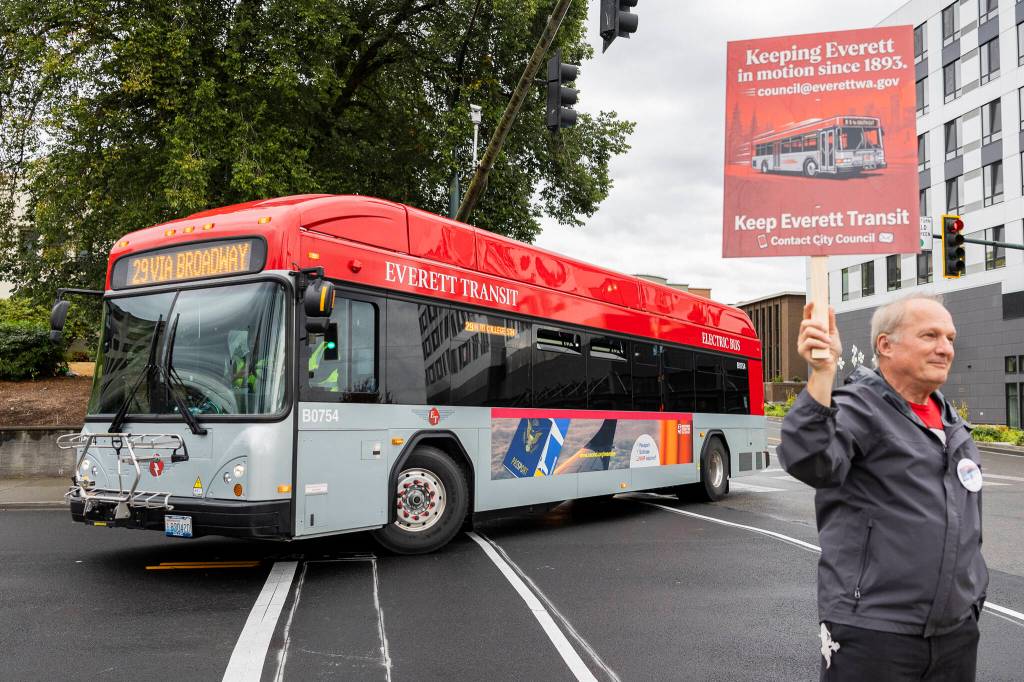
EVERETT — Members of a union representing Everett Transit drivers and mechanics gathered outside of the City Council chambers on Wednesday to protest a potential merger between Everett Transit and Community Transit.
Officials at the city of Everett and Community Transit announced in April that they were resuming talks over possibly consolidating both transit agencies, an idea that has been studied for years but was put on pause around 2024.
The union, the Amalgamated Transit Union 883, said they decided to gather outside of the council chambers to spread the word about their concerns over the possible consolidation, including worries over potential impacts to employees and the tax increase that would come along with a merger.
“We’re trying to raise awareness because most of the citizens aren’t aware,” said Steve Oss, the union’s president, on Wednesday. “They don’t know what’s going on.”
The potential merger has been the subject of much debate within the community.
Proponents say a larger, better-funded Community Transit could bring big benefits for Everett residents, even though they would pay higher sales taxes — jumping from a 0.6% transit sales tax to 1.2% — to join the county-wide transit system. It’s likely that a merger would significantly increase bus service within the city, previous studies have shown, as the increased tax revenue would allow for more frequent buses, more routes and more bus connections between Everett and other cities in the county.
At an Aug. 18 open house, Community Transit CEO Ric Ilgenfritz and Everett Mayor Cassie Franklin said the combined network would increase transit services while reducing inefficiencies, at a time when the city is expected to grow in population significantly over the next 20 years, and as Link light rail is set to arrive in downtown Everett by 2041.
Others worry that the consolidation would be an unnecessary tax increase because they say Everett Transit already provides quality bus service throughout the city. Opponents have also said that the merger would relinquish Everett’s relatively unique local control of its transit system, and have decried the fact that residents may not get a direct say on the decision because consolidation no longer requires voter approval, thanks to a new state law approved in 2025.
There’s also worries over paratransit services. Currently, Everett’s service is available to more people than it’s required to provide it to — the Americans with Disabilities act requires transit agencies to provide door-to-door paratransit service to those who cannot use fixed-route buses due to a disability, but Everett Transit’s paratransit also serves all residents over 65.
Under current plans for the possible consolidation, people currently eligible for the paratransit service would continue to receive it, but those who turn 65 after the merger goes into effect would no longer automatically qualify.
Both Franklin and Ilgenfritz said they’re committed to making sure Everett Transit employees do not lose their jobs as a result of the merger, if it goes through. They would also maintain their existing pay and benefits, per federal laws governing transit consolidations.
Anthony Michaels, an Everett Transit bus driver for 11 years, said Wednesday that he’s concerned about the fact there may not be a public vote on the merger, and the fact that many details of the potential merger still need to be worked out.
One of the main worries for drivers, Michaels said, is how the merger will affect the seniority of employees who would move from Everett Transit to Community Transit.
Seniority is a big deal for bus drivers. Operators with more years of experience get more control over their schedules and are able to pick and choose more preferable routes to drive. But a merger would see two different unions come together, both with employees who have worked at their respective transit agencies for years or even decades.
“To get from the bottom to the top takes years,” Michaels said. “… I’ve worked hard for it, so I would be really bummed if I went to another agency, and all of a sudden my seniority is much lower on their list of people, I’m back to where I was five years ago where I don’t have a choice of schedules.”
In a statement Thursday, Everett spokesperson Simone Tarver wrote that if a merger went into effect, existing union contracts would remain in place throughout the transition, and issues related to seniority of Everett Transit staff would be addressed through the collective bargaining process.
A merger with Community Transit “will bring improved and expanded transit service to all of Everett,” Tarver wrote Thursday. “We are committed to ensuring that through this proposed consolidation all of Everett Transit’s employees are taken care of.”
The Everett City Council and Community Transit board of directors are expected to vote on whether to approve an agreement that would consolidate the two transit agencies as soon as October, officials have said at board meetings for Community Transit and Everett.
“When the time for the vote does come, what we would like to hear is them saying no, no merger,” Oss said Wednesday.
Speaking to council members on Wednesday, Everett Transit driver Keith Jacobson urged the governing body to take its time with its decision.
“There’s not an emergency with Everett Transit that it has to be done right now,” Jacobson said. “You’ve got time, you know. Unless there’s some external force that is making us do it right now, we’ve got time to think about this and put it to a vote of the people, and yet we’re choosing not to do that. I think the citizens of Everett deserve a right to vote on this, especially for a sales tax increase of this size.”
Ilgenfritz and Franklin said in a previous interview that the years of work that had already gone into studying the merger gave them a head start on the process. Franklin added that implementing the merger now would give Community Transit time to build up its service in advance of the Link light rail network arriving in the city.
“I really did see what is necessary to deliver passengers to light rail stations,” Franklin said in a June 22 interview. “Yes, that’s a decade away to get to south Everett, but it still takes a while to ramp up that level of service, and we need to move now to get to where we need to be to deliver light rail to Everett and get more Everett residents riding transit.”
If officials approve a merger, it will likely take years to fully go into effect because of the planning work and public input that would have to occur to come up with a new bus network. The expanded service would be implemented in phases, possibly beginning in March 2028 and taking as long as four years to be fully put into place, according to a city document. Until that point, Everett Transit service would continue as is.
Will Geschke: 425-339-3443; william.geschke@heraldnet.com; X: @willgeschke.