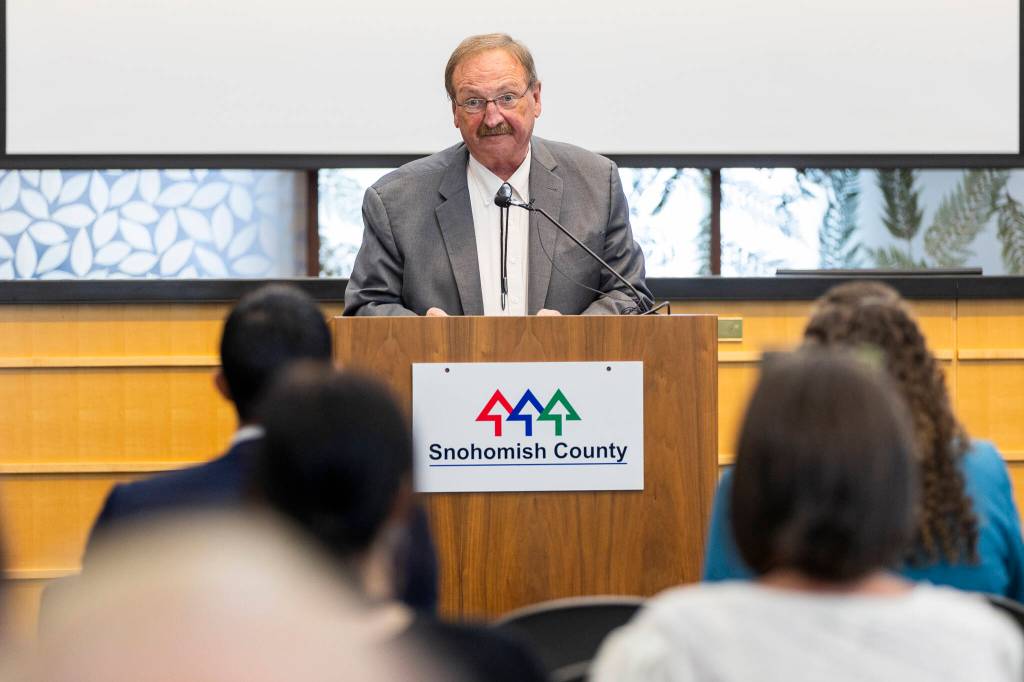
EVERETT —Snohomish County Executive Dave Somers presented his recommended $3.37 billion biennial budget, which addresses a projected $56 million deficit, for 2027-28 to the County Council during a presentation Tuesday.
The 2-year budget is a more than 4.6% increase from the county’s previous $3.22 billion biennial budget, which the County Council approved but Somers did not sign in 2024. That was the county’s first biennial budget.
“This is the tenth time I have come before this body to recommend a budget,” Somers said during the budget address. “This has been one of the hardest budget cycles and we are not alone in the fiscal challenges we face.”
Inflation, limited revenue tools allowed by the state, federal funding uncertainty and an ongoing structural deficit all contributed to a difficult process, Somers said.
However, the 2027-28 budget is not yet approved. There are still months of work ahead for the County Council to go through its process, council member Megan Dunn said after the address.
“Now it’s in our hands to look at the budget, review the budget, take a look at the proposals and make sure that we’re having a fair and open, transparent process,” she said. “It’s in the council’s hands and in a much more public venue for vetting these decisions. So, I’m hoping that we’re able to collaborate around these issues and not have disagreements.”
The council will review the budget in September, with the residents providing their perspectives during hearings in October. The council may not approve a budget until November, as it did in 2024, depending on how contentious discussions may be.
‘The known deficit’
Somers’ proposed budget calls for a general fund of $786.6 million. The general fund is the county’s most flexible funding source.
Somers and his staff entered the budget process looking at a $56 million general fund deficit over the next two years, he said during the Tuesday address. However, the actual deficit is most likely larger, Somers said.
“That’s the known deficit based on our last adopted budget,” he said. “It doesn’t factor in salary and benefit adjustments that have occurred since or will occur in the coming months, as well as underbudgeting.”
To help close the gap, the County Council approved a 0.1% criminal justice sales tax on Aug. 12, expected to bring in $24 million in annual revenue.
Somers also asked departments to cut spending by 3%, totaling about $22 million over the next two years, he said. Departments needed to either cut spending, leave positions vacant to save money or increase revenue, he said.
“We were strategic and precise,” Somers said. “Some of those cuts we took in full, some of them I reduced or reversed, and some of the reductions were managed with smart realignment of staff and programs.”
The proposed budget eliminates 17 positions in the Health Department and 14 in Planning and Development Services. Of those 31 positions, 11 are filled and the rest vacant.
The budget would eliminate a total of 79 open positions that had not been filled, including 51 in Public Works, one from the Wellness Team in Human Resources and one animal control officer. The county would “unfund” nine positions — meaning they cannot be filled unless a new revenue source becomes available — and leave 32 more positions open to reduce spending.
“We knew we could not ask our community to pay more if we weren’t also willing to take the cuts,” Somers said.
The county would also cut funding in the Medical Examiner’s Office and the Office of Social Justice.
Public Works was projecting its own $9 million deficit, but the County Council approved a new $20 car tab fee on Aug. 12 to help close the gap. The car tab fee is expected to bring in around $6 million. The department may also have to cut spending further to close the gap completely, according to Director Kelly Snyder in a May interview.
‘The remaining banked capacity’
About 6 cents of each property tax dollar goes into the county’s general fund. Another 4 cents goes into the county’s roads fund. The rest goes to schools, the state, fire districts, other special districts, cities and towns.
State law allows the county to raise its general fund property tax portion by 1% each year. If the council decides not to, that 1% is stored and can be used in subsequent years, called “banked capacity.” Currently, the county has 4.3% worth of banked capacity.
Somers’ proposed budget calls for the standard 1% increase, along with use of all remaining banked capacity.
“Anyone who looks at any budget knows your costs go up annually,” County Council member Jared Mead said after the address. “It has been strategically unwise for the last 15 years for our county to be the one of the big three — Pierce and King being the others — that did not take our 1% increases, statutorily allowed 1% increases. So we banked all of that. I think that was a mistake.”
But the council shouldn’t chase bad decisions with more bad decisions, he said.
“You have to be calculated about it,” Mead said. “Maybe this is the path we go. I don’t know yet.”
New state law also mandated new rates for the county’s veterans relief fund and developmental disabilities and mental health fund. These funds used to be tied to and have the same rate as the general fund. Now they will each have their own rate.
“We chose to set those levies at the minimum allowed by the state,” Somers said. “This still is expected to increase the amount that goes specifically to veteran, disability or mental health services.”
The proposed budget sets the developmental disabilities and mental health levy at 2.5 cents per $1,000 of assessed value, and the veterans relief levy at 1.8 cents per $1,000.
“If you combine the 1% annual increase, the remaining banked capacity and the levy changes, it adds up to about $41 more per year on an average valued home of $741,000,” Somers said.
Dunn hopes there are enough votes within the County Council to approve all of the property tax increases, she said after the address.
“We’re relying too much on sales tax,” she said. Property tax “is a more reliable funding source … And it’s a little more fair because we have the senior property tax exemption, and better exemption programs for our low-income families. So, to me, I’d like to see more of a shift back to the property tax.”
However, council member Sam Low said the increases may not be affordable for county residents.
“I highly doubt the County Council will take all recommended tax increases,” he said after the address. “That’s something that we’ll be looking at very closely over the next couple months.”
‘Work more efficiently’
The proposed budget includes more than cuts and new revenues.
“I also asked county staff and leaders to think about how we can work more efficiently,” Somers said.
In past years, the county relied on contracted nurses at the county jail. The budget would instead create six full-time positions using thoughtful shift structures and flexible leave policies, he said.
“That change is expected to save the county approximately $1.8 million per year,” Somers said.
The District Court would add two new program coordinators for its defensive driving classes.
“These classes give the opportunity to provide education on safe driving rather than simply penalties for unsafe driving,” Somers said. “It’s a way to improve safety on our roads while bringing in revenue to support services.”
The county’s Information Technology Department is working to establish a new central system to handle finance, hiring, payroll, grants and more, modernizing processes and enabling more efficient work, Somers said.
“Smaller, more focused efforts add up over time,” he said. “Initiatives like taking a close look at cell phone contracts, expanding electronic signature options and working with the Clerk’s Office to move paper processes to digital platforms have prevented hundreds of thousands of dollars in unnecessary expenses and saved thousands of staff hours.”
Taylor Scott Richmond: 425-339-3046; taylor.richmond@heraldnet.com; Bluesky: @btayokay.bsky.social