(Source: Korean Central News Agency)
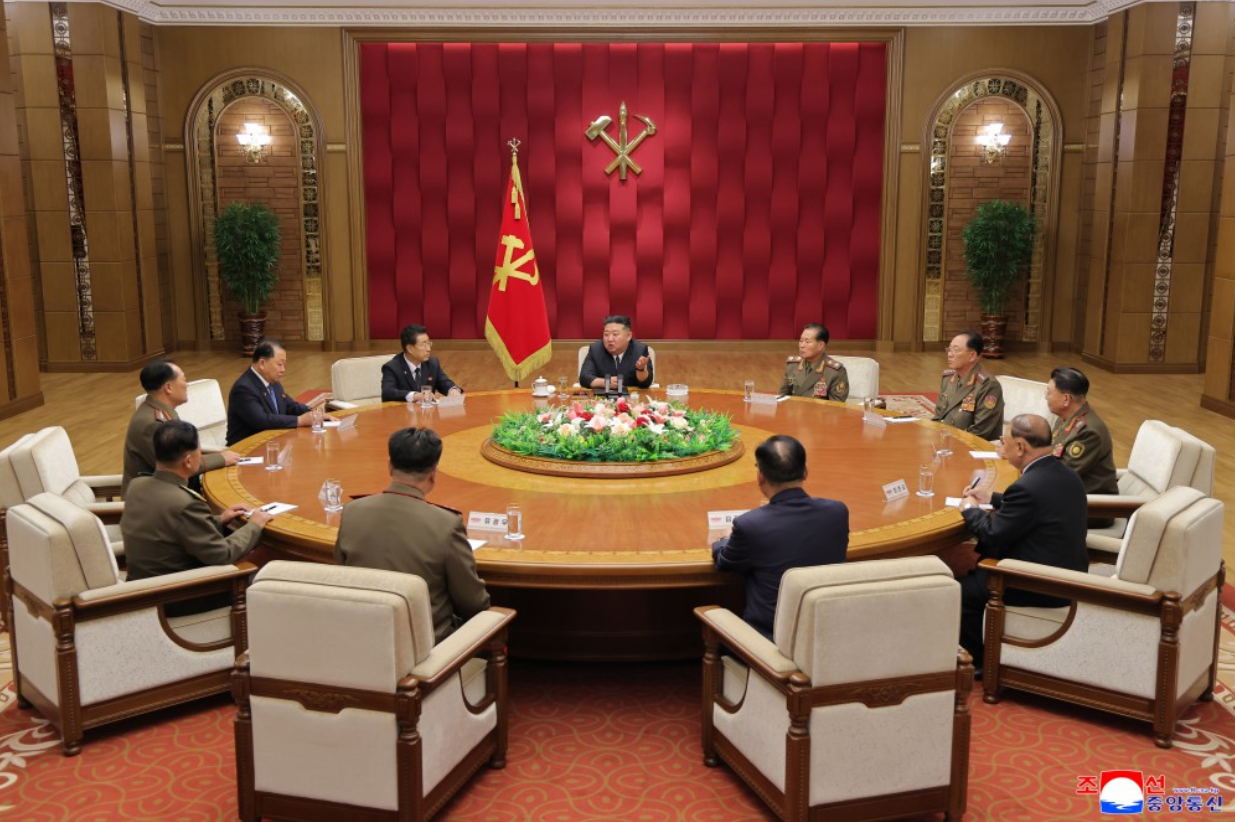
On August 29, Kim Jong Un presided over both an awards ceremony for three defense industry personnel and a meeting of the Workers’ Party of Korea (WPK) Central Military Commission (CMC) that ended with a major shake-up of top Korean People’s Army (KPA) high command personnel. Together, these events reinforced Kim Jong Un’s role as head of state and formalized decision-making processes of North Korean power institutions. The CMC meeting was also the latest high visibility leadership action tied to corruption in the KPA General Political Bureau (GPB), seemingly aimed at changing the structural environment to prevent and repeat attempts to subvert the system.
The Award Ceremony
The August 29 ceremony bestowed state awards onto individuals in the defense industry who “made a major contribution to resolving scientific and technological problems of epochal significance in developing new combat weapons systems” and having “recently developed exclusive technologies to be regarded as an event in strengthening the capability of fighting a war and the deterrence.” State media did not disclose the specific type of weapons systems or the innovation, but the use of “deterrence” and “strengthening… deterrence” strongly suggests links to the nuclear program.
However, the significance of this ceremony was how Kim Jong Un participated, reading out the Supreme People’s Assembly (SPA) decree granting the awards. This was an unusual act, although it aligns with new head of state duties specified in the revised constitution (clause 5, chapter 90), which notes the head of the State Affairs Commission (SAC) “confers state decorations on persons who have rendered distinguished services.” This does not mean Kim Jong Un reading decrees will become common at future events but demonstrates him taking on more of the head of state role and underscores the SAC’s precedence over the SPA.
CMC Personnel Shakeup
The CMC gathered for its second meeting since the Ninth Party Congress in February. Attendance was restricted to CMC members, in contrast to most CMC sessions that usually expand participation and attendance to a wider population of senior defense managers and military commanders. Compared to other CMC meetings, which mainly deliberate, debate and decide on policy, the August 29 session addressed personnel changes with some discussion on the KPA’s “structural reorganization.” It is probable that the restricted attendance was due to the discussion of sensitive information (i.e., “need to know”) about personnel affairs and organizational adjustments.
In particular, the CMC addressed five personnel changes for the top leadership of the KPA and the CMC itself.
- No Kwang Chol was dismissed as Minister of the Ministry of National Defense (MND) and removed from the Political Bureau. He was reassigned as the WPK Munitions Industry Department (MID) senior deputy director. No is part of a cohort of core elites Kim Jong Un rotates between high visibility frontline and second-tier posts for institutional continuity and to mitigate factional entrenchment.
- No was replaced by Kim Song Gi, KPA GPB Director. This appears to be a concurrent position, with Kim now serving as both MND Minister and GPB Director.
- Pak Jong Chon was appointed CMC Vice Chairman and retained his position as an MND Adviser.
- Yu Kwang U shifted from Military Security Command (MSC) Director to GPB Senior Deputy Director.
- Om Ju Ho replaced Yu as MSC Director. These GPB/MSC appointments follow a precedent of senior GPB and MSC personnel rotating between organizations.
Fallout from Pak Hui Chol Scandal
The changes described above are all tied to entrenched corruption and abuse of power centered around Pak Hui Chol, former director of the GPB Organization Department (OD). Publicized at a Central Committee Plenum in June and detailed at a rare joint leadership meeting in July, Pak’s case is the most prominent abuse of power and corruption scandal in North Korea in over a decade.
Pak served in the GPB OD role from 2022 to 2026, in charge of party life, political management and personnel affairs in the GPB and MND. He used this position and its authority for enterprise corruption, building a network of associates who sold administrative MND and GPB positions and swindled the regime out of money and materials. Although Pak’s activities were not a direct power challenge to Kim Jong Un, it did create a shadow hierarchy that triggered a months-long high-level intervention. As a result, Jo Yong Won was reappointed to lead the OGD, to which the GPB is traditionally subordinate, after only three months leading the SPA. This highlights the severity of the problems at the GPB.
The Pak case exposed a major failure in the political management structure of the KPA. Changes announced at the August 29 CMC meeting sought to reshape the interface among MND, GPB and MSC and the WPK Political Guidance of the Military Department (PGM). In addition to personnel changes, broader administrative changes were also likely, such as diversifying reporting and authority lines across different departments, weakening the grip of the OGD over the GPB. Jo’s return is intended to stabilize authority amid fallout from the Pak Hui Chol scandal and ease GPB’s transition away from OGD-centered control.
Insights and Implications
Certainly, the North Korean state media reporting of these events does not offer sufficient detail to know the full extent of what took place or the intended final outcome. However, there are a few insights to be gleaned from current available information.
- Kim Song Gi’s concurrent MND/GPB position is not unprecedented, although it has not happened in over 30 years. Kim’s concurrent appointments may be temporary, intended to fill the gaps left by the Pak Hui Chol scandal.
- Pak Jong Chon was appointed CMC Vice Chairman alongside Jong Kyong Thaek, meaning there are now two CMC Vice Chairmen. Having dual CMC vice chairmen splits policy responsibility between political management and policy compliance (Jong) and military modernization and operational implementation (Pak).
- Pak Jong Chon retains his post as MND Adviser. Under Kim Jong Un, this position has been used for retired or semi-retired officials who can provide advice based on their experience and institutional memory. Pak’s appointment to the CMC elevates this adviser’s position to a more active decision-making role, most likely based in the SAC Secretariat.
- Pak Jong Chon and Yu Kwang U’s full Political Bureau membership were both new and discretionary appointments, elevating their bureaucratic influence (MND and GPB senior deputy director respectively) by integrating them into the regime’s formal hierarchy.[1]
The August 29 events provide further insight into the decision-making landscape after the Ninth Party Congress. From these changes, Kim Jong Un appears to be reasserting the primacy of the WPK and SAC and restoring coherence and control to the KPA’s political management following the Pak Hui Chol corruption scandal.