BEREA, Sept. 1 — The International Organization for Migration (IOM) is intensifying efforts to raise awareness and mobilise stakeholders to take action against Trafficking in Persons (TIP).
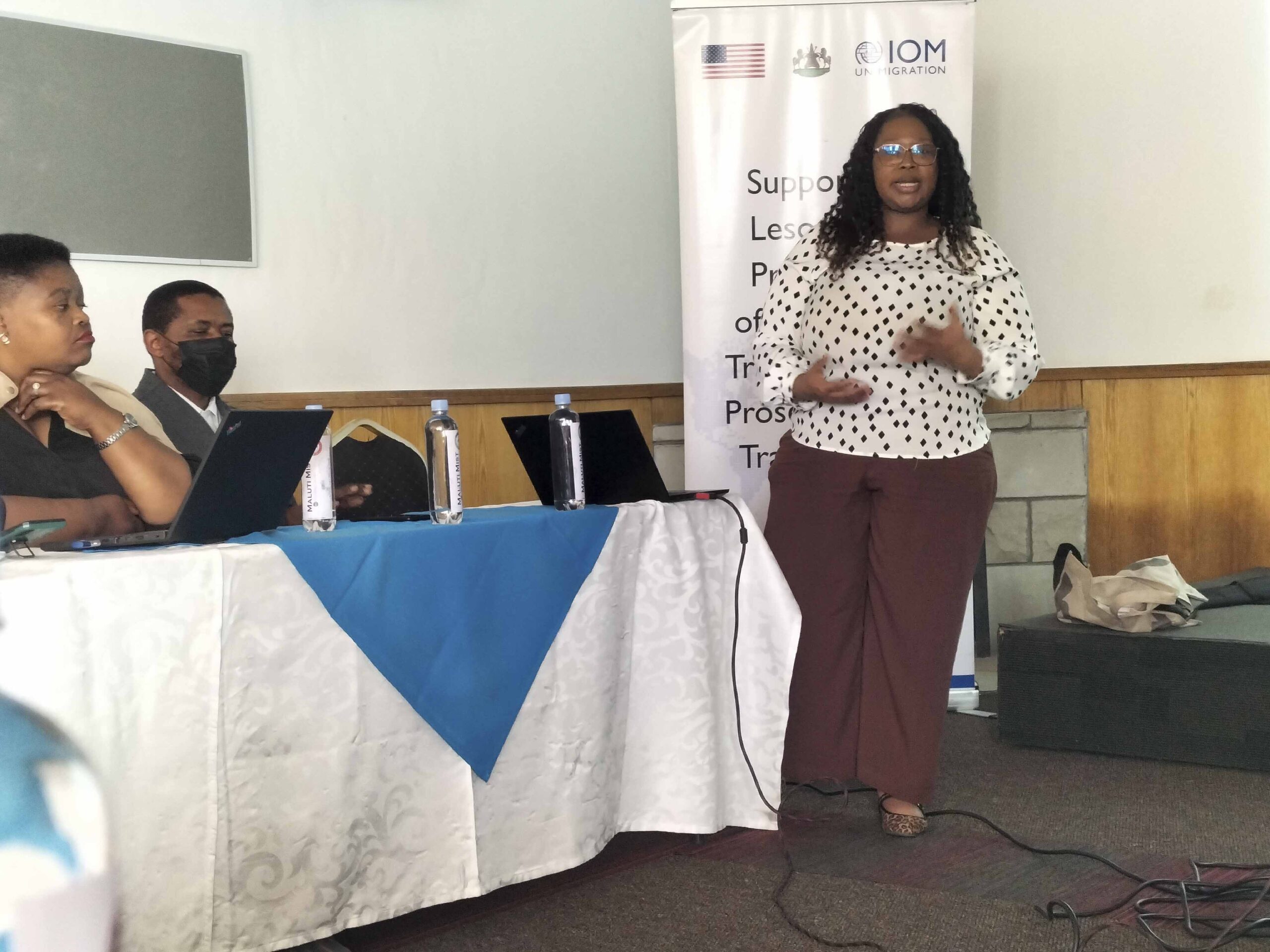
IOM on Tuesday held a one-day workshop with Heads of Departments (HODs) in Berea as part of its continuing efforts to strengthen awareness and stakeholder action against TIP.
Briefing the HODs, IOM representative Ms.. Rethabile Sechache said poverty and vulnerability were among the major factors driving people to leave their families and migrate in search of better opportunities, which could expose them to trafficking.
She said IOM launched a project in 2023 aimed at strengthening the capacity of the Government of Lesotho and civil society organisations to prosecute TIP cases and protect victims.
Ms.. Sechache said one of the project’s main objectives was to strengthen the capacity of law enforcement agencies and the judiciary on TIP-related issues, including case identification, intelligence gathering, investigation and prosecution.
She said the project also sought to strengthen collaboration among law enforcement, justice institutions and civil society at national and district levels through information sharing, reporting and joint efforts to prosecute traffickers.
She further said the project aimed to ensure that victims of trafficking received protection and immediate support from trained service providers using survivor-centred and trauma-informed approaches in all 10 districts.
“Victims of trafficking require specialised care and support. As a result, we are working in partnership with other stakeholders to prioritise their physical wellbeing and ensure that they are psychologically rehabilitated before being reintegrated into society through trained facilities, while also ensuring access to justice for all victims,” she said.
Ms. Sechache said IOM had supported the Government in reviewing TIP cases and reports, adding that joint inspections of foreign-owned businesses had been conducted by the Department of Labour, police and immigration authorities.
She said the inspections were aimed at checking whether workers had the necessary documentation to be in the country and identifying possible signs of exploitation.
“Every migrant person’s life matters, whether a foreigner or local. Hence, routine inspections are very important, particularly at foreign-owned shops, as possibilities are high that people can exploit one another,” she said.
Ms. Sechache said, in partnership with the Beautiful Dreams Society, IOM had established a transit monitoring programme involving specialised personnel at border gates to identify suspicious movements of people who may be vulnerable or potential victims of trafficking.
Echoing the sentiments, Police Head Office Anti-Trafficking Department representative Ms.. Itumeleng Monane said TIP involved three essential elements: acts, means and purpose.
She explained that victims could be recruited, transported or transferred to another place, or harboured through force, coercion, abduction or fraud, for the purpose of exploitation.
Ms. Monane said victims of trafficking were often unable to negotiate their working conditions and could be forced to work long hours for extended periods while receiving little or no payment.
She said victims were also often deprived of their identity documents.
“The worst part is that victims normally find themselves in a difficult situation where they know no one, while language can become a barrier. They rarely or never leave the house for social reasons and may be coached to respond according to the trafficker’s instructions because they fear for their lives,” she said.
Ministry of Social Development Social Worker, Ms. Lerato Ncheke, said survivors of trafficking were normally categorised as vulnerable depending on the trauma they had experienced.
She said support should go beyond rescue and shelter to ensure meaningful reintegration and independence.
Ms. Ncheke said service providers should provide holistic, survivor-centred support and build partnerships across the health, education and justice sectors.
She reiterated that recovery from trafficking was not a linear process, as every survivor’s journey was unique.
She therefore urged service providers to maintain case management and follow-ups while providing ongoing psychosocial support and adapting support plans to individual goals and cultural contexts.
Speaking on behalf of the District Administrator’s Office, Mrs. Malehola Moeketsi said the workshop had been an eye-opener, adding that the skills acquired would enable participants to identify signs of TIP and people vulnerable to exploitation.
She stressed the importance of sharing the information with others as a way of promoting a culture of public safety.
Meanwhile, Berea Police Station reported that it had recorded eight TIP-related cases.
Two of the cases involved people from other districts who were allegedly promised jobs in Berea but were subsequently exploited.
The station also reported that a foreign national was sentenced to eight years in prison for trafficking in 2022, while one case remains under investigation.
Another report under investigation involves a boy who was allegedly lured by a close family member to work as a herder in South Africa.
Ends/RM