- There are more than 1,300 documented cases since 2000 of live coral smuggling, with many cases sourcing coral from Southeast Asia, including the Philippines and Indonesia, according to data from the wildlife trade watchdog TRAFFIC.
- The cases involve at least 43 countries around the world, with the U.S. by far the biggest importer of corals.
- The cases include 3.15 million pieces of coral, with many shipments intentionally mislabeled as toys, clothes, or food to get endangered species past customs inspectors.
- Experts say there are solutions, including farm-raised coral substitutes and dyeing farmed coral to document that it was not grown in the wild, making it easier for authorities to spot illegally harvested varieties.
See All Key Ideas
ArtReef Rocks was an up-and-coming online shop offering aquarium accessories that made waves during the COVID-19 pandemic, offering hobbyists custom reefs and sculpted landscapes for their fish tanks. Aquarists raved about excellent packaging (“Not a single broken piece!”), quick turnarounds (“Arrived in only 4 days.”), and client support (“Customer service is amazing.”) — compliments that mean a lot for an online store that operates in the Philippines, more than 10,000 miles from its U.S. clients.
The company gained a solid following about six years ago within a few years and exhibited in 2023 at some of the world’s biggest saltwater aquarium trade shows: the Reefapalooza in New York and Orlando, both in the U.S. Officially registered with the Philippines’ Department of Trade and Industry as Pandorocks Artreef Artificial Reef’s Rocks Aquarium and Accessories Trading, ArtReef had distributors in the U.S., parts of Europe, Australia, the United Arab Emirates, Israel, and other countries.
Back home, its late founder and owner, Glenn Albert Binoya, is credited by the local reefing community as the “inventor” of unique aquarium landscaping described as “artificial live rocks” — substrates made of the mineral aragonite and crushed reef rocks.
But court records in the U.S. show another side to Binoya’s business.
In 2022, 10 U.S. nationals were indicted by authorities in the state of Alaska for trafficking corals in violation of the Lacey Act that regulates wildlife trade. They were accused of illegally selling coral and unlawfully conspiring to smuggle wildlife. Each of the accused men operated their own businesses selling corals in different states. And each sourced corals from the Philippines through Binoya, who in text messages wrote about how he could get corals past customs officials.
The smuggling case is far from an isolated incident. Between 2000 and 2025, more than 1,300 incidents of coral trafficking were reported across 43 countries, according to a Mongabay analysis of data shared exclusively by TRAFFIC, a U.K.-based NGO that works to prevent wildlife smuggling. The data is based on law enforcement records, news reports, and social media posts compiled and independently verified by TRAFFIC.
Live coral seized during Operation Thunderbird, a global anti-wildlife trafficking initiative. Many of the seizures of illicit wildlife products were made by U.S. Fish and Wildlife Service law enforcement officers. Image by USFWS.
In China in early 2025, port authorities seized at least 160 live, endangered stony coral that were found in plastic bags taped to the waist, abdomen, chest, and posterior of four inbound passengers. A month earlier, Chinese authorities discovered and seized 30 pieces of coral, weighing 3.2 kilograms (7.1 pounds) and valued at $30,000.
In August 2025, more than 1,500 live corals, as well as hundreds of live tortoises from the U.S. and the Philippines, were seized in Hong Kong. Authorities estimated a market value of HK$4.31 million (roughly $550,000). The parcels were declared on customs forms as clothes, toys and food. Five people who collected or assisted in collecting the packages were arrested and later released on bail.
In Malaysia, suspected illegal fishers were found with three boxes containing various types of corals with an estimated value of 13,000 ringgit (around $3,200). In the Philippines, a four-vehicle transport of smuggled goods, which included 250 sacks of white sand and broken corals, was stopped at a routine checkpoint.
These are just the cases where authorities stopped shipments. Experts say it’s difficult to assess the full extent of coral smuggling, which is exacerbating persisting threats to the world’s reefs, as many other cases remain unreported. But while strict regulations under international and national laws allow for the legal trade of corals, the appeal of rare species in the aquaria, jewelry, and curio markets continue to drive and incentivize trafficking.
Between 2015 and 2018, Binoya made at least 30 shipments to the 10 U.S. nationals later indicted in Alaska, illegally exporting a total of 3,000 pieces of coral to the U.S. Coral fragments were offered for sale to hobbyists for saltwater aquariums in their homes.
Following a coordinated investigation with Philippine authorities and the U.S. Department of the Interior and the U.S. Fish and Wildlife Service, Binoya was arrested in August 2018 at his home in Bacoor in Cavite province, 50 kilometers (30 miles) south of Manila, the Philippine capital. More than 1,700 live hard and soft corals, 15 kg (33 lb) of dead branching corals, and three giant clams — with an estimated total commercial value of 2.7 million pesos (roughly $51,000 at the exchange rate at the time) — were confiscated from his home.
According to the Philippines’ National Bureau of Investigation (NBI), Binoya was indicted for violations of the Philippine Fisheries Code, which prohibits gathering, possessing, transporting, selling, or exporting raw or processed corals, except for scientific or research purposes. He was later released on bail.
Binoya died of unrelated medical issues in 2023 while the case was ongoing. In the Philippines, criminal liability ends with the death of the accused. Had Binoya been convicted, he could have faced imprisonment of between 10 and 20 years and may have been required to pay the cost of reef restoration as well as double the amount of the administrative fine — equivalent to eight times the value of the corals or up to 10 million pesos (roughly $180,000 at the exchange rate in 2023), whichever is higher.
“The Binoya coral trafficking case underscores the urgent need to protect the Philippines’marine ecosystems,” the NBI Environmental Crime Division told Mongabay. “Only a fraction of Philippine reefs remain in excellent condition, making every trafficking incident a serious blow to conservation.”
Months after Binoya’s passing, his successor in the business had asked members of their online community not to post about “prohibited” corals.
“Bawal po mag post sa group nato ng mga pinagbabawal na coral reefs, dami po kc nag ppm sakin na bibili daw akala ako un nagbebenta eh hindi naman ako yun at alam kong bawal talaga yun,” the post read in Tagalog. “Konting respeto naman sa naiwang ala-ala ni Glenn Albert. Nandito ako para ituloy ang mga nasimulan at pinaghirapan niya.”
That translates into English as: “It is prohibited to post about protected coral reefs in this group. Many people have been sending me private messages asking to buy corals, assuming I sell them. But I don’t because I know that’s illegal. Please respect the memories of Glenn Albert. I’m here to continue what he started and worked hard for.”
ArtReef did not respond to requests for comment.
Live corals smuggled into the United States and seized by U.S. Fish and Wildlife Service agents during an investigation. Image by USFWS. Public domain.
Corals already face environmental challenges from a range of factors, including warming waters, overtourism, ocean acidification that causes bleaching, and harmful fishing practices. Coral trafficking is just one contributing factor.
A scientific study published in the journal Ocean & Coastal Management in May found that the coral trade can hit certain sought-after types of coral hard, threatening biodiversity. It’s not known how much damage is caused by coral trafficking, according to the study’s author, Bert Hoeksema, a professor of marine evolution and biology at the University of Groningen in the Netherlands.
The study listed Indonesia, Fiji, and Australia as leading exporters, and noted the trade has been valued in earlier years at hundreds of millions of dollars, though more recent figures are unavailable. The U.S. consistently topped import records.
The environmental damage from losing coral extends beyond the reef. Marine ecosystems can collapse as fish and other species lose their habitat. Reefs act as natural barriers protecting shorelines from storms and erosion. In some areas, fishing may also be an important aspect of cultural heritage. Coastal communities that rely on the seas for tourism, fishing, and sustenance can face economic loss.
A murky trade
Even as governments crack down on illegal imports, experts point to the murky nature of the coral trade. Harvesters, usually local fishermen, often don’t know they’re collecting corals illegally, according to interviews with locals and researchers in Indonesia, the Philippines, and parts of Europe. Buyers, they said, may also be unaware whether their coral purchases were plundered from the seas.
The European Union and 184 countries have agreed on rules to protect wildlife from unsustainable commerce under the Convention on International Trade in Endangered Species of Wild Fauna and Flora (CITES).
Stony corals, known scientifically as Scleractinia, are classified under CITES Appendix II. These corals are popular among aquarists because of their vibrant colors, and they grow in branching and plating shapes that create a classic reef look. Species under Appendix II are those considered not currently at risk of extinction but need protection to ensure their survival in the wild. International trade for this coral type is allowed but requires a CITES permit.
A U.S. Fish and Wildlife inspector examines live coral. Image by Office of Law Enforcement/USFWS. Public domain.
A Mongabay analysis of CITES trade data showed that in 2024 and 2025 alone, 1.3 million live corals were exported worldwide. More than half a million were imported to the U.S., and a quarter of these were taken from the wild in Indonesia.
Indonesia and the Philippines are two of six countries straddling the Pacific Coral Triangle, a 5.4-million-square-kilometer (2.1-million-square-mile) stretch of the ocean that contains 75% of the world’s coral species. Comparable to the Amazon of the oceans, the Coral Triangle “supports the livelihoods of over 120 million people through fisheries and tourism, contributing an estimated $2.3 billion annually to local economies,” according to U.S.-based conservation NGO the Coral Reef Alliance.
But CITES trade data count only official records as reported by exporting and importing countries. Coral smuggling is much harder to gauge.
At least 3.15 million pieces of coral were poached and illegally transported for trade over the past 25 years, translating to a market value of at least $9.4 million, according to analysis of TRAFFIC data. Some were live. Some were dead, processed into jewelry, or dried and powdered for cosmetics or health supplements.
The figures underestimate the full extent of smuggling. Several experts said there’s no doubt that many cases of trafficking go unreported.
“It’s actually very hard to estimate the actual amount of coral that you take out of the reef,” said Christian Voolstra, president of the International Coral Reef Society (ICRS).
Most incidents of coral trafficking that are uncovered come from seizures by customs officials following routine inspections at airports, including when luggage gets X-rayed to check for their contents. Poached corals have been discovered in personal baggage, postal packages, freight parcels, and on the person, according to the data.
TRAFFIC’s data, built upon published information, also tends to get skewed toward a country, year, or species for which there may be available information. For instance, Poland, through its Ministry of Finance, reported 264 incidents of coral trafficking in 2009 and 2010, driving up the total number of incidents in those years. But a deeper look into each of these recorded incidents shows a median weight of only 0.6 kg (1.3 lb), suggesting that officials found small amounts of coral in the luggage of tourists returning home from vacation. The majority of incidents in TRAFFIC’s database also don’t document the value or the weight of corals.
“It’s easy for tourist souvenirs to increase the number of recorded seizures, so you might see an incident involving one conch shell or one item of coral,” said Antony Bagott, senior manager of TRAFFIC’s wildlife trade data.
“Although that’s still trade,” Bagott said, “it’s often incidental rather than part of larger-scale commercial activity, so it’s not necessarily where most of the volume lies.”
More recently, in January, Polish customs officers seized nearly 5 kg (11 lb) of protected coral fragments that were found inside the luggage of a tourist. According to local news reports, the traveler had collected the 360 pieces of coral on a beach in the Seychelles as souvenirs.
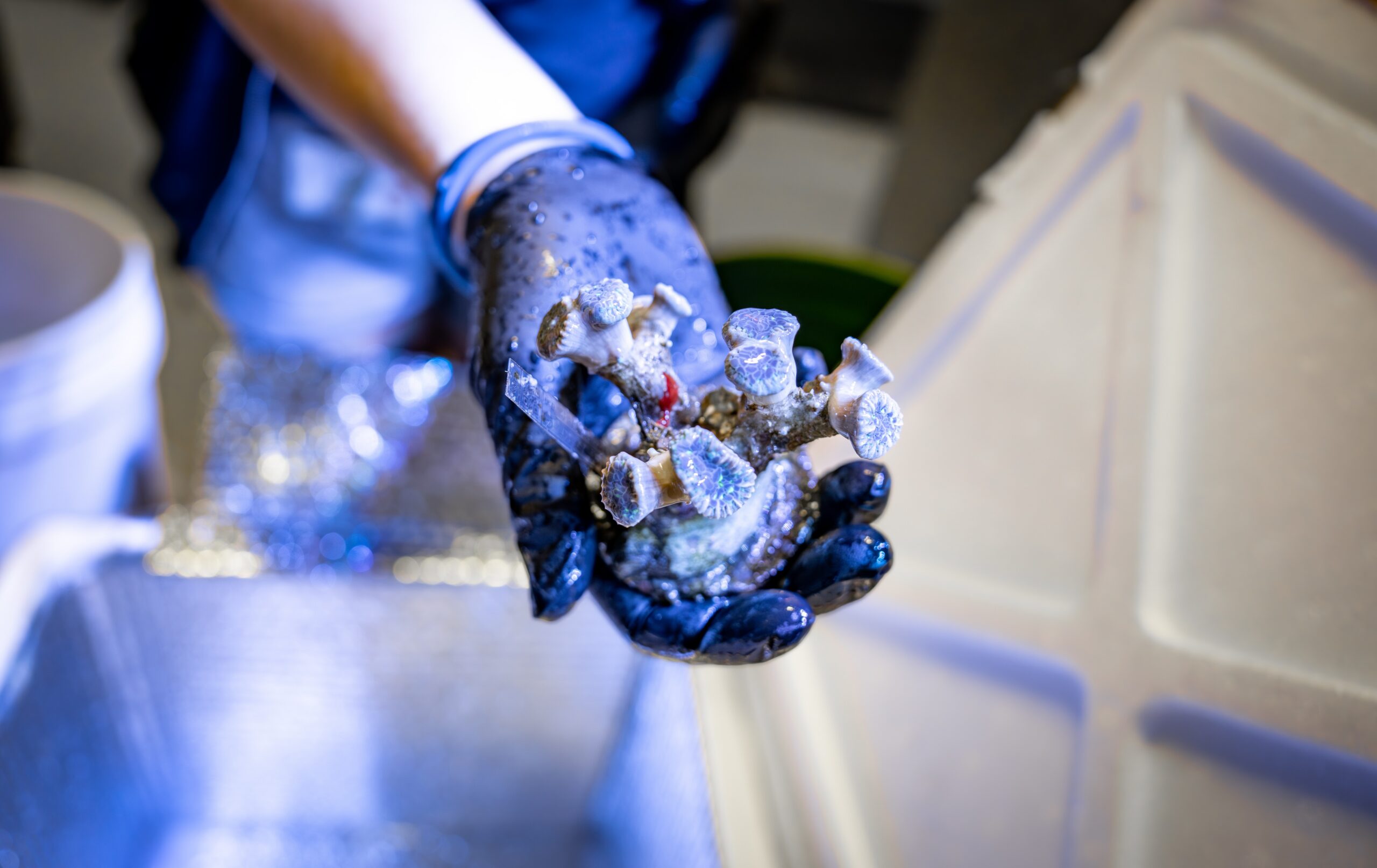
The Georgia Aquarium in Atlanta has taken in more than 500 illegally trafficked coral species confiscated by U.S. Fish and Wildlife Service. This confiscated Zoanthus sp. coral became part of the aquarium’s collection. Image courtesy of the Georgia Aquarium.
More than 40% of coral species currently face the threat of extinction, according to an audit by the International Union for Conservation of Nature (IUCN), a global environmental network that tracks and classifies species by extinction risk.
But the study, published in 2024, accounted only for corals in the West Atlantic and the Caribbean. Including coral species in the Indo-Pacific region, “the number actually hits pretty much 50%,” said one of the researchers, Michael Sweet, a professor in molecular ecology at the University of Derby in the U.K.
To be sure, global warming, overtourism, acidification, and harmful fishing practices are key factors along with harvesting and trafficking.
“This is nothing new,” Sweet said. “Scientists have certainly been shouting about it from the rooftops. But sadly, we seem to be, as a human race, sort of inept at actually making big changes.”
In some places, like the U.S. state of Florida, two major Acropora species — a kind of branching small polyp stony coral hailed by some as the “crown jewels” of reef aquariums — are now functionally extinct. This means the population of the species has become so small and dispersed that it can no longer perform its ecological functions of providing habitat for marine life and helping protect coastlines.
Such a loss is “relatively easy to record and see in an area with few species of coral,” Sweet said. “But in the Indo-Pacific, where the diversity is still quite high, we may be actually missing local extinctions.”
Scientific research tends to focus on metrics like coral cover, he added, obscuring losses in biodiversity.
Collecting corals
A study published in 2020 by the Journal of Contemporary Criminal Justice detailed how coral harvesting happens in Fiji and Indonesia, two of the world’s largest exporters.
In Fiji, harvesting is legal and community-based, regulated by village chiefs who decide the qoliqoli, or marine zones; who can harvest; and how much coral can be collected. Harvesters work in four-person teams: two members cull corals, one moves between them with a net to collect the harvest, and another stays on the boat to pack the corals as they’re brought up, according to the study.
Live trachyphyllia coral recovered during Operation Jungle Book, one of the largest wildlife trafficking-related sweep in Southern California history. Charges were filed against 16 defendants. Photo by USFWS.
In Indonesia, where harvesting is also legal, coral harvesting is more family-based, with three teams going to a harvest site at once.
Corals sought after by aquarists are usually found in shallower waters. Harvesters slice fragments with knives and saws, or chip away pieces with chisels, screwdrivers, iron bars, or bolt cutters. Red and black corals, which are more popular in the jewelry and curio markets, are mined and dredged from the deep sea.
Mediterranean red coral (Coralium rubrum) for sale in a shop. Listed as Endangered on the International Union for Conservation of Nature’s Red List. Image by Photo2023 – Own work via Wikimedia. CC BY 4.0.
It can be difficult for many people to see corals as wildlife because they don’t behave the way animals are expected to behave, said Miguel Azcuna, assistant professor at Batangas State University in the Philippines. Corals have plant-like appearances and rocky structures, he added, and they don’t show obvious movement or facial expressions that people typically associate with sentient beings.
But when you break a coral apart, “it suffers from an open wound,” said Azcuna, who is also a marine scientist at the Verde Island Passage (VIP) Center for Oceanographic Research and Aquatic Life Sciences. The VIP, a part of the Coral Triangle, is known to be the world’s “center of center” of marine shorefish biodiversity. Batangas, a province straddling the VIP, is popular for its diving spots.
Among harvested coral pieces, those considered desirable are placed in plastic bags filled with seawater and tied off with rubber bands, then stacked in buckets or Styrofoam boxes. On average, 50 pieces are collected per person per trip, and an average person makes 67 trips per year, the study found.
For those selling coral, time is of the essence. Corals can survive air exposure for only up to 15 minutes, depending on the type. Some corals can be transported out of the water for 24 to 36 hours if they’re covered with wet towels, Azcuna said.
Because corals die quickly when there are sudden, drastic changes in their environment, harvested pieces for trade are usually shipped by air cargo. In a study published in 2020 in Ocean & Coastal Management, researchers found that 90% of corals imported to the U.S. came through five gateways: Los Angeles, San Francisco, Miami, Dallas, and New York.
In May last year, about 200 corals were smuggled from Indonesia and confiscated at John F. Kennedy International Airport in New York. The shipment included Scleractinia stony corals belonging to the genera Goniopora, Acropora, Lobophyllia, Alveopora, and Euphyllia. The corals were reportedly in transit for five days but are now being rehabilitated at the New York Aquarium.
This case is one of the more recent, large-scale seizures of trafficked corals.
Exporters may skirt oversight by filing permits that declare the correct quantity but then intentionally misidentify the corals in the shipment, said the International Coral Reef Society’s Voolstra, who’s also a professor of genetics of adaptation in aquatic systems at the University of Konstanz in Germany.
“The person at the airport has zero clue about coral taxonomy,” he said. “You put a name down [on the permit], he opens the box, it’s a coral. It’s ticked off. There are plenty of opportunities to import anything.”
But the difficulty of identifying coral species also extends to scientists. Even experts and researchers themselves get confused correctly naming corals based on hierarchical and shared characteristics. Voolstra bluntly termed the problem “pretty much a shitshow called taxonomy.”
Corals can be difficult to classify due to changes in appearance — also known as morphological plasticity — driven by environmental factors such as depth, amount of sunlight, or exposure to waves, Voolstra said.
Coral recovered during Operation Jungle Book, one of the largest wildlife trafficking-related sweep in Southern California history. Charges were filed against 16 defendants. Photo by USFWS.
Another way to sidestep regulations is to mislabel shipments. In the Alaska case, shipments from the Philippines were declared as plastic items and children’s toys with declared values ranging from $1 to $35, court records showed.
A single coral fragment can sell for anywhere from $30 to more than $500, depending on its rarity, according to price lists in online shops and forums. So-called “beginner corals” like Zoanthids, a type of soft coral, are often less expensive because they tend to be more tolerant to changes in water chemistry and easier to maintain.
Rarer species command higher prices. Some corals generally referred to as “mushrooms” — because of their circular, disk-like shape that resembles a mushroom cap — sell for thousands of dollars. One of the most expensive fetched up to $10,000: dubbed a Purple Monster Jawbreaker, from the genus Discosoma. These coral types are highly prized among aquarium hobbyists because of their unique, evolving color patterns, particularly those with rare purple color morphs.
An Acropora colloquially called Fairy Food has even been listed for sale for $1 million in an online shop owned by Adam Derickson, a hobbyist based in the U.S. state of Wisconsin who turned his stony coral collection into commerce. Derickson’s listing, though, is taken within the aquarists’ community as a joke.
Because mortality in aquariums is high, a serious aquarist would not buy only one fragment. “You don’t start an aquarium if you cannot afford it,” Voolstra said.
Protected marine corals that were illegally collected and then trafficked from the Philippines. Image by USFWS. Public domain.
The challenge of growing and keeping coral fragments alive is also part of the appeal, he said, sharing stories about his aquarium hobbyist friends. “These people are interested because they want to have an aquarium on display that nobody else can basically keep alive.”
‘Low risk’
Wildlife trafficking can start as easily as a Facebook message, with retailers first reaching out to middlemen who are local to communities where coral is harvested. This, according to court records, was how Binoya, from ArtReef Rocks, got involved in smuggling corals to the U.S.
The 2022 Alaska case shined a rare spotlight on the little-noticed coral business. And this underreported environmental crime is not done in isolation.
Jerome Anthony Stringfield, who operated Florida’s Finest Reef, an online business, was indicted in the federal case in Alaska in 2022 for felony violations of conspiracy, violations of the Lacey Act, and smuggling of corals.
Stringfield received 490 coral fragments over five shipments from Binoya in the Philippines between July 2017 to August 2018, court records showed.
An excerpt from Stringfield and Binoya’s exchanges on Facebook Messenger, dated Aug. 8, 2017, indicated an agreement to “sneak in” some “chalices” (from the genera Echinophyllia and Echinopora) and “acans” (genus Acanthastrea) in the box with “zoas” (Zoanthids). Chalices, large polyp stony corals, and acans, commonly known as Starry Cup, both require CITES permits. Zoas aren’t CITES Appendix II-listed, so that trade doesn’t require documentation.
While a legal approach to coral trade exists through CITES, some buyers may be looking for specific types of corals that can be found in countries with strict prohibitions, creating a demand in the black market. Suppliers tend to be more open to taking risks, as penalties and convictions are uncommon.
“The reward far outweighs the risk because you can make a significant amount of money from this trade, unfortunately,” said Sweet, the University of Derby professor. “Obviously that doesn’t mean it’s right.”
In another Facebook Messenger exchange, dated Sept. 13, 2017, Stringfield told Binoya he could “quadruple the money” on chalice fragments and sell each for “at least $350-450.”
Stringfield, a resident of Kissimmee, Florida, faced 14 felony charges. He entered into a plea agreement, and 13 of his charges were dismissed.
For the federal crime of conspiring to smuggle protected wildlife, Stringfield was sentenced to two years of probation, a $4,000 fine, and a $100 fee. In total, his penalty amounted to roughly the value of selling only 12 chalice fragments at his minimum expected selling price of $350 each.
Allen William Ockey, a resident of Long Beach, California, procured 300 coral fragments from the Philippines through Binoya, spread out in five boxes over less than a year, according to court records. He had paid approximately $4,000 for the purchase and shipments. Most of the corals died en route or shortly after their travel.
Ockey ran two businesses: West Coast Frags, and Legit Fish Aquarium Service. He was charged with 13 felony violations.
Like Stringfield, Ockey entered into a plea deal. He was sentenced to two years of probation, faced a $100 penalty, and was required to donate $5,000 to a coral conservation project in the Philippines.
Other business owners involved in the Alaska case had similar resolutions: a plea deal for one count of conspiracy, the rest of the charges dismissed, up to two years of probation, a fee of either $25 or $100, and a fine of a few thousand dollars.
Most of the more than 1,300 incidents recorded in TRAFFIC’s database had no information on the number of people arrested, charged, fined, or imprisoned. Of those that did include such details, 108 cases involved people being charged and 22 had offenders imprisoned over the past 25 years.
One of these involved the illegal harvest of 31 Anthozoa corals — listed under CITES Appendix I, the highest level of international limits on commercial trade for species threatened with extinction — in the city of Danzhou, China. The offender used steel crowbars and was filmed poaching corals in March 2025. The video was uploaded to the internet. He confessed to the crime and pleaded guilty. The corals were estimated to be worth 201,453 yuan (roughly $30,000).
In another case, after a routine inspection at an airport in Inner Mongolia, China, in July 2023, authorities found a package containing 329 pieces of red coral from the family Coralliidae, valued at 160,000 yuan (roughly $23,000).
The red coral was being shipped to a jewelry store owner, who reportedly confessed and was imprisoned. The case is under further investigation.
Much rarer are cases where importers and retailers were held to account. In 2022, two Los Angeles-based companies, Renaissance Aquatics and Lim Aqua-Nautic Specialist, each pleaded guilty to two felony counts of unlawfully importing live coral.
‘No stopping demand’ — but some solutions
Even if a ban on the coral trade were to be implemented, scientists and advocates said hobbyists would still find a way to purchase them. But they shared some optimism that mariculture, or farm-raising corals in saltwater, could curb poaching by using fragments of a “parent” coral to grow new colonies, or “babies,” in open-ocean nurseries.
Coral display tanks. Image by eXtreme Aquatics via Flickr. CC BY 2.0.
The approach, in theory, is considered a more sustainable way of meeting coral demand. The coral would be raised on ropes or racks in ocean water. But in practice, many projects seem to be falling short.
In Bali, Indonesia, some dive shops have started their own nurseries to position themselves as sustainable businesses. This is different than coral restoration. Instead, this is more like a farm, where corals are grown to be sold. But these nurseries don’t always work because they’re built “in an area where corals will never grow,” said Claudia Koch, founder of We Do Ocean, a Bali-based marine conservation and dive center.
“You have to do a site assessment first,” Koch said, citing factors such as water flow and quality, thermal history, substrate, and sedimentation. “Some put in another four nurseries and attached corals too tiny that I don’t think they’re going to make it.”
Several sources said coral farms could create an appearance of compliance during government inspections when, in reality, corals continue to be harvested illegally from the wild.
Monitoring is further complicated by the fact that there’s no visual way to identify if a coral was legally farmed or illegally harvested. A coral glued to a small base would look identical to a coral that grew in it. To address this, Sweet suggested a “coral passport, so you can showcase the ‘baby’ growing up.”
“It gives the government officials a level of confidence to really showcase that those corals are truly cultured,” he said.
Sweet also proposed staining farm-raised coral to track growth: “If you sacrificed a little bit of that coral, you should be able to see the stain quite deep down into the skeleton.”
That’s harder to fake in coral caught in the wild. A wild-caught coral that is later stained would show the blemish only in its shallow skeleton or tissue.
But staining farm-raised coral is an expense and requires expertise. “Nobody is doing that because obviously it would be a bit of an extra cost and a little bit of extra knowledge and skill needed to enforce that and push that through,” Sweet said.
Other scientists propose a DNA test to help identify whether a coral belongs to a taxon subject to international trade regulations.
Sweet’s team at the University of Derby’s Nature-based Solutions Research Centre is also developing ex-situ coral farming, or away from the ocean. They’re not alone in exploring this alternative. Ex-situ systems would allow corals to grow in land-based tanks that provide a stable and controlled environment. Sweet’s group has already set up two farms in Indonesia — on the islands of Java and Bali, both major diving destinations. “Our job is now to showcase that you can still generate money,” he said.
The coral trade can be likened to diamond mining, where those who extract the resource see little monetary benefit. Voolstra, who has worked with a few Indonesian groups as part of his research, said harvesters “would happily switch” to alternative livelihoods if there were other options.
The underlying issue, experts said, were strict policies but weak enforcement.
“That opens up the way for economic incentives that entice you to just take the risk,” Voolstra said.
Ultimately, Sweet said, there needs to be a shift in how corals are valued.
“You should really be looking after these animals as if you look after whatever your pet is in your country — a dog or a cat or a horse, whatever you value as a true companion animal,” he said. “Corals should be treated the same in my book.”
Banner image:The Georgia Aquarium in Atlanta has taken in more than 500 illegally trafficked coral species confiscated by U.S. Fish and Wildlife Service. This confiscated Euphyllia sp. coral became part of the aquarium’s collection. Image courtesy of the Georgia Aquarium.
Citations:
Hoeksema, B. W. (2026). An unseen threat to coral reef biodiversity: The international trade of live corals for the aquarium industry as reflected by CITES records (1990-2021). Ocean & Coastal Management, 276, 108111. doi:10.1016/j.ocecoaman.2026.108111
Gutierrez, L., Polidoro, B., Obura, D., Cabada-Blanco, F., Linardich, C., Pettersson, E., … Wilson, B. (2024). Half of Atlantic reef-building corals at elevated risk of extinction due to climate change and other threats. PLOS ONE, 19(11), e0309354. doi:10.1371/journal.pone.0309354
Sosnowski, M. C., Weis, J. S., & Petrossian, G. A. (2020). Using crime script analysis to understand the illegal harvesting of live corals: Case studies from Indonesia and Fiji. Journal of Contemporary Criminal Justice, 36(3), 384-402. doi:10.1177/1043986220910295
Petrossian, G. A., Sosnowski, M. C., & Weis, J. S. (2020). Trends and patterns of imports of legal and illegal live corals into the United States. Ocean & Coastal Management, 196, 105305. doi:10.1016/j.ocecoaman.2020.105305
Veron, J. E. N., Stafford-Smith, M. G., DeVantier, L. M., & Turak, E. (2025). Review of coral taxonomy, evolution and diversity. Diversity, 17(12), 823. doi:10.3390/d17120823