Boulevard al-Nasr promises thousands of residential and commercial units, vast green spaces and a new landmark for Homs. Yet key details about the developer, main contractor, escrow arrangements and infrastructure financing remain unclear.
A major mixed-use development launched in Homs this month is attracting strong buyer interest and official support, while leaving important questions unanswered about the corporate structure, financing and execution capacity behind one of Syria’s most ambitious post-war construction ventures.
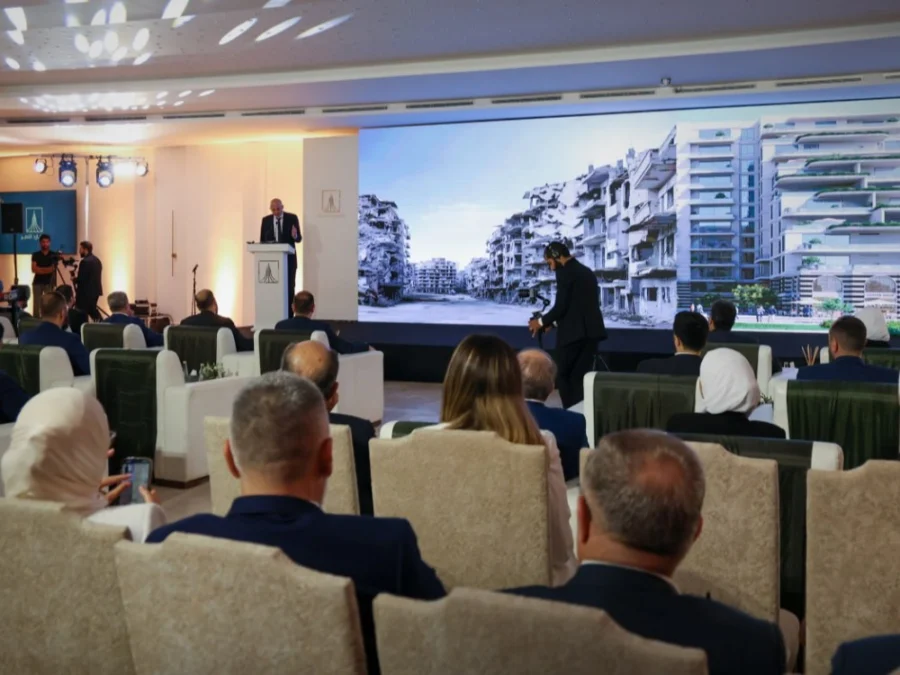
Boulevard al-Nasr, formally unveiled on 21 August 2026, is planned to include around 2,500 residential, commercial, administrative and hotel units, with approximately 500,000 square metres of above-ground construction.
Plans also envision roughly 250,000 square metres of underground parking for about 5,000 vehicles, alongside a public park approaching 350,000 square metres. Construction is scheduled to proceed in three phases, with completion targets at three, five and seven years.
The scale places the project among the most prominent reconstruction initiatives announced in Homs since the fall of the former Syrian government. Yet publicly available information reviewed for this investigation leaves several central issues unresolved.
One concerns the precise legal identity of the developer.
Material issued by Homs governorate in August 2025 referred to “Al-Omran for Real Estate Development and Investment”. The company’s website has used the same name, while another announcement on the site referred to “Al-Omran Holding”. At this month’s launch, Syria’s state news agency SANA identified Rifai Hammada as chairman of “Al-Omran Holding”, which it described as the company implementing the project.
The differing names do not necessarily indicate irregularity. Al-Omran Holding may be a parent company with a separate development subsidiary. However, publicly reviewed material does not clearly set out the legal relationship between the entities.
Nor does it provide the implementing company’s commercial registration number, jurisdiction of registration, declared capital, shareholder structure or a published copy of the final development agreement.
Some media reports have described Al-Omran as a Kuwaiti company established in 2006 and owned by Hammada. Yet several companies across the Arab world operate under the name Al-Omran or similar variants, making it difficult to attribute earlier corporate records to the Syrian project without documentation establishing the connection.
Hammada’s own business record is more readily documented.
Spanish corporate records show that HESCO European Group SL was established in 2021 with capital of €40,000, listing Rifai Hammada Abbara as its sole owner and sole administrator. Other Spanish records show engineering and property companies connected to him, while HESCO has a documented record of engineering and consultancy activity internationally.
This provides evidence of an identifiable engineering and commercial presence behind the Homs venture. It does not, however, automatically establish experience as the master developer of a project requiring large-scale financing, off-plan sales, contractor management, infrastructure delivery and the administration of thousands of buyers over several years.
Another unresolved question concerns the main construction contractor.
Publicly available announcements reviewed for the project identify Al-Omran as developer or implementing company and HESCO as involved in planning and urban design. They do not clearly identify a main contractor responsible for constructing the towers and infrastructure.
Such an appointment may still be under negotiation or may simply not have been announced. Yet for buyers committing money before completion, the identity and track record of the main contractor are important indicators of whether the project can move from design and sales to large-scale construction.
Financing arrangements are also drawing attention.
Information circulated around the subscription process says purchasers’ payments will be placed in an escrow account and released to the developer according to construction progress. If governed by a formal escrow agreement with a named bank and clear conditions for releasing funds, such an arrangement could provide meaningful protection for buyers.
The publicly available information reviewed, however, does not establish which bank operates the account, who legally controls it, who certifies construction progress or what rights buyers would have to recover their money if work were delayed or halted.
Execution presents further challenges.
The first phase alone is expected to include four twelve-storey towers, while later stages would require simultaneous work across numerous structures. Such construction demands large numbers of skilled workers in structural work, concrete, electrical and mechanical systems, air conditioning, lifts, façades, insulation, safety and quality control.
Syria has lost a substantial share of its skilled construction workforce through years of displacement and emigration, potentially making labour one of the project’s most significant constraints. Higher wages, recruitment from other provinces, returning expatriate expertise and contracts with regional companies could mitigate the shortage, although each would increase costs and logistical complexity.
Equipment presents a related challenge. A development on this scale requires tower cranes, high-capacity concrete pumps, modern formwork systems, excavation equipment, surveying technology and specialised testing facilities. Much of that capacity would likely need to be imported, requiring an organised international supply chain for procurement, shipping, installation, maintenance and spare parts.
Infrastructure may prove even more consequential.
The development will require water, sewage, electricity, telecommunications, roads, stormwater drainage and fire-fighting capacity sufficient for thousands of units, a hotel, offices, shops and parking facilities.
The original memorandum for the project indicated that the company would implement infrastructure and buildings, while Homs governorate would provide administrative facilitation, data and oversight. Yet the division of responsibility for external connections and major upgrades to surrounding municipal networks remains unclear in the material reviewed.
If existing networks lack sufficient capacity, internal infrastructure alone would not resolve the problem. Additional substations, sewage capacity, roads and connection points could become necessary, raising the question of who will finance them and when they will be completed.
The project has also evolved substantially since it was first announced.
In August 2025, Homs governorate described a scheme expected to provide around 4,500 homes and improve living conditions and public services. The project unveiled a year later instead comprises around 2,500 residential, commercial, administrative and hotel units.
The change does not necessarily represent a contradiction, since the design and definition of units may have changed. It does, however, reflect a shift from the language of large-scale housing provision towards a more complex, mixed-use real estate development.
That distinction is reinforced by the project’s design and pricing.
According to subscription details cited in the investigation, the smallest units begin at around seventy-two thousand dollars, with buyers required to make an initial reservation payment and complete thirty per cent of the purchase price within three months.
This structure means advance sales could become an important source of construction finance. At the same time, features such as underground parking, extensive landscaping, contemporary architecture, hotels, offices and retail space help create a higher-value product that can be marketed to expatriates and investors willing to commit substantial sums before completion.
The project’s configuration therefore appears more consistent with a high-value investment development than with a low-cost housing programme designed to maximise the number of affordable homes.
That is not unusual for a private developer. A commercially driven company has an incentive to increase sales values and attract investment. But it raises a broader question for Syrian reconstruction policy over how much new development will address the housing needs of residents unable to afford property priced in the tens of thousands of dollars.
For Boulevard al-Nasr, much of the uncertainty could be resolved through disclosure.
Publication of the developer’s full legal registration and ownership structure, the identity and track record of the main contractor, the terms of the escrow arrangement, infrastructure responsibilities and a detailed construction timetable would allow prospective buyers to assess risks more independently.
The available evidence provides no basis for describing Boulevard al-Nasr as a fictitious project. It has official support, strong initial demand and identifiable engineering figures behind it.
The unresolved issue is whether the development organisation has the financial, administrative and construction capacity to translate an ambitious masterplan into a functioning neighbourhood on schedule.
For prospective buyers, that question may matter more than the strength of early sales.
This article was translated and edited by The Syrian Observer. The Syrian Observer has not verified the content of this story. Responsibility for the information and views set out in this article lies entirely with the author.